
Apple Reveals How Developers Can Harness Siri AI in Their Apps
Apple's annual Platforms State of the Union is always one of the most anticipated events for developers across the globe, and the 2026 edition did not disappoint. Going well beyond the headline announcements of the keynote, Apple used the session to dive deep into the technical details that matter most to the people who build the apps we use every day. Chief among the reveals was a comprehensive look at how developers can integrate the new Siri AI and Apple Intelligence features directly into their own applications — a capability that could fundamentally reshape how users interact with third-party software on iPhone, iPad, and Mac.
What Is the Platforms State of the Union?
For those unfamiliar, the Platforms State of the Union is a developer-focused session held annually alongside Apple's Worldwide Developers Conference (WWDC). While the main keynote is designed for a broad public audience, the State of the Union goes deeper, walking engineers and designers through the new frameworks, APIs, and design paradigms they will need to understand in order to build the next generation of Apple platform apps. It is, in essence, where the real technical story gets told.
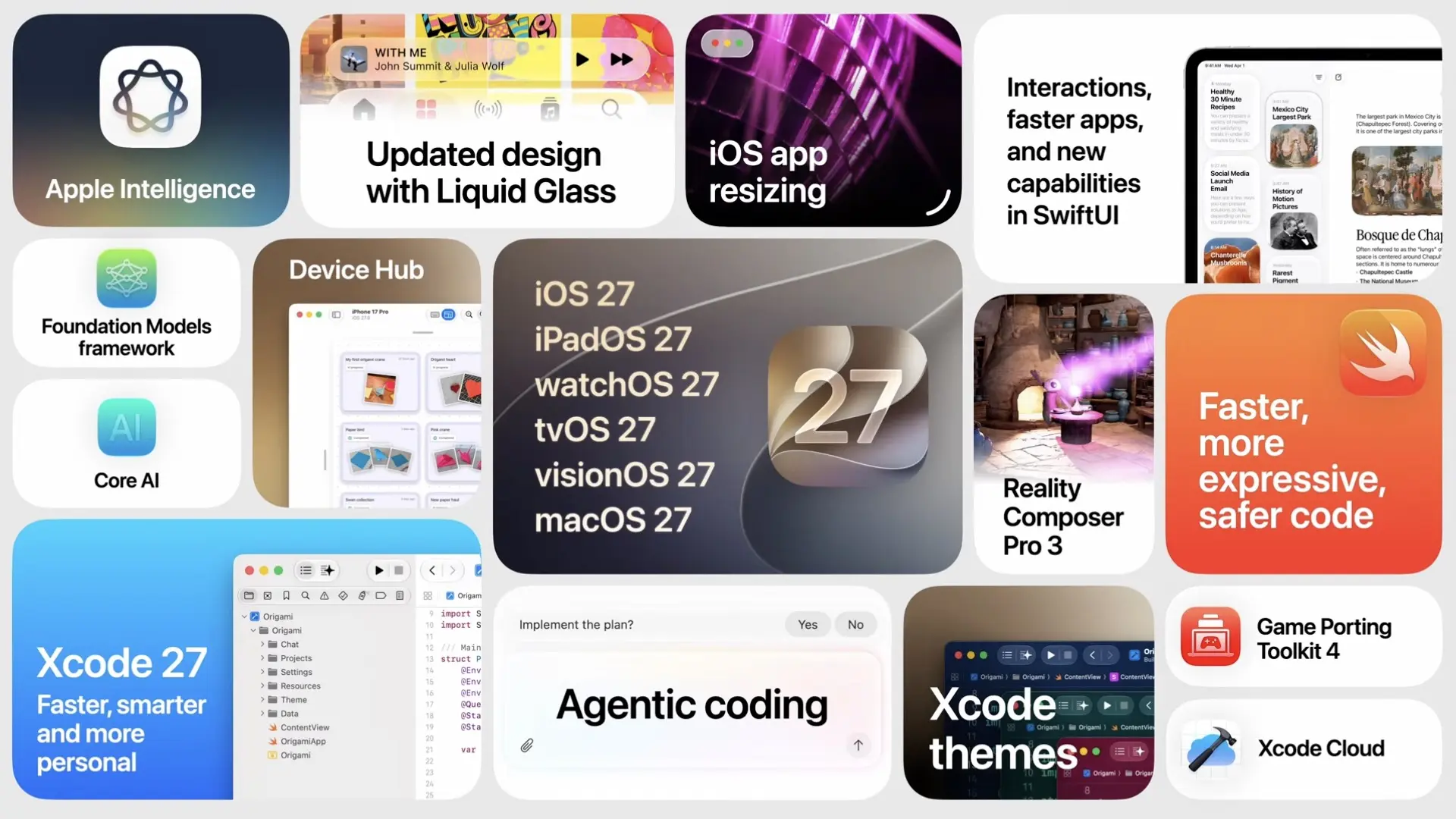
This year, the session was framed around the OS 27 releases — covering iOS 27, iPadOS 27, macOS 27, watchOS 27, and tvOS 27 — and the sweeping changes Apple is bringing to all of its platforms simultaneously. Three pillars dominated the conversation: Siri AI and Apple Intelligence integrations, the redesigned Liquid Glass visual language, and a host of other developer-facing improvements that promise to make apps smarter, more capable, and more beautiful than ever before.
Siri AI and Apple Intelligence: A New Era for App Developers
The most significant technical announcement centered on how third-party apps can now tap into Siri AI and the broader Apple Intelligence platform in meaningful new ways. Apple has dramatically expanded the App Intents framework, giving developers richer tools to expose their app's functionality to Siri in a way that feels natural and conversational rather than scripted and rigid.
In practical terms, this means that a user could ask Siri to perform complex, multi-step tasks inside a third-party app simply by speaking naturally. Whether it's drafting a message in a notes app, pulling up a specific workout in a fitness tracker, or finding a document inside a productivity suite, Siri can now understand the context and intent of a request and execute it without requiring the user to open the app manually.
How the App Intents Framework Has Evolved
Apple's engineers explained that the updated App Intents framework introduces several key improvements that make Siri integration more powerful and flexible:
- Semantic understanding: Siri can now interpret the meaning behind a user's words rather than relying on rigid command structures, making interactions feel far more natural across apps that adopt the new APIs.
- On-device processing: Much of the intelligence powering these interactions runs locally on the device, meaning faster responses and stronger privacy protections for users — a core Apple value that remains front and center.
- Contextual awareness: Apps that integrate with the updated framework can share relevant context with Siri, enabling the assistant to make smarter suggestions and take more nuanced actions based on what the user is doing at any given moment.
- Writing Tools and summarization APIs: Developers can now call upon Apple Intelligence's built-in Writing Tools — including summarization, rewriting, and proofreading — from directly within their own apps, offering users a consistent, high-quality AI writing experience without developers needing to build or license their own large language models.
The message from Apple was clear: rather than building a walled garden around its own AI features, the company wants Siri and Apple Intelligence to become a shared platform that lifts the quality and capability of every app on the App Store.
Liquid Glass: Designing for the New Visual Era
Alongside the AI-focused announcements, Apple spent considerable time walking developers through Liquid Glass — the bold new design language that defines the look and feel of the OS 27 family of operating systems. First teased at the main keynote, Liquid Glass represents the most significant visual overhaul Apple has undertaken since the introduction of flat design with iOS 7 back in 2013.
The design system draws on translucency, depth, and fluid motion to create interfaces that feel alive and responsive. Developers were shown how SwiftUI and UIKit have been updated to support Liquid Glass natively, meaning that apps built with Apple's standard frameworks will automatically inherit many of the new visual characteristics without requiring a full redesign from scratch.
What Developers Need to Know About Adopting Liquid Glass
Apple's design evangelists emphasized that adopting Liquid Glass is not just an aesthetic choice — it is increasingly an expectation. As the new OS rolls out to hundreds of millions of devices, users will come to associate the polished translucent look with a sense of quality and up-to-date craftsmanship. Apps that lag behind risk feeling dated by comparison.
The good news is that Apple has invested heavily in making the transition as smooth as possible. New system components, updated color APIs, and improved blur and vibrancy materials mean that developers can achieve the Liquid Glass aesthetic with relatively modest updates to existing codebases. Apple also provided detailed Human Interface Guidelines to help teams make deliberate, thoughtful decisions when applying the new design tokens to their own unique visual identities.
Additional Developer Features Across the OS 27 Releases
Beyond Siri AI and Liquid Glass, the Platforms State of the Union touched on a wide range of other developer improvements. Swift 6 continues to mature, bringing enhanced concurrency models and improved performance tooling. RealityKit and visionOS development tools received notable updates for spatial computing. HealthKit and HomeKit frameworks are being expanded with new data types and automation capabilities. And Safari's WebKit engine is getting fresh support for emerging web standards that will allow more powerful web applications on Apple devices.
Taken together, these announcements paint a picture of an Apple that is deeply focused on empowering its developer community to build the best possible experiences on its platforms. With Siri AI now open to deeper app integration and Apple Intelligence emerging as a genuine developer platform rather than a closed-off system feature, the OS 27 release cycle could mark one of the most transformative moments in the history of Apple software development.
Looking Ahead: What This Means for Apple Users
For everyday users, the real-world impact of these Platforms State of the Union announcements will unfold gradually over the coming months as developers update their apps to take advantage of the new capabilities. The apps you rely on most — your favorite productivity tools, health trackers, creative platforms, and communication apps — will become progressively smarter, more visually refined, and more deeply connected to Siri AI as developers embrace what Apple has put on the table. The promise of a truly intelligent, seamlessly integrated Apple ecosystem is closer to reality than it has ever been before.