
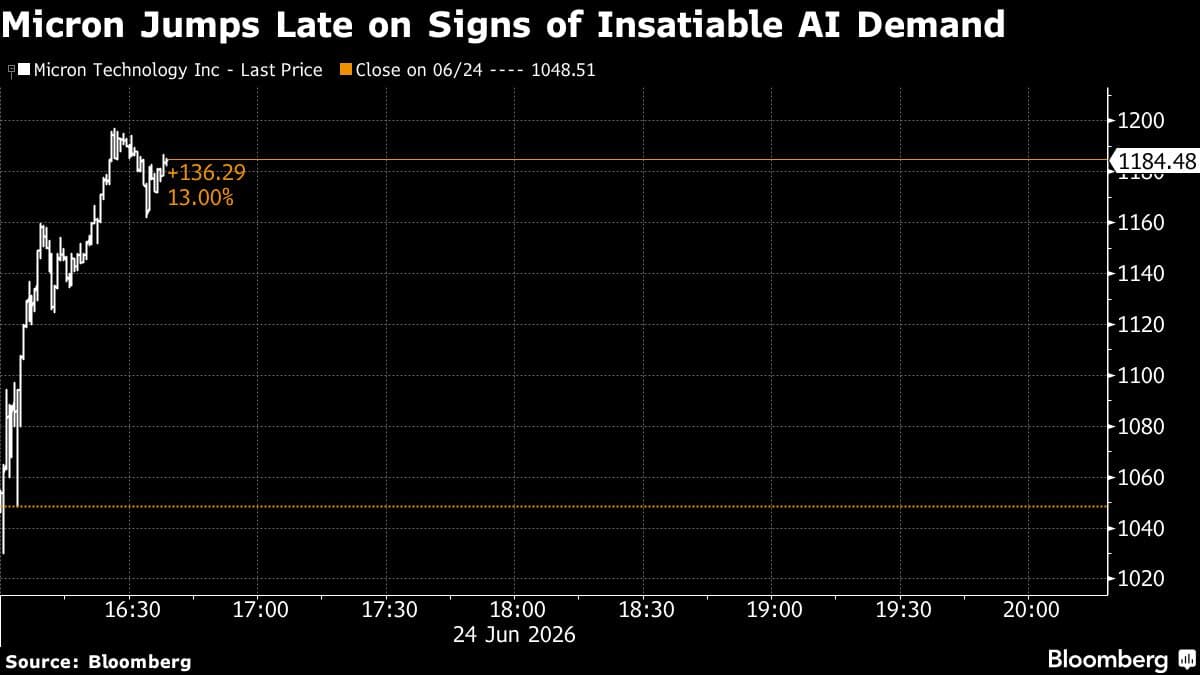
Asia Stocks and US Futures Surge Following Micron's Blowout AI Forecast
Global financial markets received a powerful jolt of optimism as Asian stocks rallied sharply alongside US equity futures, driven by a blockbuster sales outlook from Micron Technology Inc. The semiconductor giant's forecast exceeded Wall Street expectations by a wide margin, reigniting investor enthusiasm for the artificial intelligence trade that has been one of the defining investment themes of recent years. For market participants who had grown cautious amid mixed economic signals, Micron's results served as a timely reminder that the AI growth story remains very much alive and well.
The ripple effect of Micron's announcement was felt across multiple asset classes and time zones, underscoring just how closely interconnected global markets have become — and how central the AI narrative is to investor sentiment worldwide.
What Micron's Outlook Means for the AI Trade
Micron Technology is one of the world's leading producers of memory chips, including DRAM and NAND flash storage — components that are absolutely essential for running the data centers and large language models that power modern artificial intelligence applications. When Micron raises its sales forecast, it is not simply good news for one company. It is a signal that demand across the entire AI supply chain is accelerating.
The company's blowout guidance pointed to surging orders from hyperscale cloud providers and AI infrastructure builders, suggesting that capital expenditure on AI hardware remains robust despite broader macroeconomic uncertainties. For investors, this was confirmation that the extraordinary spending boom in AI is not a short-term blip but a durable, multi-year cycle that continues to drive real revenue growth for chipmakers and their partners.
Analysts were quick to note that Micron's results have historically functioned as a leading indicator for the broader semiconductor sector. When Micron beats expectations by the kind of margin reported, companies like Nvidia, SK Hynix, Samsung Electronics, and TSMC tend to benefit from improved sentiment and upward earnings revisions in the days and weeks that follow.
Asian Markets React: A Broad-Based Rally
The positive reaction across Asian equity markets was both swift and broad-based. Technology-heavy indices led the gains, with semiconductor stocks and electronics manufacturers posting some of the sharpest advances. Investors across the region interpreted Micron's strong numbers as validation of their own AI-related holdings, prompting renewed buying activity that lifted the overall market tone.
Key dynamics that shaped the Asian rally included the following:
- Semiconductor stocks in South Korea and Taiwan posted notable gains, as investors anticipated that companies supplying components to Micron's customers would see elevated demand in the months ahead.
- Japanese technology equities also benefited, with AI-linked names attracting fresh capital as traders recalibrated their earnings expectations upward.
- Hong Kong and Chinese technology shares participated in the broader rally, reflecting growing confidence that global AI spending would support demand for a wide range of hardware and software solutions.
- Broader market indices firmed up, as positive sentiment from the tech sector spilled over into financials, industrials, and consumer discretionary stocks.
The synchronised nature of the gains across diverse markets highlighted how AI has become the single most powerful driver of global equity sentiment, capable of lifting risk appetite across geographies and sectors simultaneously.
US Equity Futures: Setting the Stage for Wall Street
Alongside the Asian rally, US equity futures climbed in tandem, signalling that Wall Street was prepared to extend recent gains when trading resumed. Futures tied to the S&P 500, Nasdaq 100, and Dow Jones Industrial Average all moved higher, reflecting broad optimism that Micron's results would translate into positive momentum for American markets.
The Nasdaq 100, with its heavy concentration of technology and AI-related stocks, was particularly in focus. Investors in US markets have been watching Micron closely as a real-time gauge of AI infrastructure spending, and the blowout outlook gave bulls exactly the ammunition they needed to push back against any lingering doubts about the sustainability of the current technology cycle.
Market strategists noted that the Micron catalyst arrived at a useful moment, helping to stabilise sentiment after a period of choppy trading driven by uncertainty over interest rate policy, geopolitical tensions, and mixed corporate earnings from other sectors.
Why the AI Trade Continues to Drive Global Markets
It is worth stepping back to understand why a single company's sales forecast can move markets from Tokyo to New York. The answer lies in the scale and scope of the artificial intelligence investment cycle that is currently underway.
Technology companies, cloud providers, governments, and enterprises around the world are collectively spending hundreds of billions of dollars annually to build and expand AI infrastructure. This spending flows through an interconnected global supply chain that touches semiconductor manufacturers, memory chip producers, networking equipment makers, data center builders, and software developers across multiple continents.
When a company like Micron — which sits at a critical node in that supply chain — signals that demand is exceeding expectations, it validates the entire AI investment thesis. It tells investors that the buildout of AI capacity is proceeding faster than many anticipated, and that the companies positioned to benefit from this trend are likely to generate stronger revenue and earnings than previously modelled.
What Investors Should Watch Next
With Micron's results now digested, market participants will be turning their attention to several key developments in the weeks ahead. Earnings reports from other major semiconductor companies will be closely scrutinised for signs of whether the demand strength Micron described is industry-wide or more narrowly concentrated. Federal Reserve policy signals will remain important for determining whether the macroeconomic backdrop remains supportive of risk assets. And any new announcements around AI infrastructure investment from major technology firms will be watched for further confirmation that the spending cycle shows no signs of slowing.
For now, however, the market's message is clear: the artificial intelligence trade is very much alive, and Micron's blowout outlook has given investors around the world renewed confidence that the companies building the infrastructure of tomorrow's economy are still in the early innings of a powerful and enduring growth cycle.