
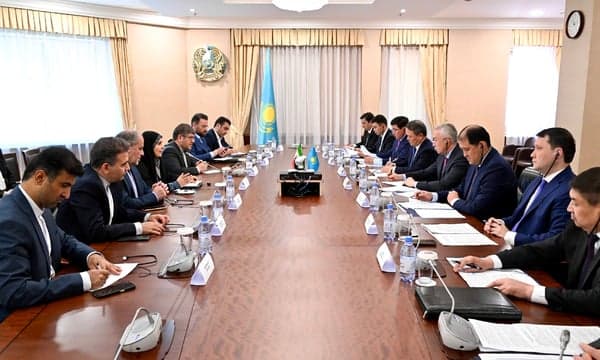
Kazakhstan and Iran: A Transport Partnership Built Over Years
Long before the latest flare-up of Iran-U.S. hostilities captured global headlines, Kazakhstan and Iran were quietly building one of Central Asia's most strategically significant transport partnerships. The bilateral relationship, rooted in geography and economic necessity, has been years in the making — and recent geopolitical turbulence may be testing its resilience more sharply than ever before.
For observers of Eurasian connectivity, the question is no longer simply whether the Kazakhstan-Iran transport corridor can grow. It is whether the two countries can sustain the momentum they have worked so hard to build, even as the broader geopolitical environment grows more unpredictable by the month.
Why the Kazakhstan-Iran Transport Corridor Matters
To understand the stakes, it helps to appreciate what the corridor actually represents. Kazakhstan, a landlocked nation of enormous geographic scale, has long faced the challenge of getting its goods — particularly energy exports, grain, and raw materials — to global markets efficiently. Iran, sitting at the crossroads of the Middle East, Central Asia, and the Caspian Sea, offers Kazakhstan something rare: a credible southern gateway to the Persian Gulf and, through it, to South Asia, the Indian Ocean, and beyond.
This is not a speculative trade route. It is part of the broader International North-South Transport Corridor (INSTC), a multi-modal network linking Russia, Azerbaijan, Iran, and India, among others. Kazakhstan has been positioning itself as a key node within this broader architecture, and its partnership with Iran is central to that ambition.
The corridor encompasses rail connections, road infrastructure, and Caspian Sea ferry routes. Goods moving from Kazakhstan through Iran can reach the port of Bandar Abbas on the Persian Gulf or Bandar Anzali on the Caspian coast, opening up trade lanes that bypass the traditional bottlenecks of the Suez Canal or overland routes through Russia and Europe.
Years of Groundwork — and the Gains Made
The transport relationship between Astana and Tehran did not emerge overnight. Over the past decade, both governments have invested in bilateral rail agreements, border crossing improvements, and customs harmonization measures designed to cut transit times and reduce friction for freight operators. Kazakhstan has consistently highlighted Iran as a priority partner in its multimodal logistics strategy, and Iranian officials have reciprocated by pointing to Kazakh cargo volumes as a benchmark for corridor viability.
Notable milestones include expanded cooperation on the Kazakhstan-Turkmenistan-Iran (KTI) railway, a route that links the Kazakh rail network through Turkmenistan to the Iranian system. Since its launch, the KTI corridor has processed growing volumes of cargo, demonstrating that the physical infrastructure — when supported by political will — can deliver real results.
Caspian ferry services have also improved, with Kazakhstan's Aktau and Kuryk ports serving as departure points for cargo heading to Iranian Caspian ports. These sea links provide redundancy and flexibility for freight operators navigating the complex web of Central Asian logistics.
How the Iran-U.S. Conflict Has Reshaped the Picture
The Iran-U.S. conflict — encompassing sanctions regimes, periodic military escalations, and deep uncertainty over Iran's nuclear program — has never been entirely absent from the calculations of those planning freight routes through Iranian territory. But recent intensifications of that conflict have brought the issue into sharper relief.
For Kazakhstan, the dilemma is a familiar one for many countries in its region: how to pursue legitimate economic interests in corridor development with Iran while managing the risk of secondary sanctions exposure or diplomatic blowback from Western partners. Kazakhstan has invested heavily in attracting Western capital, maintaining balanced foreign policy relationships, and positioning itself as a reliable partner for European and American businesses. Deepening ties with Iran — even in the ostensibly neutral domain of transport infrastructure — carries reputational and legal risks that Astana cannot afford to ignore.
At the same time, the economic case for the corridor has arguably grown stronger amid global supply chain disruptions. As alternative routes have faced congestion, political interference, or outright closure, the Iran transit corridor has looked increasingly attractive to freight operators seeking diversification. Kazakhstan is acutely aware that other regional players — including Russia and China — are moving aggressively to capture transit revenues and infrastructure influence. Standing still is not a neutral option.
The Road Ahead: Balancing Opportunity and Risk
Sustaining momentum on the Kazakhstan-Iran transport corridor will require both countries to navigate a set of overlapping challenges simultaneously.
- Sanctions compliance: Kazakhstan's private sector and state-linked entities must carefully assess their exposure under U.S. and EU sanctions frameworks before deepening operational ties with Iranian transport counterparts.
- Infrastructure investment: Continued upgrades to border crossings, rail capacity, and port facilities on both sides of the Caspian are essential if the corridor is to handle growing cargo volumes reliably.
- Diplomatic calibration: Astana will need to continue its trademark multi-vector diplomacy, reassuring Western partners that corridor development with Iran is commercially driven and does not represent a strategic pivot.
- Interoperability standards: Harmonizing customs procedures, documentation requirements, and transit regulations across the multiple jurisdictions involved remains a persistent technical challenge that slows cargo movement and raises costs.
Iran, for its part, has strong incentives to keep the partnership alive. Transit revenues, foreign investment in port and rail infrastructure, and the broader signal of economic engagement with a respected Central Asian neighbor all serve Tehran's interests at a time when its international isolation remains substantial.
A Corridor Worth Watching
The Kazakhstan-Iran transport corridor sits at the intersection of some of the most consequential geopolitical trends of our era: the fragmentation of global supply chains, the intensifying competition for Eurasian transit dominance, and the persistent tension between economic pragmatism and geopolitical alignment. Whether both countries can sustain — and expand — the momentum they have built will be one of the more important, if underreported, stories in regional logistics over the years ahead.
What is clear is that the foundation is real, the economic logic is sound, and both Kazakhstan and Iran have invested too much to walk away easily. The question of sustainability, then, may ultimately hinge less on infrastructure or economics than on the political choices made in Astana, Tehran, and Washington in the months and years to come.