
China Stock Gauge Sinks as Global Investors Chase AI Supply Chain Winners
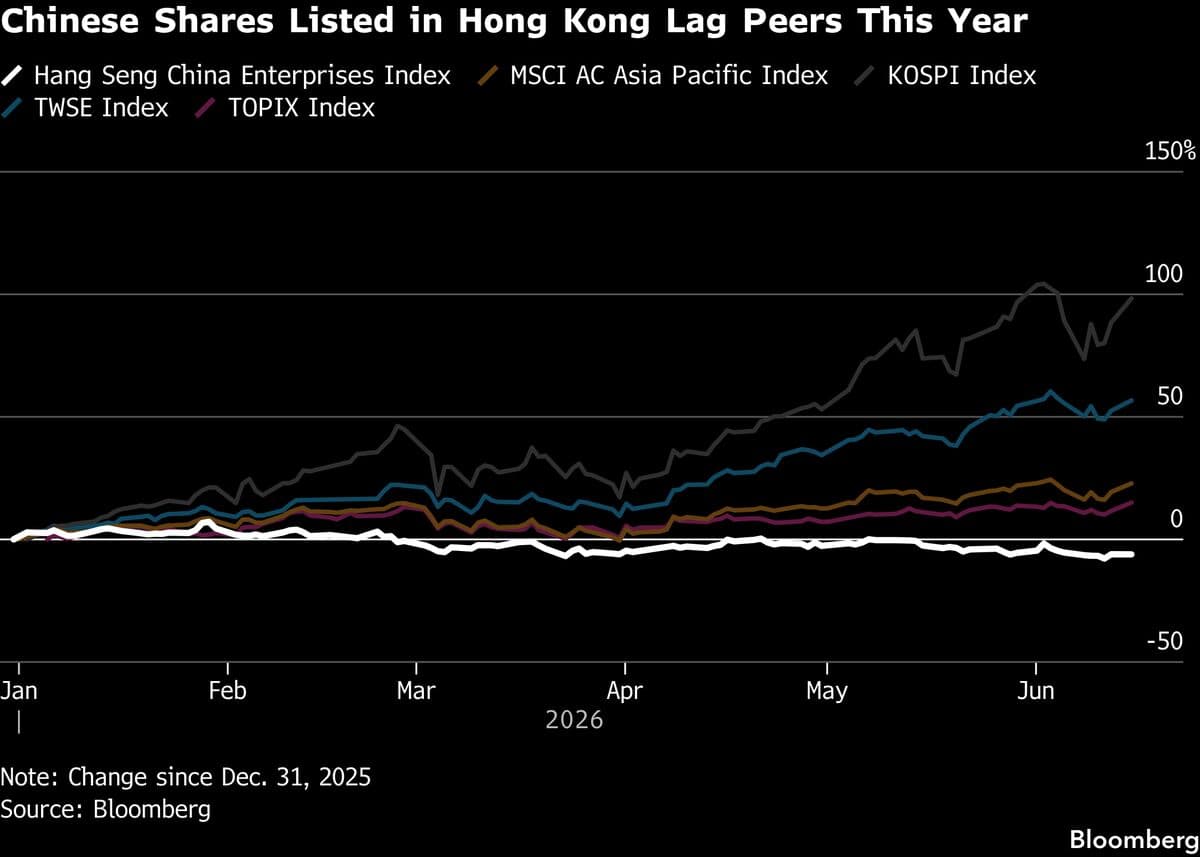
A powerful rotation is reshaping global equity markets, and Chinese stocks listed in Hong Kong are feeling the full force of its undertow. As institutional and retail investors worldwide pour capital into artificial intelligence supply chain companies — chipmakers, data center operators, power infrastructure providers, and semiconductor equipment manufacturers — the offshore China benchmark is sinking toward troubling milestones. The internet platforms and consumer discretionary giants that have long dominated indexes like the Hang Seng China Enterprises Index are being left behind, raising urgent questions about where Chinese equities fit in the new AI-driven investment playbook.
The AI Trade Is Leaving Hong Kong-Listed Chinese Stocks Behind
The global appetite for artificial intelligence investments has never been stronger. From Wall Street to Tokyo to Amsterdam, money is flowing aggressively into companies that build, supply, and power the AI ecosystem. Nvidia, TSMC, ASML, and a growing constellation of data center REITs and power utilities have become the darlings of 2024 and 2025 portfolios, delivering outsized returns that are drawing capital away from almost every other corner of the market.
For Chinese stocks listed in Hong Kong, the timing could hardly be worse. The offshore China benchmark is heavily weighted toward sectors that are structurally out of step with the AI investment thesis. E-commerce platforms, social media companies, food delivery services, and consumer staples giants make up a dominant share of the index. While these businesses remain fundamentally sound — and in many cases highly profitable — they are simply not the companies that global fund managers are reaching for when they want exposure to the AI revolution.
The result is a market that looks increasingly disconnected from the global rally powering equity indexes in the United States, Japan, and parts of Europe. Traders who might otherwise find value in discounted Chinese internet stocks are instead directing liquidity toward AI supply chain players offering cleaner narratives and more direct exposure to the technology megatrend defining this decade.
Understanding the Offshore China Benchmark's Structural Disadvantage
To understand why Hong Kong-listed Chinese shares are struggling in this environment, it helps to look at what the offshore benchmark actually holds. Unlike the technology-heavy indexes in the United States — where AI-adjacent companies like Nvidia, Microsoft, and Alphabet carry enormous weight — the Hang Seng and related China offshore gauges are dominated by companies in sectors that global investors currently view as lower-growth or structurally challenged.
Key structural disadvantages include:
- Heavy weighting toward internet and consumer platforms: Companies like Alibaba, Tencent, Meituan, and JD.com represent a significant portion of the offshore benchmark. While these are enormous businesses by any measure, they are consumer-facing platforms, not AI hardware or infrastructure companies.
- Limited direct exposure to the AI supply chain: The chipmakers, advanced packaging specialists, and high-bandwidth memory producers driving the AI trade are predominantly listed in the United States, Taiwan, South Korea, and the Netherlands — not Hong Kong.
- Macro headwinds compounding the sector mismatch: Ongoing concerns about China's domestic consumption recovery, the property sector, and geopolitical friction between Beijing and Washington continue to weigh on sentiment for Chinese equities broadly.
- Regulatory uncertainty lingering: Despite a relative easing of China's tech crackdown compared to its peak years, global investors have not fully forgotten the regulatory campaigns that battered Chinese internet stocks earlier this decade.
Bleak Milestones Mount for Hong Kong-Listed Chinese Shares
The performance gap between Chinese offshore equities and global AI-exposed markets has grown wide enough that analysts are now flagging bleak technical and fundamental milestones. The index levels that previously served as support are being tested or broken, and fund flow data suggests that the selling pressure is not coming primarily from panic — it is coming from deliberate portfolio reallocation.
Global asset managers running multi-region mandates are making active decisions to underweight China and overweight markets where AI supply chain companies are listed. When a pension fund or sovereign wealth vehicle decides to add AI exposure, it typically buys into US or Taiwanese semiconductors, not Hong Kong-listed consumer platforms. That reallocation dynamic, playing out across hundreds of institutional portfolios simultaneously, creates persistent selling pressure on the offshore China gauge that is difficult to reverse without a compelling new catalyst.
Can Chinese Tech Companies Reclaim Their Place in the AI Narrative?
There is a legitimate counterargument to the prevailing pessimism. China's largest technology companies are not standing still on artificial intelligence. Alibaba, Tencent, Baidu, and others have invested heavily in large language models, AI-powered cloud services, and generative AI applications. Baidu's ERNIE Bot, Alibaba's Qwen model family, and a growing roster of domestic AI startups suggest that China is building meaningful AI capabilities at the application and model layer.
The challenge is that building and deploying AI models is not the same, in investors' eyes, as being a node in the physical supply chain that makes AI hardware possible. The market is currently rewarding companies that make the picks and shovels — the chips, the memory, the cooling systems, the power infrastructure — not necessarily the companies building the software applications that run on top of them.
For Chinese internet companies to reclaim a stronger position in global portfolios, they may need to demonstrate not just that they are using AI, but that their AI investments are translating into measurable revenue growth, margin expansion, and competitive moats that justify higher valuations.
What Investors Should Watch Going Forward
For investors monitoring Chinese offshore equities, several factors will determine whether the current underperformance represents a lasting structural shift or a cyclical dislocation that eventually reverses.
- China's domestic AI policy signals: Government support for AI development, semiconductor self-sufficiency initiatives, and public investment in AI infrastructure could create new catalysts for Chinese tech stocks.
- Earnings from major platform companies: Strong revenue growth or margin beats from Alibaba, Tencent, or JD.com could remind global investors that these companies still generate enormous free cash flow.
- Geopolitical developments: Any easing of US-China technology tensions — or conversely any escalation — will have an outsized impact on how global investors price Chinese equities.
- Valuations versus global peers: Hong Kong-listed Chinese tech stocks already trade at significant discounts to their US counterparts. If the discount grows extreme enough, contrarian value investors may step in.
The Bottom Line
The sinking of China's offshore stock gauge is not happening in a vacuum. It is the direct consequence of a global investment community making a clear, rational choice: right now, capital wants to be in the companies building the physical and digital infrastructure of artificial intelligence. Until the composition of the offshore China benchmark shifts meaningfully, or until Chinese tech companies find a more convincing way to insert themselves into the AI supply chain narrative, Hong Kong-listed Chinese equities will likely continue to struggle against the gravitational pull of the global AI trade rotating capital elsewhere.