
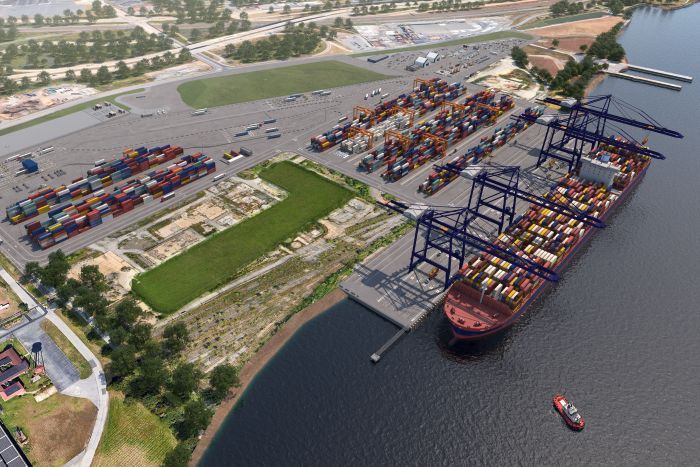
Enstructure Moves Forward on Long-Awaited Delaware River Container Terminal
After years of planning, delays, and anticipation from the regional shipping community, Enstructure — one of North America's most prominent terminal operators and stevedoring companies — has officially begun preliminary work on a new large-vessel container terminal along the Delaware River. The project, which has been in the pipeline for some time, promises to reshape cargo logistics across the mid-Atlantic region and give shippers a competitive new option for moving goods into and out of the northeastern United States.
This development marks a pivotal moment not only for Enstructure but for the broader supply chain infrastructure of the eastern seaboard. As ports compete for market share and as the global shipping industry continues its transition toward ever-larger container vessels, the need for deep-water, big-ship capable terminals in strategic locations has never been greater. The Delaware River corridor, long considered an underutilized asset relative to its geographic advantages, may soon see a significant transformation.
Why the Delaware River? Understanding the Strategic Location
The Delaware River runs along the border of several major eastern states, including Pennsylvania, New Jersey, and Delaware, placing it within close reach of some of the most densely populated and economically active markets in the United States. Philadelphia and Wilmington anchor the corridor, and the region collectively represents tens of millions of consumers and a robust industrial and commercial base.
Despite these advantages, the Delaware River port system has historically struggled to attract the volume of container traffic that rivals like the Port of New York and New Jersey or the Port of Baltimore command. Infrastructure limitations, channel depth constraints, and a lack of modern big-ship berths have traditionally held the region back. Enstructure's new terminal aims to directly address these gaps.
By developing a facility capable of accommodating large modern container vessels — the kind that now dominate transoceanic trade lanes — the terminal would open the Delaware corridor to a new class of shipping traffic. This would significantly reduce inland transportation costs for mid-Atlantic shippers who currently route cargo through more distant ports, saving time and money across entire supply chains.
What Enstructure's Terminal Project Involves
Enstructure, which operates a network of terminals and stevedoring operations across North America, is known for its expertise in port logistics, cargo handling, and terminal management. The company's decision to invest in a new Delaware River facility signals strong confidence in the region's long-term trade potential, even as global shipping markets navigate post-pandemic volatility and shifting cargo patterns.
While full construction details continue to develop, the early-stage work being undertaken represents the essential groundwork — site preparation, environmental assessments, engineering planning, and stakeholder coordination — that must precede any large-scale port infrastructure project. These initial steps, though less visible than crane installations or dock construction, are critical to ensuring the terminal can ultimately be built to meet modern operational standards.
The facility is being designed with big-ship capacity in mind, reflecting the industry's ongoing shift toward ultra-large container vessels (ULCVs) that carry thousands more TEUs (twenty-foot equivalent units) per voyage than older ship classes. Ports that cannot accommodate these vessels increasingly risk being bypassed by major ocean carriers as they optimize their route networks for efficiency and scale.
What This Means for Mid-Atlantic Shippers
For importers, exporters, manufacturers, and retailers across the mid-Atlantic region, a new big-ship terminal on the Delaware River could deliver meaningful competitive advantages. The most immediate benefit would be reduced drayage and inland transportation costs. Cargo currently destined for the mid-Atlantic that arrives through New York, Baltimore, or even further afield must travel considerable distances by truck or rail before reaching its final destination. A closer, capable port changes that calculus entirely.
- Shorter inland transport distances for businesses located in Pennsylvania, Delaware, New Jersey, and surrounding states.
- Access to more direct ocean carrier services as shipping lines add calls to a facility that can handle their largest vessels.
- Improved supply chain resilience by introducing a new port option that distributes cargo risk and reduces dependence on any single gateway.
- Potential for faster cargo processing as a purpose-built modern terminal incorporates the latest in port technology and throughput design.
These advantages matter enormously in an era when supply chain disruptions have demonstrated just how fragile over-concentrated logistics networks can be. Port diversification is no longer just a cost optimization strategy — it is increasingly a risk management imperative for businesses of all sizes.
The Broader Context: North American Port Competition Heats Up
Enstructure's Delaware River investment arrives at a time of intensifying competition among North American ports for container volume. East Coast ports have broadly gained ground relative to West Coast counterparts in recent years, driven by Panama Canal expansion, labor uncertainties on the Pacific coast, and shipper preference for supply chain diversification. Ports from Savannah to Halifax have invested heavily in capacity and efficiency to capture this shifting volume.
The Delaware River terminal, if successfully developed, would add a compelling new node to this competitive landscape. It would give ocean carriers another strong East Coast option and give shippers a gateway that combines geographic centrality with modern big-ship capabilities.
Looking Ahead: A Long Road to Full Operation
It is important to note that the initial steps Enstructure is taking now are just the beginning of what will be a multi-year development process. Port infrastructure projects of this scale involve complex permitting, environmental review, financing, and construction timelines that typically extend across several years before a terminal reaches operational status.
Nonetheless, the fact that Enstructure has moved from planning into active early-stage work is a meaningful signal. It suggests the company has cleared enough of the preliminary hurdles — commercial, regulatory, and financial — to commit resources to the ground-level work that sets larger construction in motion.
For the mid-Atlantic shipping community, this is a development worth watching closely. The eventual completion of a modern, big-ship-capable container terminal on the Delaware River would mark one of the most significant additions to East Coast port infrastructure in a generation, reshaping how goods flow into and out of one of America's most important economic regions.