
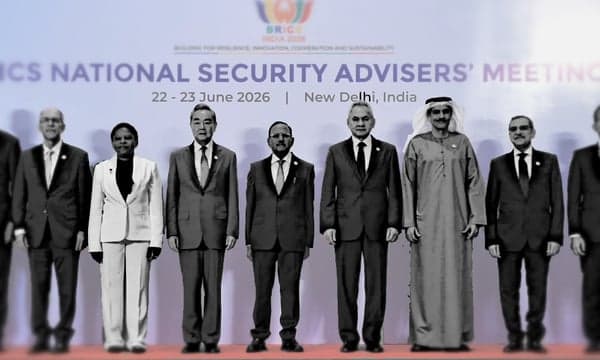
The Future of BRICS After the Iran War
The geopolitical landscape of 2025 has been irrevocably altered by the Iran conflict, sending shockwaves through international institutions and multilateral alliances alike. Among the most consequential fault lines to emerge is the one running through BRICS — the bloc of major emerging economies whose internal cohesion is now being tested as never before. With India holding the BRICS presidency and a leaders' summit scheduled for September, analysts and policymakers are watching closely to see whether the grouping can maintain its relevance, or whether competing national interests will pull it apart at the seams.
In a recent discussion, international relations scholar Carlos Frederico Pereira da Silva Gama joined host Tushar Shetty to unpack the priorities and divergences shaping India's BRICS presidency in this dramatically changed environment. Their conversation illuminates a bloc grappling with profound questions about identity, direction, and survival in a multipolar world that is becoming increasingly difficult to navigate.
What the Iran War Means for BRICS Cohesion
The Iran conflict has exposed the deep ideological and strategic fault lines that have always existed within BRICS but were previously manageable. Member states responded to the war in starkly different ways, reflecting their own national priorities, alliance commitments, and domestic political pressures. Russia, already isolated from Western institutions following its war in Ukraine, largely aligned its rhetoric with Iran's regional positioning. China, while calling for restraint, was careful not to antagonize either side too visibly, given its vast economic interests across the Middle East.
India, by contrast, took a notably cautious and balanced stance — one that has become something of a trademark of New Delhi's foreign policy under its current leadership. India condemned civilian casualties, called for diplomacy, and avoided any language that could be interpreted as endorsing either belligerent. This measured approach reflects India's broader strategic doctrine of "multi-alignment," through which it maintains productive relationships with the United States, Russia, China, and Gulf states simultaneously.
For BRICS, however, this diversity of responses is both a strength and a source of tension. A bloc that markets itself as an alternative to Western-led institutions must demonstrate a capacity for collective action. When its members respond to the same crisis with conflicting positions, the credibility of that collective identity comes under strain.
India's BRICS Presidency: Key Priorities for 2025
Despite these tensions, India has articulated a clear and ambitious agenda for its BRICS presidency. New Delhi is focusing on several interrelated themes that reflect both its own national interests and a genuine attempt to give the bloc renewed purpose.
- Reform of global financial institutions: India has consistently pushed for greater representation of the Global South in bodies like the IMF and World Bank. Under its presidency, BRICS is expected to amplify calls for voting reform and to strengthen the New Development Bank as a credible alternative funding mechanism.
- Digital public infrastructure: India's success with its own digital infrastructure stack — including Aadhaar, UPI, and DigiLocker — has given it significant credibility in this space. New Delhi hopes to position BRICS as a platform for sharing and exporting these frameworks to developing nations.
- Food and energy security: The Iran war has disrupted regional supply chains and contributed to commodity price volatility. India is keen to use its presidency to develop BRICS-level frameworks for food and energy security that reduce member states' vulnerability to external shocks.
- Expanding the BRICS+ format: Following the 2023 expansion, the bloc now includes Egypt, Ethiopia, Iran itself, Saudi Arabia, and the United Arab Emirates. Managing this expanded membership — with all its attendant rivalries and divergences — is one of the most delicate tasks India faces.
Managing Divergences: The China-India Dynamic
Perhaps no bilateral relationship within BRICS is more consequential — or more fraught — than that between India and China. The two countries share a contested border that has periodically erupted into military standoffs, and they compete fiercely for influence across Asia, Africa, and the Indian Ocean region. Yet both recognize that BRICS provides a useful forum in which they can engage on neutral ground and project an image of solidarity with the Global South.
The Iran war has added another layer of complexity. China's deepening economic ties with Iran, formalized through the 25-year cooperation agreement signed in 2021, put Beijing in an awkward position as the conflict intensified. India, which has historically significant energy and commercial ties with Iran but also a growing strategic partnership with the United States, had to navigate its own delicate balancing act. These divergent pressures mean that even crafting a joint BRICS statement on the conflict required painstaking diplomatic negotiation.
What to Expect at the September Leaders' Summit
All eyes are now on the September BRICS leaders' summit, which India is hosting and which carries enormous symbolic weight. The agenda is expected to cover the bloc's internal reform processes, the progress of BRICS currency discussions, and the development of a framework for settlement in currencies other than the US dollar — a perennial topic that has gained new urgency as Western sanctions have demonstrated the weaponization of dollar-denominated systems.
Observers will also be watching for any joint statement on the Iran war, however carefully worded. The ability of BRICS to issue even a broadly agreed communiqué on a live geopolitical conflict would represent a meaningful demonstration of institutional maturity. Failure to do so, on the other hand, would reinforce critics' arguments that the bloc is more of a talking shop than a genuine alternative pole of global governance.
BRICS at a Crossroads: Opportunity or Fragmentation?
The Iran war has accelerated a reckoning that was already underway inside BRICS. The bloc's original identity — five dynamic emerging economies united by growth potential and dissatisfaction with Western-led institutions — has become increasingly difficult to sustain as its membership has expanded and as global crises have forced members to reveal their true strategic preferences.
Yet the conditions that created BRICS in the first place have not disappeared. Western institutions remain skewed toward older power structures. Dollar dependency remains a vulnerability. The appetite for a more representative global order — across the Global South — remains strong. India's presidency offers a genuine opportunity to refocus the bloc around practical, deliverable outcomes rather than grand ideological declarations.
Whether BRICS emerges from the September summit as a reinvigorated force or a fractured coalition will depend largely on how skillfully India manages the divergences within its membership — and how seriously the world's major powers take the proposition that the post-Iran-war global order should be shaped by more voices than it currently is. The stakes, in every sense, could hardly be higher.