
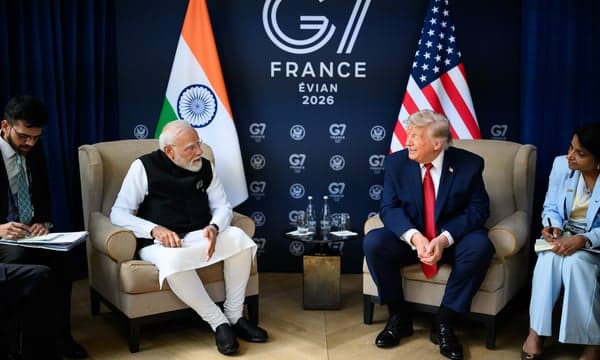
India's US Tilt: A Relationship Built on Unequal Terms
In the complex theatre of global geopolitics, few relationships have evolved as visibly — and as asymmetrically — as the one between India and the United States. What began as a carefully managed balancing act has gradually morphed into something far less flattering for New Delhi: a strategic tilt toward Washington that, despite its costs, continues to yield diminishing returns. For India, the arrangement increasingly resembles a dynamic of all stick and no carrot — obligations without rewards, gestures without guarantees.
Understanding how India arrived at this uncomfortable position requires tracing the arc of a partnership that has been celebrated in diplomatic summits and joint statements, yet tested repeatedly in the hard currency of actual policy outcomes.
From Strategic Autonomy to Strategic Accommodation
India has long prided itself on the doctrine of strategic autonomy — the ability to engage with all major powers without becoming beholden to any single one. For decades, this non-aligned posture allowed New Delhi to extract benefits from both Washington and Moscow while avoiding the entanglements that formal alliances bring. It was a pragmatic philosophy born from the Cold War and refined through the turbulent decades that followed.
But the geopolitical landscape has shifted dramatically. The rise of China as a regional and global challenger, the friction along the Line of Actual Control, and the deepening of Indo-Pacific security frameworks have nudged India steadily closer to the American orbit. The Quad, defence agreements such as BECA and COMCASA, and deepening military-to-military cooperation all signal a relationship that has moved well beyond symbolic partnership.
The question that increasingly demands an answer is: what has India actually received in exchange for this strategic accommodation?
Washington's Growing Demands, New Delhi's Shrinking Returns
The United States has been vocal — and at times blunt — about its expectations of India. Washington has pushed New Delhi to reduce its dependence on Russian military equipment, distance itself from Moscow in the aftermath of the Ukraine conflict, align more explicitly with Western positions in multilateral forums, and open its markets further to American goods and investment.
India has made concessions, some visible and some quiet. It has abstained rather than opposed Western resolutions on Russia at the United Nations. It has deepened procurement ties with American defence suppliers. It has enthusiastically participated in Quad summits and joint naval exercises. It has signalled a willingness to diversify away from Russian arms, even at considerable financial and logistical cost.
And yet, the rewards have been meagre. American tariffs on Indian exports have remained a persistent irritant. Visa bottlenecks continue to frustrate Indian professionals and students. Technology transfer arrangements, long promised as the fruit of a maturing defence partnership, have advanced at a glacial pace. Washington has shown little inclination to support India's permanent membership bid at the United Nations Security Council with the kind of unambiguous political capital it would take to make that aspiration real.
Perhaps most tellingly, whenever India exercises even a modest degree of independent judgment — whether on energy policy, trade with Russia, or engagement with Iran — Washington is quick to signal displeasure. The implicit message is clear: the tilt is never quite enough.
The Leverage Deficit: Why India Finds Itself in a Weak Bargaining Position
Part of India's challenge lies in the structural imbalance of the relationship. The United States, as the world's dominant military and technological power, holds significant cards. Access to advanced technology, favourable trade terms, investment flows, and security guarantees are all instruments Washington can deploy — or withhold — as diplomatic tools.
India, despite its growing economic weight and demographic heft, has not yet translated raw potential into consistent geopolitical leverage. Its economy, while large, remains deeply dependent on external technology and capital. Its military modernisation is ongoing but incomplete. And its domestic political imperatives — including managing public sentiment around sovereignty and national pride — constrain how far any government can go in accommodating foreign demands without political cost.
The result is a bargaining dynamic in which India feels compelled to demonstrate its value to Washington repeatedly, while Washington feels little urgency to reciprocate in kind.
The Risk of Eroding Strategic Autonomy
Beyond the immediate transactional disappointments, there is a deeper strategic concern. Every concession India makes — every degree of tilt toward Washington — narrows the space for independent manoeuvre that has historically defined Indian foreign policy at its most effective.
If India is seen internationally as a junior partner in the American strategic framework rather than an independent pole in a multipolar world, it loses a crucial asset: the credibility of being a nation that can speak to and engage with all sides. This is the very quality that has given India influence in forums like the G20, BRICS, and the Global South more broadly.
Sacrificing that credibility for a partnership that has so far offered more obligation than opportunity represents a strategic cost that deserves far more serious domestic debate than it has yet received.
A Rebalance Is Overdue
None of this is to argue that India should abandon or fundamentally rupture its relationship with the United States. The partnership holds genuine value in areas ranging from technology collaboration to people-to-people ties. But value must be mutual to be sustainable.
India needs to reclaim leverage within the relationship — to negotiate harder, demand reciprocity more explicitly, and resist the creeping assumption that loyalty to Washington's strategic preferences is its own reward. Healthy partnerships are built on mutual benefit, not on one party endlessly demonstrating its usefulness while the other holds the carrots perpetually out of reach.
The lesson from India's recent experience is uncomfortable but important: in geopolitics, as in any negotiation, those who give without conditions often find themselves without leverage. India's foreign policy tradition is rich enough, and its strategic interests complex enough, to chart a more balanced course — one that engages Washington as a genuine equal rather than an eager supplicant.