
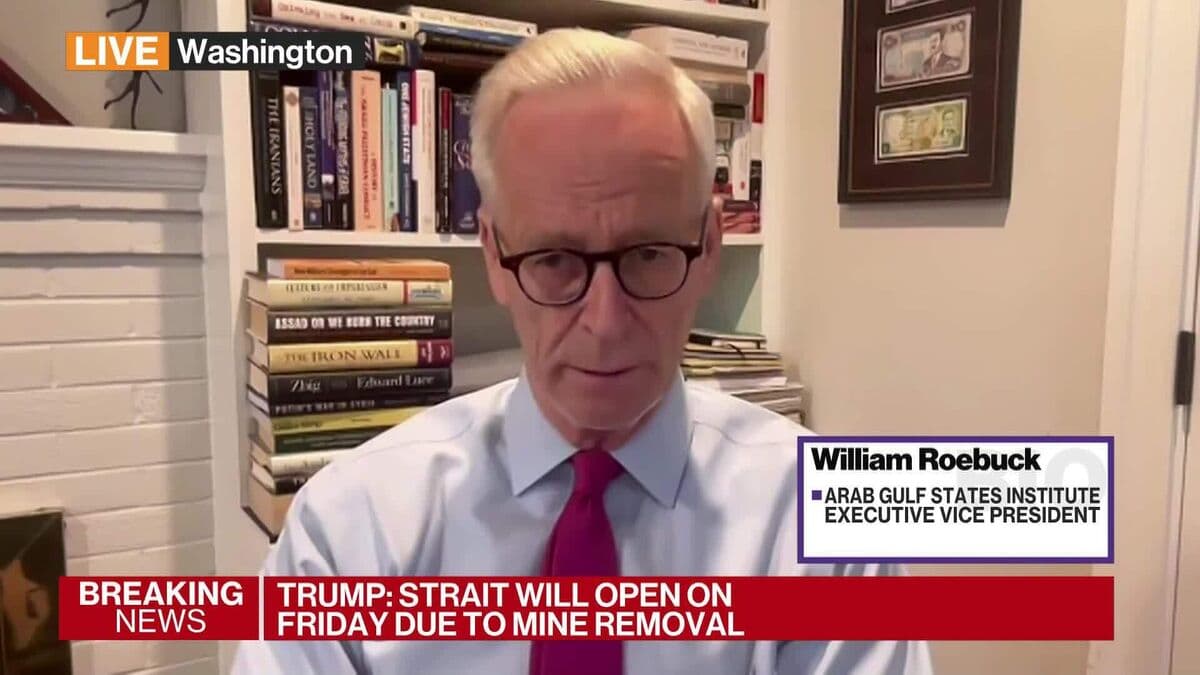
Iran-US Conflict Enters a New Diplomatic Phase, Says Former US Ambassador Roebuck
The long-standing tensions between the United States and Iran may be on the verge of a significant transformation. According to William Roebuck, Former US Ambassador to Bahrain and Executive Vice President at the Arab Gulf States Institute (AGSI), the conflict between Washington and Tehran is no longer strictly a military or economic standoff. Instead, it is shifting decisively onto what he describes as a "diplomatic track." Speaking on Bloomberg's The Asia Trade with anchors Shery Ahn and Haidi Stroud-Watts, Roebuck offered a measured but notably optimistic outlook for the future of US-Iran relations — one that carries enormous implications for regional stability, global energy markets, and the broader architecture of Middle Eastern geopolitics.
Who Is William Roebuck and Why Does His Analysis Matter?
William Roebuck is not merely an academic commentator. As a former US Ambassador to Bahrain and a senior figure at the Arab Gulf States Institute, he brings decades of frontline diplomatic experience to his assessments. The AGSI is one of the most respected think tanks focused on the Arabian Gulf region, and its leadership regularly provides analysis that shapes policy conversations in Washington, Riyadh, Abu Dhabi, and beyond.
When Roebuck speaks about the Iran-US dynamic, he does so with the kind of institutional knowledge and regional fluency that few others can claim. His characterization of the current moment as a transition into a "new stage" is therefore not a casual observation — it reflects a carefully considered reading of diplomatic signals, back-channel communications, and the broader strategic calculus on both sides.
What Does "Moving Into a New Stage" Actually Mean?
Roebuck's framing of the conflict as "moving into a new stage" is rich with meaning. For years, the relationship between Washington and Tehran has been defined by sanctions, proxy conflicts, nuclear brinkmanship, and occasional episodes of direct confrontation. The assassination of General Qasem Soleimani in 2020, the repeated sabotage of tankers in the Persian Gulf, and Iran's steady advances in uranium enrichment have all contributed to a climate of acute strategic hostility.
Yet Roebuck's assessment suggests that both sides may now have sufficient reason to step back from the precipice. Whether driven by economic pressure on Iran, shifting political priorities in Washington, or broader regional realignments — including the landmark Saudi-Iran rapprochement brokered by China in 2023 — the conditions for diplomatic engagement appear more favorable than they have been in years.
The phrase "diplomatic track" is particularly significant. In the parlance of international relations, moving to a diplomatic track implies structured dialogue, the possibility of formal agreements, and a mutual recognition that the costs of continued confrontation outweigh the benefits. It does not mean peace is guaranteed, but it does mean that both parties are, at least in principle, willing to talk.
Key Factors Driving the Diplomatic Shift
Several converging factors help explain why the Iran-US conflict may be transitioning toward diplomacy at this particular moment.
- Economic pressure on Iran: Years of compounding US-led sanctions have taken a severe toll on Iran's economy. Inflation, currency depreciation, and restricted access to global financial systems have created domestic pressures that make a negotiated easing of sanctions increasingly attractive to Iranian leadership.
- Regional normalization trends: The broader Middle East has been undergoing a remarkable period of normalization and dialogue. Saudi Arabia and Iran restored diplomatic relations in 2023, reducing the likelihood of destabilizing proxy conflicts and creating space for US-Iran talks to proceed with less regional interference.
- US strategic recalibration: Washington has demonstrated a recurring interest in reducing its military footprint in the Middle East and redirecting strategic attention toward the Indo-Pacific. A diplomatic resolution with Iran would facilitate that pivot without leaving a power vacuum in the Gulf.
- Nuclear timeline pressures: Iran's nuclear program has advanced significantly, increasing the urgency for a negotiated framework that prevents further enrichment. Both sides have strong incentives to reach an agreement before the situation becomes irreversible.
Implications for the Arab Gulf States
For the Gulf Cooperation Council (GCC) states — Saudi Arabia, the UAE, Kuwait, Qatar, Bahrain, and Oman — a diplomatic resolution between Washington and Tehran would represent both an opportunity and a challenge. On one hand, reduced Iran-US hostility lowers the risk of a regional military escalation that could have catastrophic consequences for Gulf economies and infrastructure. On the other hand, Gulf states have historically relied on the threat of Iran as a justification for close US security partnerships and elevated defense spending.
Roebuck's institutional home at AGSI makes his analysis particularly attuned to these dynamics. The Gulf states will be watching closely to ensure that any US-Iran agreement does not come at the expense of their own security guarantees or strategic interests.
What Comes Next: Watching the Diplomatic Track Unfold
While Roebuck's outlook is cautiously optimistic, it is worth emphasizing that diplomatic tracks are rarely linear. Talks can stall, domestic political pressures can derail progress, and spoiler actors — both regional and international — have strong incentives to prevent a US-Iran agreement from materializing.
Nevertheless, the very fact that a seasoned diplomat of Roebuck's caliber is characterizing the moment as a shift toward dialogue is itself a meaningful signal. It suggests that within informed policy circles, there is a growing consensus that the era of pure confrontation between Washington and Tehran may be giving way to something more complex and — potentially — more constructive.
For investors, policymakers, and regional observers, keeping a close watch on the US-Iran diplomatic track in the coming months will be essential. The stakes — spanning oil markets, regional security architectures, nuclear non-proliferation, and global trade routes through the Strait of Hormuz — could not be higher.
Conclusion
William Roebuck's assessment on Bloomberg's The Asia Trade offers a timely and authoritative perspective on one of the world's most consequential geopolitical relationships. As the Iran-US conflict transitions from a posture of confrontation toward a diplomatic track, the world is watching to see whether this new stage will deliver lasting stability or prove to be another false dawn. What is clear is that the conversation has changed — and that change, in diplomacy, is often the first step toward resolution.