
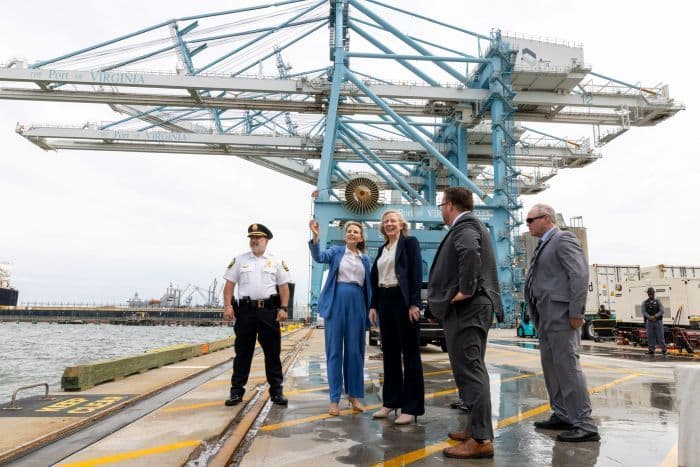
Port of Virginia Sets Its Sights on Becoming the Premier US East Coast Gateway
The Port of Virginia has long been one of the most strategically positioned ports along the United States East Coast, but its leadership is no longer content with simply being a major player. With the completion of a landmark harbor deepening project, the port's chief executive is making a bold declaration: Norfolk wants to be the preferred gateway for container services entering and exiting the US East Coast (USEC). The newly inaugurated deeper harbor is not just an infrastructure milestone — it is a calculated move to reshape the competitive dynamics of American maritime trade.
What the Harbor Deepening Actually Means for Shipping
For years, one of the subtle but commercially significant limitations facing East Coast ports was the inability to accommodate fully loaded ultra-large container vessels (ULCVs). While these megaships could technically call at certain ports, draft restrictions often forced carriers to arrive partially loaded, reducing efficiency and undermining the economic case for direct service calls. The Port of Virginia's deeper harbor directly addresses this constraint.
With the harbor now dredged to greater depths, the largest container ships currently operating on major trade lanes can arrive at Norfolk fully loaded. This is not a minor operational detail — it fundamentally changes the calculus for ocean carriers when designing their service loops. A port that can receive a fully laden 24,000 TEU vessel offers shipping lines a meaningfully different value proposition than one that requires cargo to be offloaded or rerouted elsewhere to manage vessel draft.
The Port of Virginia's CEO has been explicit about the opportunity this creates. In his view, the port now has the physical infrastructure to serve as a genuine fulcrum for container services along the US East Coast, anchoring itineraries and acting as a primary hub rather than a secondary call.
The Strategic Importance of USEC Gateway Status
The US East Coast container market has historically been competitive, with ports from Savannah to New York-New Jersey vying for volume and carrier commitments. Gateway status — the designation of a port as a primary entry and exit point for containerized goods — carries enormous commercial weight. Ports that achieve gateway standing attract more frequent sailings, larger vessel deployments, and deeper integration into global supply chains.
For importers and exporters in Virginia and across the mid-Atlantic and southeastern United States, a stronger Port of Virginia means shorter cargo dwell times, more competitive freight rates, and improved supply chain resilience. For global carriers, it means a reliable, deep-water East Coast hub capable of handling next-generation vessels without compromise.
The port's ambition is well-timed. The Panama Canal expansion has already redirected significant container volumes toward East Coast ports, a trend that accelerated during the supply chain disruptions of the early 2020s. Carriers and shippers that once defaulted to West Coast routing have become more open to East Coast alternatives, and the Port of Virginia is positioning itself to capture and retain that business permanently.
Infrastructure Investment as a Competitive Weapon
The harbor deepening is part of a broader infrastructure investment narrative at the Port of Virginia. The port has consistently invested in terminal modernization, automation, and landside connectivity, including rail access that links Norfolk to major inland markets. These investments compound the value of the deeper harbor by ensuring that once cargo arrives, it can move efficiently through the port and into the broader supply chain.
- Deeper draft capability: Allows fully loaded ULCVs to call without cargo restrictions, maximizing vessel economics for ocean carriers.
- On-dock rail: Provides direct intermodal connections to the US interior, reducing truck dependency and transit times for inland shippers.
- Terminal automation: Improves throughput efficiency and reduces per-move costs, making the port more attractive for high-volume carrier deployments.
- Strategic location: Norfolk sits within reach of major mid-Atlantic and southeastern population and manufacturing centers, offering strong cargo origination and destination volumes.
How the Port of Virginia Compares in the USEC Landscape
The US East Coast port landscape is not static. The Port of Savannah has grown dramatically over the past decade to become the second-busiest container port in the United States, while the Port of New York and New Jersey remains the largest by volume. Baltimore, Charleston, and Jacksonville round out a competitive field that is continuously evolving.
What differentiates Norfolk's pitch is the combination of depth, automation, rail connectivity, and the explicit strategic intent of its leadership to pursue gateway status. Ports that win in the long term tend to be those that make deliberate infrastructure choices years before the demand materializes — and the Port of Virginia's harbor deepening fits squarely into that model of forward-looking investment.
Ocean carriers, for their part, are watching closely. Deployment decisions for the largest vessel classes are made years in advance, and port infrastructure capability is among the most heavily weighted factors in those decisions. By eliminating draft constraints, Norfolk has removed one of the most significant structural barriers to becoming a first-call port on major Asia-USEC trade lanes.
What Comes Next for the Port of Virginia
The completion of the harbor deepening is a beginning, not an endpoint. The Port of Virginia's leadership will need to translate physical capability into carrier commitments, service announcements, and ultimately cargo volume. Marketing the port's expanded capabilities to beneficial cargo owners, freight forwarders, and ocean carriers will be critical in the months and years ahead.
Shippers evaluating their East Coast port options should monitor how quickly carriers respond to Norfolk's enhanced infrastructure. Early mover advantage in establishing supply chain routings through a port can be sticky — once logistics networks are built around a gateway, they tend to persist.
For the broader US maritime industry, the Port of Virginia's harbor deepening is a reminder that port competitiveness is won through patient, large-scale infrastructure investment. Norfolk has made its move. The question now is whether the market responds by making it the USEC gateway its CEO envisions.