
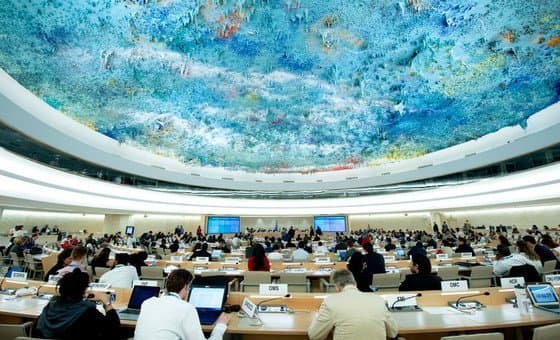
The UN Human Rights Council at 20: A Landmark Anniversary in a Turbulent World
Twenty years ago, the United Nations Human Rights Council (UNHRC) formally began its work as the world's principal intergovernmental body dedicated to the promotion and protection of fundamental human rights across the globe. Established in 2006 to replace the much-criticized UN Commission on Human Rights, the Council was created with a bold mandate: to address human rights violations wherever they occur, hold states accountable, and amplify the voices of the world's most vulnerable people. Two decades later, that mission remains as urgent and as contested as ever.
As the Council marks this significant anniversary, it does so against a backdrop of rising authoritarianism, armed conflict, climate-driven displacement, digital surveillance, and deep geopolitical divisions that strain multilateral institutions to their limits. The challenges it faces today are both familiar and entirely new — a reflection of how much the world has changed, and how much it has stubbornly remained the same.
What Is the UN Human Rights Council and Why Does It Matter?
The Human Rights Council is an intergovernmental body within the United Nations system, composed of 47 member states elected by the UN General Assembly. It meets three times a year in Geneva and holds special sessions when urgent human rights crises demand it. Its core tools include the Universal Periodic Review (UPR) — a mechanism through which every UN member state's human rights record is assessed — as well as special procedures, independent experts, and fact-finding missions.
Unlike many international bodies, the Council has the power to shine a public spotlight on even the most powerful governments. Its reports, resolutions, and mandates have contributed to accountability processes in countries ranging from Syria and Myanmar to Belarus and Sudan. For millions of people living under repressive regimes, the Council represents one of the few multilateral spaces where their suffering can be formally recognized on a world stage.
Twenty Years of Progress: Notable Achievements
Reflecting on two decades of work, the Council has notched a number of important milestones that deserve recognition. The Universal Periodic Review, launched in 2008, has completed multiple full cycles covering all 193 UN member states — a genuinely unprecedented achievement in the history of international human rights monitoring. The UPR process has prompted thousands of state commitments to reform laws and practices affecting civil liberties, women's rights, minority protections, and more.
The Council has also expanded the roster of thematic Special Procedures — independent experts and working groups who monitor specific issues such as torture, freedom of expression, the rights of persons with disabilities, and climate change. Today, there are more than 45 such mandates, reflecting both the breadth of human rights concerns and the growing recognition that rights are indivisible and interconnected.
Perhaps most significantly, the Council has demonstrated that it can act swiftly in moments of acute crisis. Its special sessions on situations in Ukraine, Ethiopia, Gaza, and Afghanistan are examples of the body mobilizing international attention — even if robust follow-through has not always materialized.
Persistent and Old Challenges the Council Has Yet to Overcome
Yet for all its achievements, the Human Rights Council has long been dogged by structural and political weaknesses that limit its effectiveness. Chief among them is the question of membership. Because seats are allocated by regional groups and states are elected rather than vetted purely on rights records, countries with serious human rights concerns have regularly served on the Council — sometimes using their position to shield themselves or allies from scrutiny. This contradiction between the body's mandate and its membership remains one of its most frequently cited criticisms.
Geopolitical bloc dynamics have also frequently paralyzed action on some of the most serious situations. The Council operates by consensus or simple majority, and powerful states have often marshaled regional allies to block or water down resolutions targeting their partners. The failure to establish robust and ongoing accountability mechanisms for situations like the conflict in Yemen — despite years of documented atrocities — illustrates how political calculations can override the protection of civilians.
New Challenges in the Council's Third Decade
As the Council enters its third decade, it faces a set of challenges that its founders could not have fully anticipated. The rapid expansion of artificial intelligence and digital surveillance technologies has created vast new frontiers for human rights abuses — from facial recognition tools used to track ethnic minorities to algorithmic systems that deny people access to housing, employment, or justice. The Council is only beginning to grapple with a regulatory and normative framework adequate to these threats.
Climate change, too, is increasingly recognized as a human rights emergency. Communities on the front lines of flooding, drought, and extreme heat — often the world's poorest and most marginalized populations — face threats to their rights to life, health, food, and shelter. In 2021, the Council formally recognized the right to a clean, healthy, and sustainable environment, but translating that recognition into concrete state obligations remains a work in progress.
The rise of civic space restrictions worldwide also presents a mounting challenge. Across dozens of countries, civil society organizations, journalists, and human rights defenders face criminalization, surveillance, and violence. Without a vibrant civil society able to document abuses and engage with UN mechanisms, the Council's capacity to respond effectively is fundamentally weakened.
Looking Ahead: Can the Council Rise to the Moment?
The twentieth anniversary of the Human Rights Council is both a moment of reflection and a call to action. Reform proposals — including tighter scrutiny of member state candidacies, stronger follow-up mechanisms for UPR recommendations, and more robust funding for independent investigations — continue to circulate among member states and civil society alike.
The Council's legitimacy ultimately rests not on its institutional longevity, but on its willingness to confront power honestly and consistently. In a world where fundamental rights are under pressure from every direction, a reformed, more courageous Human Rights Council is not merely desirable — it is indispensable.
Whether the body can summon the political will to meet this moment will define not just its next twenty years, but the trajectory of human rights protection for generations to come.