
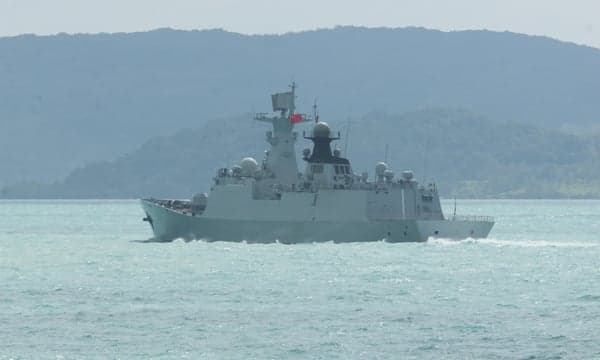
Australia's Geographic Advantage Is Shrinking — and the PLA Is the Reason Why
For most of Australia's modern history, distance has been its most reliable defender. Sitting at the southern edge of the Indo-Pacific, separated from potential adversaries by thousands of kilometres of ocean, Australia has long enjoyed the luxury of geographic insulation. That buffer has shaped defence doctrine, spending priorities, and the country's broader sense of strategic safety for generations. But that comfort is now under serious strain. The rapid development of the People's Liberation Army (PLA) is steadily chipping away at one of Australia's principal defensive assets: geography itself.
Understanding what this shift means — and how Australia should respond — has become one of the most pressing questions in the country's national security debate.
How the PLA Has Transformed Over the Past Two Decades
The PLA of today bears little resemblance to the force it was at the turn of the century. What was once a large but technologically limited ground-centric military has undergone a sweeping transformation. Under the direction of the Chinese Communist Party, and accelerated significantly under Xi Jinping's leadership, the PLA has pursued modernisation across every domain: air, sea, land, space, and cyber.
China's defence budget has grown dramatically year on year, and while official figures are widely believed to understate true military spending, the results are visible in hardware, capability, and posture. The PLA Navy (PLAN) has become the largest navy in the world by number of vessels. The PLA Air Force now operates a growing fleet of fifth-generation stealth fighters. The PLA Rocket Force fields a vast and increasingly sophisticated arsenal of ballistic and cruise missiles, many specifically designed to strike at the long-range assets that Western militaries — including Australia's — depend on.
This is not incremental improvement. It is a structural shift in the regional balance of power.
Why Geography Mattered — and Why It Matters Less Now
Australia's geographic position has historically meant that any adversary seeking to project force against the continent would face enormous logistical challenges. Sustaining a military campaign across the distances involved in the Indo-Pacific has traditionally required capabilities that very few nations possessed. This reality allowed Australia to maintain a comparatively modest defence establishment relative to its landmass and the complexity of its strategic environment.
The PLA's modernisation changes this calculus in several critical ways.
- Long-range strike: Chinese ballistic and cruise missiles now have ranges that place Australian territory, and certainly Australian forces operating in the region's northern approaches, within potential reach. Platforms like the DF-26 intermediate-range ballistic missile — sometimes dubbed the "Guam Killer" — have ranges that extend well into Australia's strategic neighbourhood.
- Naval reach: The PLAN's growing blue-water capability means Chinese naval forces can now operate far from the Chinese coastline for sustained periods. Regular deployments into the Indian Ocean and waters closer to Australia have become routine, a development that was virtually unimaginable two decades ago.
- Air power projection: The PLA Air Force's expansion of long-range bomber capabilities, combined with potential access to basing arrangements across the Pacific and Indian Ocean regions, significantly extends the aerial threat horizon that Australian defence planners must account for.
- Space and cyber domains: Increasingly, military competition is fought in domains where geography is largely irrelevant. China's demonstrated capabilities in counter-space operations and cyber warfare can threaten Australian systems and infrastructure directly, regardless of physical distance.
The Strategic Implications for Australian Defence Policy
Australia's defence establishment has been grappling with these realities, and the response is visible in the policy shifts of recent years. The 2023 Defence Strategic Review represented a significant departure from previous strategic thinking, explicitly acknowledging that the concept of a "10-year warning time" before a major conflict — a foundational assumption of earlier defence planning — was no longer credible.
The review called for a fundamental reshaping of the Australian Defence Force (ADF) toward a strategy of denial: the ability to hold adversary forces at risk and deter aggression before it reaches Australian shores. This requires investment in long-range strike, enhanced northern base infrastructure, improved intelligence and surveillance capabilities, and deeper interoperability with allies — most notably the United States and the United Kingdom through the AUKUS partnership.
The AUKUS agreement, and its centrepiece commitment to provide Australia with nuclear-powered submarines, is perhaps the clearest expression of how seriously Canberra now views the challenge posed by PLA expansion. Nuclear-powered submarines offer range, endurance, and survivability that conventional vessels cannot match — capabilities directly suited to operating in a contested Indo-Pacific environment shaped by Chinese military power.
Alliances, Deterrence, and the Limits of Australia Acting Alone
No realistic assessment of Australia's strategic position suggests that it can manage the PLA challenge unilaterally. The US alliance remains the cornerstone of Australian defence, and the increased rotational presence of American forces through Darwin and other facilities reflects a mutual recognition that deterrence in the Indo-Pacific is a shared enterprise. Quad partnerships with the United States, Japan, and India add further layers of strategic depth.
Yet dependence on allies also carries risk. A more contested and uncertain American domestic political environment raises legitimate questions about the reliability and permanence of US commitments. Australia must therefore pursue a hedged approach — deepening alliances while simultaneously building genuine sovereign capability.
What Comes Next
The rapid development of the PLA is not a distant or theoretical concern for Australia. It is a present and accelerating strategic reality that is reshaping the entire Indo-Pacific security environment. Geography has not disappeared as a factor — Australia's distance still matters — but it can no longer be relied upon as a passive guarantee of safety.
The choices Australia makes in the coming decade on defence investment, alliance management, and strategic posture will determine how well it navigates a more dangerous and competitive regional order. The erosion of geographic advantage demands a more active, capable, and forward-thinking approach to national security than Australia has needed to sustain at any point in its recent past.