
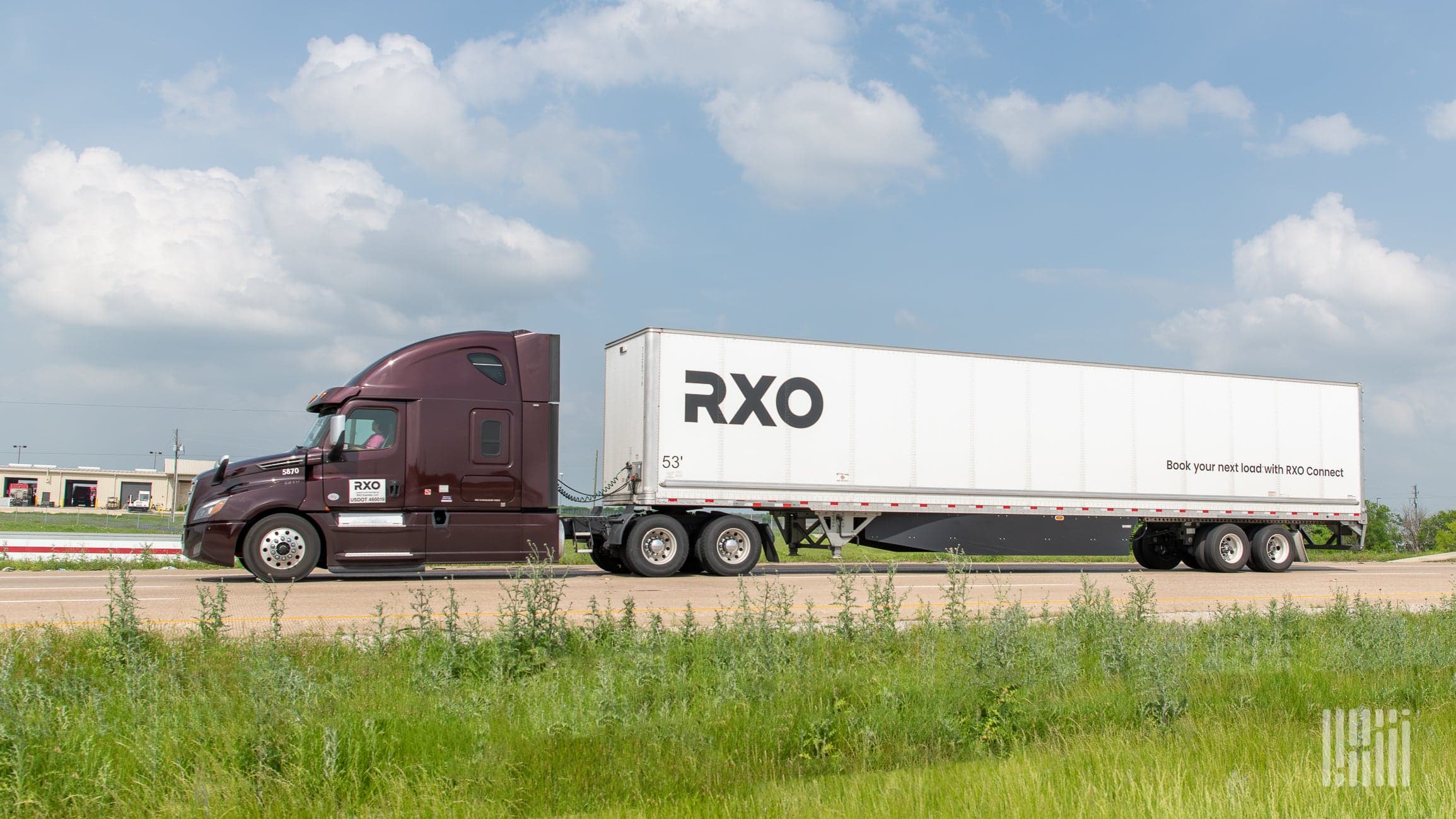
S&P Global Affirms RXO's Debt Rating While Maintaining Negative Outlook
In a closely watched move for the freight and logistics industry, S&P Global Ratings has affirmed RXO's debt rating at BB, while simultaneously holding its negative outlook on the third-party logistics giant. The decision reflects both a cautious optimism about improving freight market conditions and a lingering uncertainty about whether those improvements can be sustained long enough to meaningfully strengthen RXO's financial footing.
For investors, analysts, and industry observers, this rating action carries significant weight. It not only speaks to the current state of RXO as a publicly traded company on the NYSE (ticker: RXO), but also reveals how one of the world's most influential credit rating agencies is interpreting the broader trucking and freight landscape heading into what many have described as a market recovery cycle.
What the Rating Affirmation Actually Means
A BB rating from S&P Global places RXO firmly in non-investment grade territory — two full notches below the threshold that separates investment-grade debt from speculative-grade, or so-called "junk," debt. While the term "junk" carries an unfair stigma for many well-run companies that carry such ratings, it does have practical implications: borrowing costs tend to be higher, institutional investors with strict mandates may be restricted from holding the debt, and the company faces increased scrutiny from lenders and counterparties alike.
The BB rating was affirmed not only for RXO's general corporate credit but also for its unsecured notes, reinforcing the agency's consistent view of the company's current financial risk profile. An affirmation, while not a downgrade, is also not a vote of confidence in the traditional sense. It is more of a "hold" signal — a declaration that conditions have not changed enough in either direction to warrant a revision.
The Negative Outlook: What It Signals and What It Doesn't
The persistence of the negative outlook is arguably the more consequential element of S&P's action. A negative outlook signals that a downgrade is possible — though not guaranteed — if financial performance or market conditions deteriorate or fail to improve sufficiently. Importantly, there is no defined time limit on how long a company can remain on a negative outlook; it could last months or extend for several years depending on circumstances.
According to S&P Global, the negative outlook "reflects the risk that the company will be unable to increase its relative profitability or improve its credit measures to the levels we believe are necessary to stabilize the rating." In plain terms, RXO needs to demonstrate stronger, more durable earnings power before the agency will be comfortable moving the outlook back to stable — let alone considering any positive rating action.
This is a notably conservative stance, but one that S&P Global appears to feel is warranted given the mixed signals currently emanating from the freight market.
S&P Global's Conservative Take on the Freight Market Recovery
One of the most telling aspects of S&P's commentary was its measured skepticism toward the recent uptick in trucking pricing. "It is unclear if the recent rebound in trucking pricing is sustainable," the agency stated — a sentence that encapsulates the uncertainty gripping the freight sector right now.
The trucking industry has endured an extended freight recession, characterized by overcapacity, depressed spot rates, and compressed carrier margins. While there have been signs of improvement — including tightening capacity in certain lanes and modest spot rate recovery — the broader picture remains fragile. S&P Global's reluctance to fully embrace this recovery as a reason to revise RXO's outlook suggests the agency wants to see more consistent, multi-quarter evidence of improvement before adjusting its stance.
That said, S&P did acknowledge that RXO's credit metrics are expected to improve in the near term, suggesting the agency is not entirely dismissing the current market momentum. It is a nuanced position: cautiously hopeful, but unwilling to get ahead of the data.
RXO's Rating Compared to Moody's: A Notable Divergence
An interesting subplot to this story is the divergence between S&P Global's and Moody's respective ratings on RXO. While S&P has RXO at BB — two notches below investment grade — Moody's rates the company at Ba1, which is one notch below the investment-grade cutoff. That places Moody's one full notch higher than S&P in its assessment of RXO's creditworthiness.
Such split ratings between major agencies are not uncommon, but they do create complexity for market participants. Institutional investors, lenders, and bond traders must weigh both ratings when making decisions, and the gap between the two can influence pricing in the secondary market for RXO's debt.
The divergence also raises an implicit question: which agency's view will prove more accurate as the freight cycle evolves? If trucking pricing strengthens sustainably and RXO's margins expand as anticipated, Moody's relatively more constructive view may be validated. If conditions deteriorate or the recovery proves short-lived, S&P's caution may look prescient.
What Comes Next for RXO's Credit Profile
For RXO, the path forward from a credit perspective is straightforward in theory, if challenging in practice. The company must demonstrate consistent improvement in its profitability and key credit metrics — measures like leverage ratios, interest coverage, and free cash flow generation — before S&P Global will feel comfortable revising its outlook to stable.
- Sustaining and growing gross margins as freight volumes recover will be critical to narrowing the gap between RXO's current metrics and the thresholds S&P views as consistent with a stable BB rating.
- Demonstrating disciplined cost management, even as the company potentially invests in technology and capacity to capture share in an improving market, will be closely watched by analysts and rating agencies alike.
- Continued execution on its strategic positioning as a leading asset-light 3PL — leveraging technology, carrier relationships, and data — will be key differentiators that could accelerate the financial improvement S&P is looking for.
The broader freight market backdrop will also play a decisive role. A sustained trucking pricing recovery driven by demand growth and capacity rationalization would provide a natural tailwind to RXO's revenue and margin profile. Conversely, any renewed softness — whether driven by macroeconomic slowdown, inventory destocking, or a flood of new carrier capacity — could push the outcome in the wrong direction quickly.
The Bigger Picture for the 3PL Sector
RXO's credit situation is not occurring in a vacuum. The entire third-party logistics sector has faced headwinds over the past two-plus years as the post-pandemic freight boom gave way to a prolonged correction. Companies across the 3PL landscape have had to adapt to lower transaction volumes, tighter margins, and more demanding shipper relationships in an environment where carriers have had negotiating leverage stripped away by excess capacity.
S&P Global's conservative framing of the trucking market recovery likely applies to many players in this space, not just RXO. Rating agencies tend to lag market inflection points by design — they need sustained evidence of change before revising their assessments. That means even if freight conditions continue to improve through the rest of the year, it may be some time before that improvement translates into rating actions across the sector.
For now, RXO remains rated BB with a negative outlook at S&P Global — a position that demands continued operational focus, financial discipline, and a bit of help from a freight market that is showing promise but has yet to fully prove its durability.