
The $35 Billion Problem Hiding in Plain Sight
Cargo theft is no longer a fringe concern buried in insurance reports. It has become one of the most pressing operational challenges facing U.S. businesses today, costing the industry an estimated $35 billion annually — a figure that has surged 60% year over year. Behind that staggering number is a surprisingly simple vulnerability: shippers lose visibility of their freight between carrier scans. Packages and pallets travel through long, unmonitored gaps in the supply chain, and by the time a theft is discovered, recovery is rarely an option.
This blind spot has persisted because existing tracking solutions were never purpose-built for individual shipments. GPS asset trackers work well for trucks and trailers, but attaching an expensive, rechargeable device to every outbound box is neither practical nor cost-effective. Traditional carrier scan systems only update status at pickup and delivery, leaving hours or even days of transit completely dark. For high-value cargo, that darkness is an open invitation.
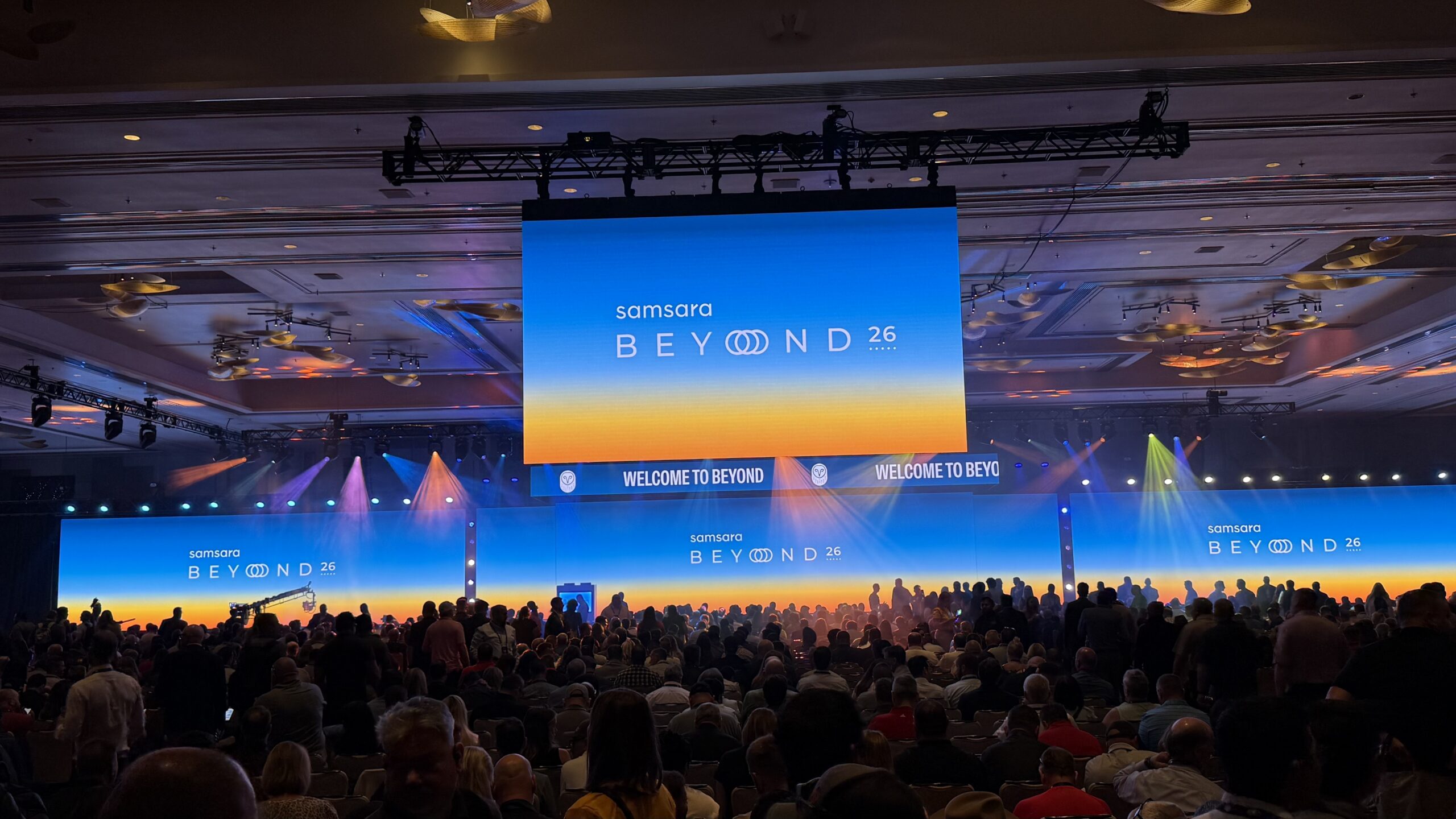
At its Beyond 2026 customer conference in Las Vegas, Samsara (NYSE: IOT) announced it is closing that gap — with technology that fits inside an envelope.
Introducing the Samsara Tracking Label
Samsara's answer to the cargo visibility problem is the Samsara Tracking Label, a single-use, paper-thin Bluetooth label designed to deliver near-real-time shipment tracking from the moment a box leaves a dock to the moment it arrives at its destination. It is adhesive-backed and flexible, making it as easy to apply as any standard shipping label.
The device is built with logistics practicality at its core. It carries a 45-day battery life — more than sufficient for even the longest domestic supply chain journeys — and contains no lithium or hazardous materials. That last detail matters more than it might initially seem. Because the label is free of restricted materials, it ships pre-cleared for air, ground, and rail transport without triggering dangerous goods compliance requirements. When a shipment reaches its destination, the label can simply be discarded without any special disposal procedures, eliminating the reverse logistics headache that comes with reusable tracking hardware.
David Gal, Samsara's vice president of connected equipment, captured the product philosophy succinctly during the keynote presentation.
"Our customers have been using asset tags to track critical shipments, and that works, but it's not purpose-built for cargo," Gal said. "What they've been asking for is a label they can slap on a box and walk away. That's exactly what the Tracking Label is."
The Samsara Network: The Engine Behind the Label
A Bluetooth label is only as useful as the infrastructure listening for it, and this is where Samsara's existing platform becomes a decisive competitive advantage. The Tracking Label is powered by the Samsara Network — a vast, already-deployed ecosystem of millions of connected devices spanning commercial trucks, trailers, buses, construction equipment, and warehouse scanners. According to the company, the network covers 99% of major U.S. roads and tens of thousands of worksites.
As a shipment moves through the supply chain, any Samsara-connected device in its proximity automatically detects the Tracking Label's Bluetooth signal and relays its location back to the platform. This passive crowdsourced model means visibility does not depend on the carrier installing or operating any special hardware. A shipper using the Tracking Label gains location awareness through Samsara's existing network without requiring any coordination with or buy-in from the carriers handling their freight.
This is a meaningful architectural distinction. Most tracking solutions require either carrier cooperation or dedicated infrastructure at key transit points. Samsara's approach flips that model, using the density of its already-deployed fleet network to provide coverage that grows stronger as more Samsara customers come online — creating a self-reinforcing visibility layer across the U.S. supply chain.
Agent Studio: Building AI Workflows Without Writing Code
The Tracking Label was not the only major announcement at Beyond 2026. Samsara also unveiled Agent Studio, a no-code tool that empowers operations teams to build and deploy AI-powered workflows without requiring IT support or engineering resources.
In the context of cargo and fleet management, this capability carries significant practical value. Operations managers can now design automated workflows — such as triggering an alert when a tracked shipment deviates from its expected route, escalating a notification if a label goes silent for an extended period, or automatically generating incident reports when anomalies are detected — all without writing a single line of code.
Agent Studio represents Samsara's broader push to make its platform accessible to the operational layer of a business, not just its technical teams. For mid-market shippers and fleet operators who lack large IT departments, this kind of no-code automation tooling can meaningfully accelerate how quickly they respond to theft, delay, or route deviation events.
Why Cargo Visibility Has Become a Strategic Priority
The timing of Samsara's launch reflects a wider shift in how supply chain leaders are thinking about risk. Cargo theft has evolved beyond opportunistic smash-and-grabs into organized, sophisticated operations that specifically target high-value shipments during in-transit gaps. Electronics, pharmaceuticals, and food and beverage products are among the most frequently targeted categories.
Insurance costs are rising in response, and shippers are increasingly being asked by insurers and enterprise buyers to demonstrate active tracking protocols as a condition of coverage or contract. Near-real-time visibility is transitioning from a nice-to-have feature into a baseline expectation for responsible supply chain management.
What This Means for Shippers and Fleet Operators
For companies already operating within the Samsara ecosystem, the Tracking Label represents a low-friction extension of existing investment. For businesses evaluating tracking solutions for the first time, it offers an entry point that requires no infrastructure buildout and no carrier negotiation — just a label applied to a box at the point of origin.
- Cost-effective per-shipment tracking: Single-use, disposable design eliminates recovery and recharging costs associated with reusable hardware.
- Carrier-agnostic visibility: Detection happens through Samsara's network, not the carrier's scanning system, ensuring coverage regardless of which carrier handles the freight.
- Compliance-ready for multimodal shipping: No hazardous materials means no special documentation for air, ground, or rail shipments.
- Scalable for high-volume operations: Paper-thin, adhesive-backed form factor integrates naturally into existing pack-and-ship workflows.
As cargo theft continues its costly upward climb, the ability to maintain unbroken visibility across every leg of a shipment's journey is no longer a luxury reserved for high-security freight. Samsara's Tracking Label makes that visibility accessible, disposable, and deployable at scale — one label at a time.