
Cargo Theft Is a $35 Billion Problem — and It's Getting Worse
Cargo theft is quietly draining the U.S. economy at a staggering rate. American businesses are losing an estimated $35 billion every year to stolen freight, and that number has surged roughly 60% year over year. For shippers, carriers, and logistics operators, the financial damage is compounded by a frustrating operational reality: for much of a shipment's journey, nobody really knows where it is.
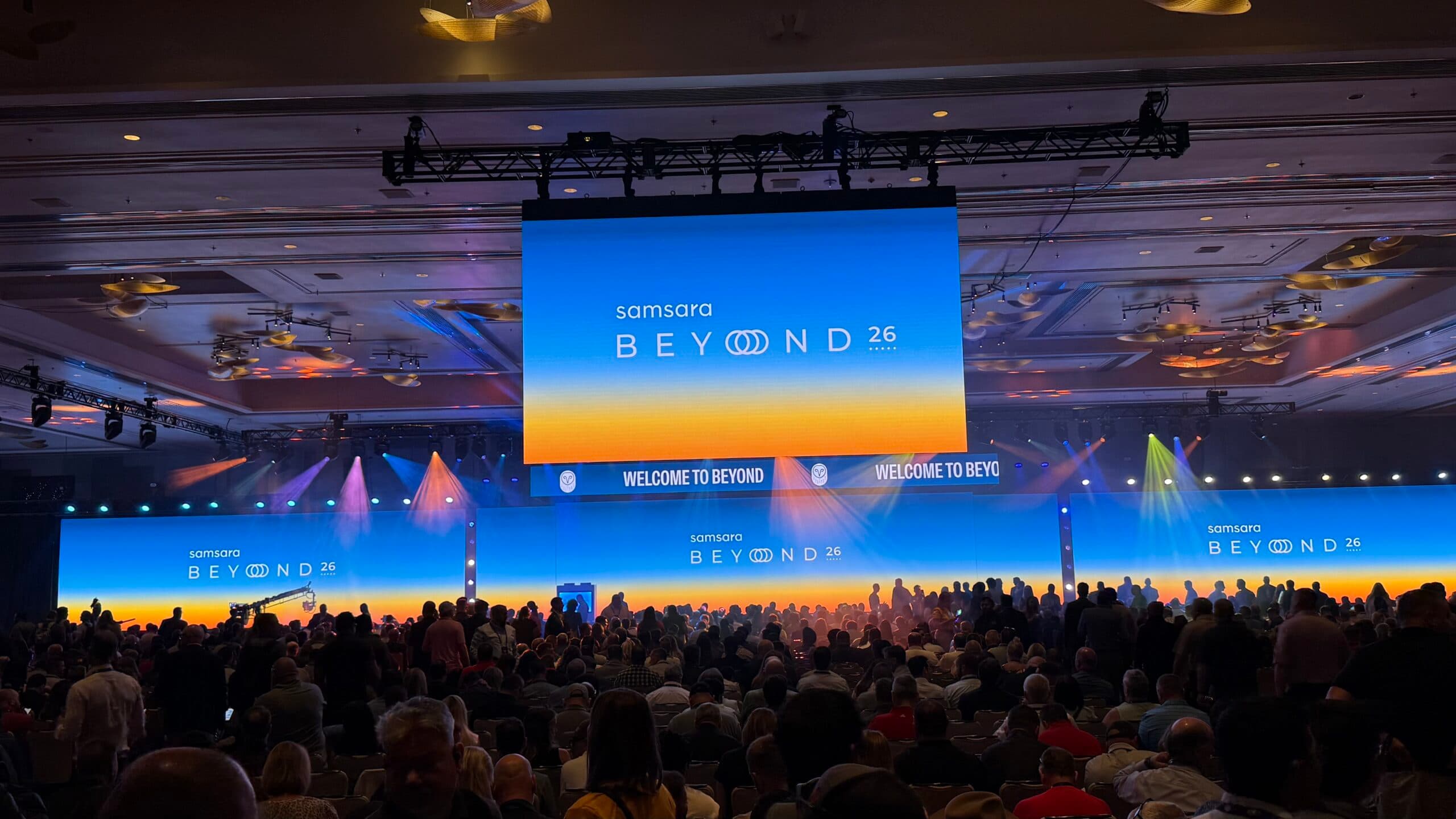
Between carrier scans at pickup and delivery, freight can travel hundreds of miles with zero real-time visibility. That dark window is precisely where cargo theft thrives. It is also exactly the problem that connected operations platform Samsara (NYSE: IOT) has set out to solve with a bold pair of product announcements made at its Beyond 2026 customer conference in Las Vegas.
Samsara Enters the Cargo Visibility Market With a New Tracking Label
At the center of Samsara's announcement is the Samsara Tracking Label — a single-use, adhesive-backed, paper-thin Bluetooth device designed to attach directly to a shipment and deliver near-real-time location updates throughout its journey. The product targets a specific and persistent blind spot that has long plagued supply chain operations: the gap between the moment a carrier picks up a package and the moment it arrives at its destination.
The Tracking Label is remarkably straightforward by design. It is flexible enough to adhere to a wide variety of package surfaces, contains no lithium or hazardous materials, and arrives ready for air, ground, and rail transport without any special clearance process. Once a shipment reaches its destination, the label can simply be thrown away — no special disposal required, no return logistics, no complexity.
Perhaps its most practical feature is a 45-day battery life, which means the label can sustain visibility across even long-haul or slow-moving shipments without running out of power before delivery is confirmed.
How the Samsara Network Powers Real-Time Tracking
The Tracking Label does not operate in isolation. Its effectiveness is driven by the scale of the Samsara Network — a vast, always-on infrastructure built from millions of connected devices deployed across trucks, trailers, buses, construction equipment, and warehouse scanners. This network covers 99% of major U.S. roads and extends into tens of thousands of worksites across the country.
As a labeled shipment moves through the supply chain, the Samsara Network continuously listens for the Bluetooth signal emitted by the label. Whenever a network-connected device comes within range, it logs the label's location and reports it back in near-real time. Critically, this process requires no involvement from the carrier. Shippers do not need to negotiate data-sharing agreements, integrate carrier APIs, or rely on third-party scan events to know where their freight is. The network simply picks up the signal wherever it appears.
This passive, infrastructure-driven approach is what makes the Tracking Label meaningfully different from existing asset tracking solutions. As David Gal, Samsara's vice president of connected equipment, explained during the Beyond 2026 keynote, the company's customers had already been using asset tags to monitor critical shipments — but those tools were never built with cargo in mind.
"Our customers have been using asset tags to track critical shipments, and that works, but it's not purpose-built for cargo," Gal said. "What they've been asking for is a label they can slap on a box and walk away. That's exactly what the Tracking Label is."
That simplicity is not accidental. It reflects a deliberate product philosophy: give operations teams something that requires virtually no learning curve, integrates into existing workflows without friction, and delivers actionable data without demanding technical overhead.
Agent Studio: AI Workflows Without the IT Bottleneck
Alongside the Tracking Label, Samsara also unveiled Agent Studio, a no-code platform that allows operations teams to build and deploy AI-powered workflows without needing to involve IT departments or write a single line of code. While the Tracking Label addresses the physical challenge of shipment visibility, Agent Studio targets the operational challenge of acting on data quickly and intelligently.
Supply chain and fleet operations generate enormous volumes of data every day — from vehicle telemetry and route performance to exception alerts and compliance documentation. Agent Studio is designed to let frontline operations teams configure automated workflows that respond to that data in real time, whether that means triggering an alert when a shipment deviates from its expected path, escalating a cargo exception to a supervisor, or generating a summary report at the end of a shift.
By removing the IT dependency from workflow creation, Samsara is betting that the people closest to operational problems — dispatchers, logistics coordinators, fleet managers — are best positioned to design the automated responses to those problems. Agent Studio gives them the tools to do exactly that.
Why This Moment Matters for Supply Chain Security
The timing of Samsara's announcement reflects growing urgency across the logistics industry. As cargo theft numbers climb and supply chains face mounting pressure to deliver both speed and reliability, the demand for granular, real-time visibility has never been higher. Traditional tracking methods — built around discrete carrier scan events — were designed for an era when freight moved more predictably and theft was a smaller systemic risk.
Today's environment is different. Organized cargo theft has grown more sophisticated, often exploiting the visibility gaps between scan points to intercept high-value shipments. Solutions that eliminate those gaps, rather than simply reporting on them after the fact, represent a genuine shift in how the industry can approach loss prevention.
A Practical Tool for a $35 Billion Problem
The Samsara Tracking Label is not a complex platform play. It is a simple, disposable piece of hardware backed by one of the largest connected device networks in North America. For shippers dealing with theft, spoilage, misrouting, or compliance requirements, the ability to attach a label to a box and track it in near-real time — without calling a carrier or deploying an IT project — represents a meaningful operational upgrade.
Combined with the no-code AI capabilities of Agent Studio, Samsara is positioning itself not just as a fleet management company but as a comprehensive connected operations platform capable of securing and automating the full arc of freight movement, from warehouse floor to final delivery.
With $35 billion on the line every year, the industry's appetite for exactly that kind of solution has rarely been greater.