
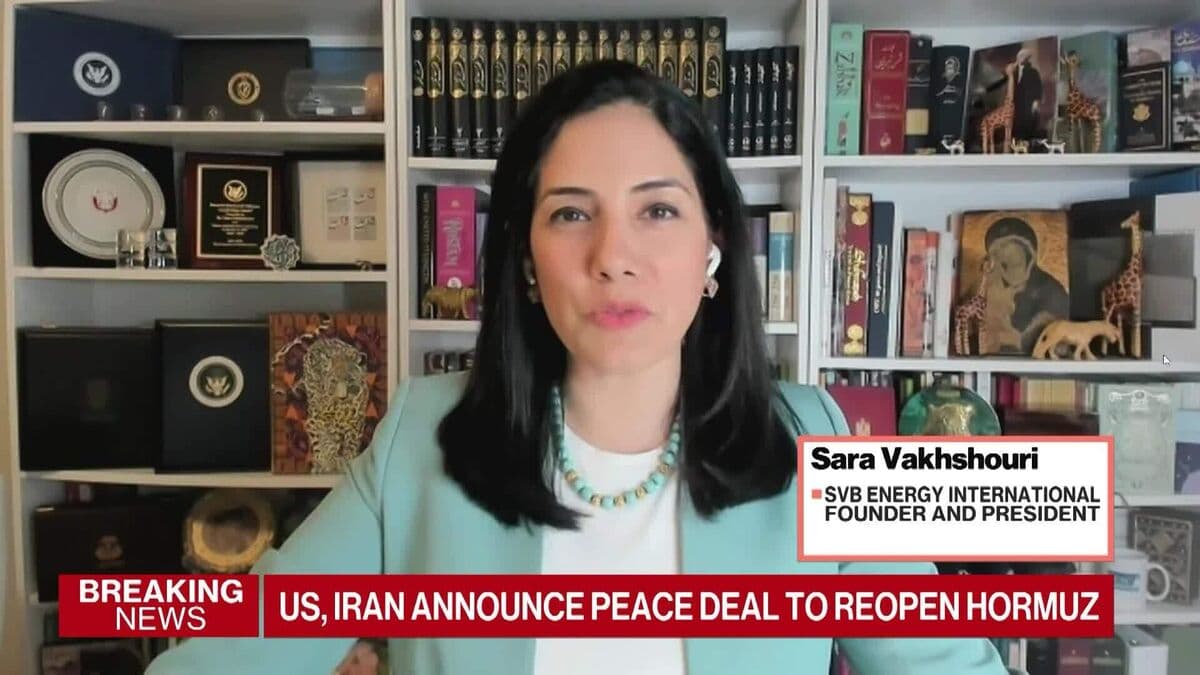
SVB Energy's Sara Vakhshouri on the Oil Price Outlook: Hormuz, Adaptation, and What Comes Next
Few voices in global energy analysis carry as much weight as Sara Vakhshouri, founder of SVB Energy International. In a recent appearance on Bloomberg's The China Show, hosted by David Ingles and Yvonne Man, Vakhshouri delivered a measured but consequential assessment of the oil market: after months of navigating disruption in the Strait of Hormuz, the market has largely adapted — and if the waterway truly reopens, prices could fall back to pre-war levels. That single observation carries enormous implications for energy traders, policymakers, and economies that depend on oil price stability.
Understanding the Strait of Hormuz's Role in Global Oil Supply
The Strait of Hormuz is one of the most strategically vital chokepoints in the world. Roughly 20% of the world's oil — and nearly a third of all liquefied natural gas — passes through this narrow stretch of water between Oman and Iran. Any significant disruption to traffic through the strait sends immediate shockwaves through global energy markets, pushing up crude oil benchmarks like Brent and WTI and raising fuel costs for consumers worldwide.
When geopolitical tensions in the Middle East escalate — as they have during the conflict that prompted Vakhshouri's commentary — the Strait of Hormuz instantly becomes the focal point of supply-risk calculations by traders, hedge funds, and national energy ministries. Historically, even the threat of disruption has been enough to trigger sharp upward movements in crude prices. The question Vakhshouri addresses, however, is not whether the disruption happened, but how durably the market has responded to it.
How the Oil Market Has Adapted to the Disruption
According to Vakhshouri, the oil market has shown a remarkable ability to absorb the shock. This kind of adaptation is not unprecedented. Over the past decade, energy markets have developed more sophisticated rerouting mechanisms, diversified supply chains, and expanded strategic petroleum reserves. Buyers who once depended heavily on Gulf flows have, over time, built relationships with alternative suppliers — from the United States and its shale boom to West African producers and Latin American exporters.
Several key dynamics have supported this adaptation:
- Supply diversification: Major oil-importing nations, particularly in Asia, have steadily broadened their supplier base, reducing their acute vulnerability to any single transit route.
- U.S. production growth: The continued expansion of American shale output has added a flexible, non-OPEC buffer to global supply, helping to cap price spikes that might otherwise have been far more severe.
- Strategic reserves deployment: Coordinated releases from the International Energy Agency (IEA) member nations and individual country reserves have historically blunted the immediate supply impact of geopolitical crises.
- Tanker rerouting: Shipping companies and national oil companies have, in some cases, adjusted routing strategies or accepted longer transit times to avoid the highest-risk corridors.
Together, these factors have meant that while the disruption has added a risk premium to oil prices, the market has not experienced the catastrophic supply shortage that a Hormuz closure would have caused in earlier decades. Vakhshouri's assessment reflects that underlying structural resilience.
The Price Outlook: Could Oil Return to Pre-War Levels?
Perhaps the most significant element of Vakhshouri's analysis is her forward-looking price call. She indicated that if the Strait of Hormuz "truly" reopens — a careful qualifier — oil prices could fall back to the levels seen before the conflict began. That word "truly" is doing a great deal of analytical work. It signals that a nominal or partial reopening, or one accompanied by ongoing uncertainty and the threat of renewed closure, would not be sufficient to fully remove the geopolitical risk premium embedded in current prices.
For oil to fully retrace to pre-war levels, the market would need to be convinced that the reopening is durable, verifiable, and not subject to rapid reversal. That requires not just physical clearance of the waterway but a broader de-escalation of the political and military tensions that caused the disruption in the first place. Energy markets trade not only on present supply and demand fundamentals but on forward expectations — and those expectations remain clouded as long as the underlying geopolitical drivers of risk have not been resolved.
From a price mechanics perspective, a confirmed and stable Hormuz reopening would likely trigger a swift unwinding of the war risk premium. Depending on the size of that premium — which analysts have estimated at anywhere from a few dollars to double digits per barrel during peak tension — the price correction could be sharp and fast.
What This Means for Energy Investors and Policymakers
Vakhshouri's commentary has practical implications across a wide range of stakeholders. For energy investors and traders, the key takeaway is directional: the downside risk to oil prices is real and potentially significant if geopolitical conditions improve, and portfolios should be positioned to account for a possible retracement rather than assuming a sustained elevated price environment.
For policymakers in oil-importing nations — including major Asian economies such as China, Japan, India, and South Korea, all of which are deeply exposed to Middle Eastern supply — Vakhshouri's analysis offers cautious optimism. Lower oil prices would ease inflationary pressure, reduce energy import bills, and provide some relief to current account balances that have been strained by elevated crude costs.
For OPEC+ producers, however, a fall to pre-war price levels would be unwelcome. Many Gulf producers have budgeted for oil revenues at price levels well above what pre-war benchmarks implied, and a significant price decline would put fiscal pressure on their national budgets and sovereign wealth fund contributions.
Sara Vakhshouri and SVB Energy International: A Trusted Voice on Oil Markets
Sara Vakhshouri is widely recognized as one of the foremost independent experts on Middle Eastern energy policy and global oil market dynamics. As the founder of SVB Energy International, she brings together deep regional knowledge of Iran, the Gulf states, and OPEC policy with rigorous market analysis. Her appearances on platforms like Bloomberg's The China Show reflect the premium that global financial media and institutional investors place on her assessments, particularly when geopolitical complexity makes standard supply-demand modeling insufficient.
Her commentary on the Strait of Hormuz is a reminder that understanding the oil market in periods of geopolitical stress requires more than reading inventory data or OPEC communiqués. It requires granular knowledge of regional political dynamics, shipping and logistics realities, and the behavioral economics of how markets price risk over time — all areas where Vakhshouri's expertise is widely acknowledged.
The Bottom Line
The oil market has shown genuine resilience in adapting to Strait of Hormuz disruption, but geopolitical risk premiums remain embedded in current prices. Sara Vakhshouri's assessment is clear: a true, durable reopening of the waterway would be a meaningful downside catalyst for crude oil prices, potentially returning them to pre-conflict levels. For anyone tracking the global energy landscape — from portfolio managers to energy ministers — that is a scenario worth preparing for, even as the conditions required to trigger it remain uncertain.