
Taiwan's Energy Crossroads: Sovereignty, Security, and Geopolitical Pressure
In an era defined by intensifying geopolitical rivalry, few places on Earth face energy challenges as complex and consequential as Taiwan. Caught between two competing superpowers — each advancing its own vision of global energy dominance — Taiwan must chart a course that keeps its lights on, its economy humming, and its political autonomy intact. The strategic goal for most countries is energy systems that are affordable and cannot be blocked or held hostage. For Taiwan, those stakes are existential.
Understanding how Taiwan navigates this tightrope requires examining both the geopolitical landscape and the island's unique energy vulnerabilities — and recognizing that the choices Taiwan makes today will shape its security and sovereignty for decades to come.
The Two Competing Energy Visions
The United States and China are not merely competing for military or economic supremacy — they are actively promoting rival frameworks for how the world should produce, distribute, and depend on energy. These frameworks carry profound implications for every country that must choose a side, align with both, or carefully avoid aligning with either.
The American Vision: Clean Energy Alliances and Supply Chain Reshoring
Washington's energy strategy increasingly revolves around building allied networks centered on clean technology, liquefied natural gas (LNG) exports, and the reshoring of critical supply chains away from China. Through mechanisms like the Inflation Reduction Act and its diplomatic outreach via the Indo-Pacific Economic Framework, the United States is encouraging partner nations to diversify away from Chinese energy infrastructure and technology — particularly in solar panels, batteries, and grid components where China currently dominates global manufacturing.
For Taiwan, aligning with this vision offers access to advanced clean energy technology partnerships and political goodwill from Washington. It also aligns with Taiwan's own democratic values and its existing deep integration into US-led semiconductor and technology ecosystems.
The Chinese Vision: Infrastructure Investment and Energy Dependency
China's approach is different in both method and ambition. Through the Belt and Road Initiative and its dominance of solar panel, wind turbine, and battery manufacturing, Beijing has positioned itself as the indispensable supplier of the world's energy transition. Chinese state-backed firms manufacture the majority of the world's solar modules, control significant shares of the rare earth minerals essential for clean energy, and are rapidly expanding overseas energy infrastructure investments.
For Taiwan, China's energy leverage is not merely economic — it is deeply intertwined with military and political pressure. The Taiwan Strait remains one of the world's most critical shipping lanes, and any conflict or blockade scenario would immediately threaten Taiwan's energy imports, the vast majority of which arrive by sea.
Taiwan's Energy Vulnerabilities
Taiwan is heavily dependent on imported energy. The island imports roughly 98 percent of its energy needs, primarily in the form of liquefied natural gas, coal, and oil. This extreme import dependency makes Taiwan exceptionally vulnerable to supply disruptions — whether caused by natural disaster, maritime conflict, or economic coercion.
Taiwan's decision to phase out nuclear power has added further complexity. The island's three remaining nuclear plants have faced political controversy for years, and the government under the Democratic Progressive Party has committed to a nuclear-free future. Critics argue this accelerates the island's fossil fuel dependency precisely at a moment when energy security should be paramount. Supporters counter that Taiwan's seismic activity and the risks of nuclear vulnerability during conflict make phaseout a prudent long-term move.
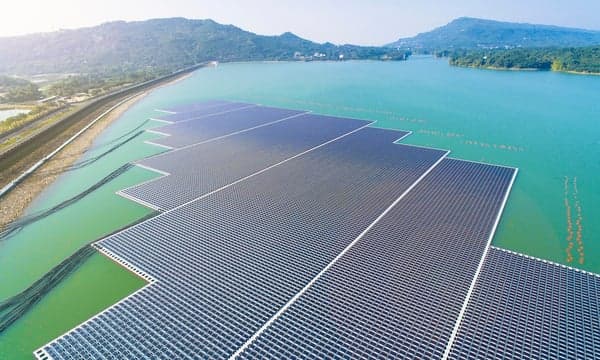
Against this backdrop, the pressure to expand renewable energy — particularly offshore wind and solar — has intensified. Taiwan sits in a geographic sweet spot for offshore wind development, and the government has set ambitious capacity targets designed to replace nuclear baseload and reduce fossil fuel imports over the coming decade.
Navigating Between Giants: Taiwan's Strategic Energy Choices
Taiwan's balancing act is visible in the specific choices it has made — and avoided — in building out its energy infrastructure.
- Offshore wind partnerships: Taiwan has deliberately prioritized European and American developers for its offshore wind sector, awarding major contracts to companies like Ørsted, Vestas, and wpd. This keeps Chinese firms out of critical energy infrastructure while building technical capacity and partnerships with democratic allies.
- Solar supply chain caution: Given China's dominance of global solar manufacturing, Taiwan faces a genuine dilemma. Procuring cheap Chinese solar panels accelerates the energy transition but risks embedding dependency on a geopolitical rival. Taiwan has been cautiously exploring diversification toward Southeast Asian and domestic manufacturers, though this comes at higher cost.
- LNG diversification: Taiwan has been expanding its LNG import capacity and diversifying suppliers, reducing reliance on any single source. New regasification terminals and floating storage units are part of a broader resilience strategy designed to ensure supply continuity even under partial disruption.
- Grid hardening and storage: Recognizing that any conflict scenario would target infrastructure, Taiwan is investing in grid resilience, distributed generation, and battery storage systems to reduce the impact of potential supply shocks.
The Broader Lesson Taiwan Teaches the World
Taiwan's energy dilemma is not unique — it is an accelerated, high-stakes version of a challenge facing dozens of countries worldwide. As the United States and China compete to define the architecture of the global energy transition, smaller nations are being forced to make choices with long-term strategic consequences that go far beyond economics.
The countries that build energy systems that are genuinely affordable, domestically resilient, and free from coercive dependency will be the ones that preserve the most meaningful sovereignty in the decades ahead. Taiwan understands this better than most. Its energy decisions are not simply about kilowatts and contracts — they are about survival, self-determination, and the ability to operate as a free society in an increasingly contested world.
Whether Taiwan can successfully thread this needle — harnessing the clean energy transition to build genuine resilience without deepening dangerous dependencies — will be one of the defining geopolitical energy stories of the coming decade. The world would do well to watch closely, and to learn from both Taiwan's successes and its difficult compromises along the way.