
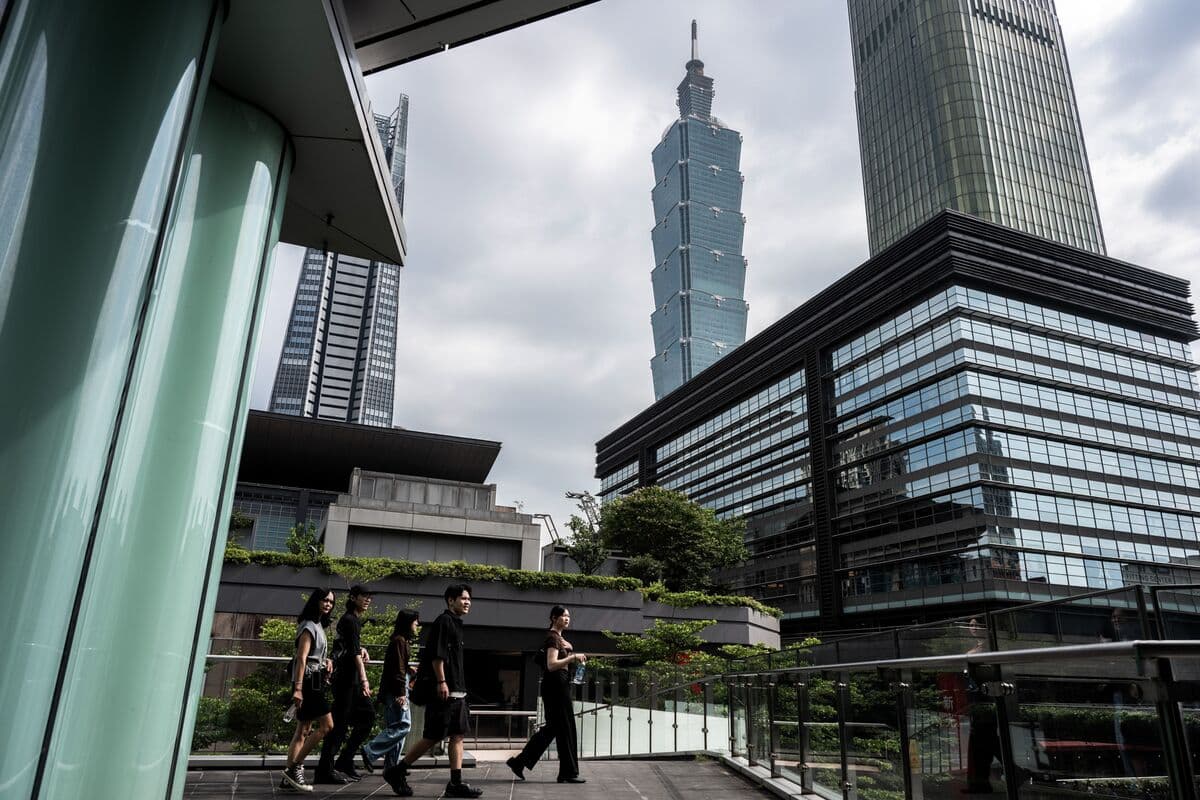
When FOMO Becomes a Financial Strategy: Taiwan's Debt-Driven AI Stock Boom
There is a phrase circulating among retail investors in Taiwan right now that speaks volumes about the current mood in financial markets: "FOMO really got me." It is not just a casual admission. For thousands of ordinary Taiwanese citizens, the fear of missing out has translated into a concrete financial decision — borrowing significant sums of money to invest in a stock market that has already surged by roughly 100%. At the center of it all is Taiwan Semiconductor Manufacturing Company (TSMC), the chipmaking giant riding a historic wave of artificial intelligence-driven demand. But as the rally grows more frenzied, economists and analysts are sounding a familiar and sobering alarm: this could be a bubble in the making.
The AI Boom and Its Epicenter in Taiwan
To understand why Taiwanese investors are taking such aggressive risks, you have to understand what TSMC represents — not just to Taiwan, but to the entire global technology ecosystem. TSMC manufactures the advanced semiconductors that power AI systems developed by companies like NVIDIA, Apple, and a growing roster of hyperscale cloud providers. As the world's insatiable appetite for AI computing continues to grow, so does demand for TSMC's chips, and so does its stock price.
Taiwan's benchmark index, the TAIEX, has reflected this enthusiasm dramatically. Fueled largely by TSMC's extraordinary performance, the index delivered returns that left global peers in the dust, effectively doubling from its recent lows and drawing in a flood of both institutional and retail capital. For everyday investors watching the numbers climb month after month, the psychological pull became nearly irresistible.
Borrowing to Invest: The Mechanics of Margin Debt in Taiwan
When sentiment turns euphoric, retail investors often resort to leverage — borrowing money to amplify their market exposure. In Taiwan, this takes the form of margin loans, a well-established but inherently risky mechanism that allows investors to buy more shares than their cash holdings would otherwise permit. The borrowed capital magnifies both gains and losses equally, creating a high-stakes dynamic that financial professionals typically warn against outside of very specific, carefully managed scenarios.
Reports indicate that margin debt in Taiwan's equity markets has climbed to levels that are raising eyebrows across the financial community. Brokerage firms have seen a surge in applications for margin accounts, and the volume of margin-financed stock purchases has expanded sharply alongside the broader rally. Many of the borrowers are not institutional traders with sophisticated risk frameworks — they are ordinary people, some of them first-time investors who have been drawn in by stories of neighbors, colleagues, and social media contacts making life-changing returns.
The Psychology Behind the Risk: Why FOMO Is So Dangerous
Fear of missing out is one of the most well-documented behavioral biases in finance. It causes investors to make decisions based not on rigorous analysis of value and risk, but on the emotional discomfort of watching others appear to profit while they stand on the sidelines. In a bull market supercharged by a genuine technological revolution — the rise of AI — that psychological pressure intensifies considerably, because the underlying narrative feels both real and urgent.
This is precisely what makes the current situation in Taiwan so precarious. The AI boom is not fiction. TSMC genuinely is benefiting from structural demand tailwinds that could persist for years. But the price at which investors are buying into that story matters enormously. Paying a high premium for a real trend, especially with borrowed money, leaves investors dangerously exposed when sentiment shifts, valuations correct, or macroeconomic conditions change unexpectedly.
Warning Signs: Are We Watching a Bubble Form?
Several indicators suggest the market may be moving beyond rational exuberance into speculative territory. Among the key concerns analysts have flagged:
- Soaring margin debt levels that historically precede sharp market corrections when confidence falters and lenders issue margin calls.
- Retail participation spikes driven by social proof rather than fundamental research, often a late-cycle signal in bull markets.
- Concentration risk stemming from an outsized dependency on a single sector — semiconductors — and, within that, a single dominant company.
- Valuation expansion that has outpaced even the strong earnings growth reported by leading companies, compressing the margin of safety for new investors.
History offers cautionary precedents. The dot-com bubble of the late 1990s, Japan's asset price bubble of the 1980s, and the U.S. housing crisis of the mid-2000s all shared common threads: a genuine underlying trend, widespread public participation, and the aggressive use of borrowed money to chase returns. None of these historical parallels guarantee that Taiwan's market will collapse, but they do underscore why the current conditions warrant serious caution.
What Could Trigger a Reversal?
Markets fueled by leverage are inherently fragile. A reversal in Taiwan's AI-driven rally could be sparked by a range of catalysts, including a slowdown in global AI infrastructure spending, geopolitical tensions involving Taiwan and its semiconductor supply chain, a broader global risk-off shift triggered by rising interest rates or recession fears, or simply a technical correction following an extended period of outsized gains. When margin debt is elevated and prices are stretched, even modest negative news can trigger a cascade of forced selling as investors scramble to meet margin calls, amplifying the downside far beyond what fundamentals alone would justify.
The Bigger Picture: What Taiwan's Market Tells Us About Global AI Sentiment
Taiwan's debt-fueled stock rally is not happening in a vacuum. It is a local manifestation of a global phenomenon — the extraordinary enthusiasm surrounding artificial intelligence and the companies positioned at the heart of its infrastructure. From Wall Street to Tokyo to Taipei, markets have priced in enormous expectations for AI's transformative economic impact. The question that investors everywhere must ask themselves is whether current prices adequately reflect the risks alongside the rewards — or whether the narrative has, for now, simply overwhelmed the numbers.
For Taiwanese retail investors who have borrowed to ride this wave, that question carries urgent personal consequences. The rally may continue, and some will profit handsomely. But markets do not reward courage alone. They reward discipline, patience, and an honest reckoning with risk — none of which tend to accompany the phrase "FOMO really got me."