
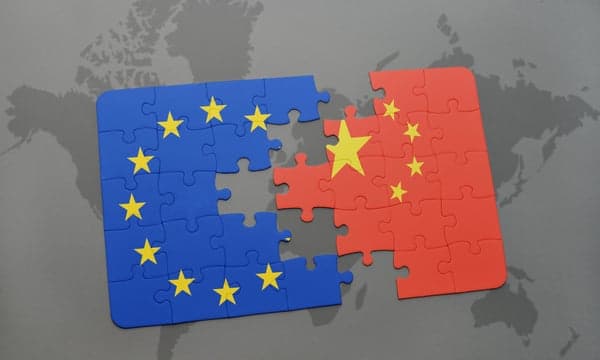
The Structural Limits of the EU's China Policy
The European Union's approach to China has never been simple. For years, European policymakers have toggled between economic pragmatism and geopolitical caution, struggling to define a coherent posture toward the world's second-largest economy. The European Council's latest policy mandate appears to crystallize that tension rather than resolve it — pairing diplomatic dialogue with an expanding set of trade defense tools that, taken together, signal a relationship institutionally wired for friction. Understanding why this approach carries structural limits is essential for anyone tracking EU-China relations, European trade policy, or the broader reshaping of the global economic order.
A Mandate Built on Contradictions
At its core, the European Council's latest directive attempts to hold two incompatible impulses in balance. On one hand, Brussels reaffirms its commitment to high-level dialogue with Beijing — a recognition that the EU and China are deeply interdependent trading partners, with bilateral trade volumes running into the hundreds of billions of euros annually. On the other hand, the same mandate endorses the development and potential deployment of new trade defense instruments specifically designed to counter what European officials describe as unfair Chinese economic practices.
This dual-track logic is not new in EU foreign economic policy. Versions of it have governed the bloc's relationships with other complex partners. But with China, the stakes are considerably higher, and the contradictions considerably harder to paper over. When a trade defense tool is institutionalized — when it moves from ad hoc measure to standing policy infrastructure — it sends a signal that transcends any individual dispute. It tells Beijing, and the world, that Brussels views structural economic confrontation as a permanent feature of the relationship rather than a temporary corrective.
That signal has consequences. Chinese officials and state media have consistently framed European trade defense actions as protectionism dressed in the language of fairness. Each new mechanism gives Beijing additional rhetorical and diplomatic ammunition to portray the EU as an unreliable partner — one that talks of cooperation while systematically building barriers.
Why "De-Risking" Is Easier Said Than Done
The EU has adopted the term "de-risking" to describe its ambition of reducing strategic dependencies on China without fully decoupling. It is a carefully chosen word, designed to distinguish European policy from the harder-edged American approach. But in practice, de-risking faces its own structural limits.
European supply chains are deeply entangled with Chinese manufacturing, rare earth production, and intermediate goods. Key sectors — from electric vehicles and batteries to solar panels and pharmaceuticals — rely on Chinese inputs at multiple stages of production. Unwinding those dependencies takes years and requires investment on a scale that EU member states have struggled to coordinate. Meanwhile, China's own industrial policy has accelerated, expanding its competitive advantage in precisely the sectors where European firms most want to compete.
This creates a paradox: the more aggressively the EU pursues de-risking, the more it disrupts short-term economic interests; the more cautiously it proceeds, the less effective the de-risking becomes. There is no clean policy path through this terrain, and the latest mandate does not pretend otherwise. Instead, it institutionalizes the ambiguity — which may be politically sustainable in Brussels but is strategically unsatisfying for businesses, member states, and partner governments trying to read where Europe is headed.
Member State Divergence and the Cohesion Problem
One of the most underappreciated structural limits of EU China policy is the persistent divergence among member states. The bloc's 27 members bring vastly different economic exposures, historical relationships, and geopolitical orientations to any conversation about China. Germany's export-dependent industrial economy views the Chinese market differently than Poland's security-focused strategic calculus, which in turn differs from Hungary's openly China-friendly posture under Viktor Orbán.
This divergence means that any EU-wide policy on China is, almost by definition, a negotiated compromise — one that must be broad enough to accommodate competing national interests. The result tends to be frameworks that sound robust at the headline level but allow considerable flexibility in implementation. Trade defense tools can be adopted in principle while being applied selectively in practice. Dialogue can be endorsed while individual member states pursue bilateral arrangements that cut across the common position.
Beijing is acutely aware of this dynamic and has historically exploited it, cultivating bilateral relationships with individual European governments as a way of diluting EU-level pressure. The latest mandate does not fundamentally alter that calculus.
The Long-Term Strategic Question
What the European Council's mandate ultimately reveals is that the EU has not yet answered the most fundamental strategic question in its China policy: is Beijing primarily a partner to be engaged, a competitor to be managed, or a systemic rival to be countered? EU documents have used all three framings simultaneously since at least 2019 — and the new mandate continues that tradition.
This ambiguity has served a purpose. It has allowed the EU to maintain economic relationships while building political and regulatory defenses, buying time as the geopolitical landscape shifts. But it comes at a cost. Without a clear long-term orientation, European businesses face investment uncertainty, member states continue to freelance, and China retains the initiative in defining the terms of the relationship.
What Comes Next
The institutionalization of trade defense tools within the EU's China framework is not, by itself, a crisis. It is a rational response to genuine economic grievances and legitimate concerns about market distortions. But rationality at the instrument level does not guarantee coherence at the strategic level. For EU China policy to move beyond its structural limits, European policymakers will eventually need to make harder choices — about values, about economic interests, and about the kind of global order they are trying to build.
Until those choices are made explicitly, the EU's China policy will remain what it has long been: a sophisticated hedge in search of a strategy.