
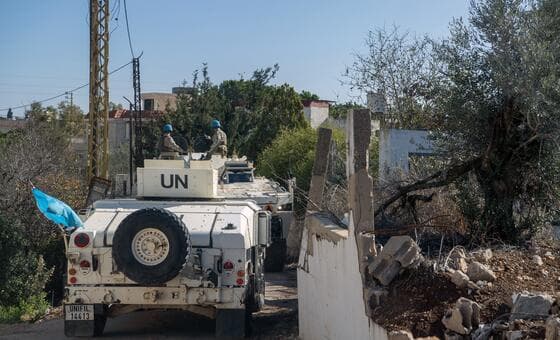
UN Reaffirms Freedom of Movement for Peacekeepers in Lebanon
The United Nations has once again issued a firm call for the unrestricted freedom of movement for its peacekeeping forces stationed in Lebanon. The appeal comes as the UN Interim Force in Lebanon, widely known as UNIFIL, continues its critical mission of monitoring developments in the country's volatile southern region. The situation has gained renewed urgency in the wake of a provisional agreement recently signed between the United States and Iran — a diplomatic milestone that carries significant implications for Lebanon's fragile security landscape.
This latest statement from the United Nations underscores the organization's long-standing commitment to ensuring that its peacekeepers can operate without obstruction, a principle that is not only essential to the effectiveness of the mission but also enshrined in international law and the mandate established under UN Security Council Resolution 1701.
What Is UNIFIL and Why Does It Matter?
UNIFIL, the United Nations Interim Force in Lebanon, was originally established in 1978 following Israel's invasion of southern Lebanon. Its mandate was significantly expanded in 2006 after the conflict between Israel and Hezbollah, tasking the force with monitoring the cessation of hostilities, supporting the Lebanese Armed Forces, and helping ensure that southern Lebanon would not be used as a launching ground for attacks against neighboring states.
Today, UNIFIL comprises approximately 10,000 troops from more than 40 contributing nations. The force operates along the Blue Line — the boundary demarcated by the United Nations between Lebanon and Israel — and plays a pivotal role in maintaining a semblance of stability in one of the Middle East's most sensitive corridors. Without the ability to move freely and carry out patrols, UNIFIL's capacity to fulfill this mandate is fundamentally compromised.
The Significance of Freedom of Movement
Freedom of movement is not a bureaucratic formality — it is the operational backbone of any UN peacekeeping mission. When peacekeepers are blocked, harassed, or prevented from accessing certain areas, it creates dangerous blind spots in conflict monitoring and opens the door to unchecked escalation.
In recent years, UNIFIL personnel in southern Lebanon have faced recurring incidents in which their patrols were obstructed or their vehicles were blocked by local groups. These incidents have drawn sharp condemnation from the United Nations and from troop-contributing nations alike. The UN's reiteration of its demand for freedom of movement reflects ongoing frustration with conditions on the ground and a determination to hold all parties accountable to their obligations under international agreements.
The ability of peacekeepers to move without restriction allows them to:
- Monitor ceasefire lines and report violations in real time
- Gather credible, impartial information about military buildups or movements
- Deter provocations through a visible and active presence
- Respond quickly to incidents that could spiral into broader conflict
- Build trust between communities on both sides of the Blue Line
How the US-Iran Provisional Agreement Changes the Equation
The recently signed provisional agreement between the United States and Iran has injected a new variable into Lebanon's already complex security environment. While the full details of the accord continue to be analyzed by regional observers, its potential impact on Iran-backed groups operating in Lebanon — most notably Hezbollah — is a matter of intense speculation and concern.
Iran has long been the primary patron of Hezbollah, providing the group with funding, weapons, and political direction. Any shift in the relationship between Washington and Tehran therefore reverberates across the Lebanese political and security landscape. If the agreement leads to a reduction in regional tensions, it could create conditions more favorable to UNIFIL's mission. However, analysts caution that interim deals can also produce instability during transitional periods, as armed actors recalibrate their strategies and test boundaries.
The United Nations is clearly monitoring these developments with great care. By reaffirming the freedom of movement for its peacekeepers at this particular moment, the UN is sending a clear signal to all parties: regardless of shifting diplomatic winds, the international community's commitment to maintaining stability in southern Lebanon remains firm and non-negotiable.
International Responsibility and the Path Forward
The effectiveness of UNIFIL ultimately depends on the cooperation of all parties on the ground — the Lebanese government, the Lebanese Armed Forces, Israel, and armed non-state actors. The United Nations has repeatedly stressed that all stakeholders bear a responsibility to respect the mission's mandate and to refrain from any actions that impede peacekeeping operations.
Troop-contributing countries have also been increasingly vocal about the conditions their personnel face. Several nations have issued formal protests following incidents in which their soldiers were harassed or threatened, and some have warned that persistent violations of UNIFIL's freedom of movement could force a reassessment of their participation in the mission. This is a prospect the United Nations — and the broader international community — is eager to avoid.
Conclusion: Stability in Lebanon Requires Unimpeded Peacekeeping
Southern Lebanon remains one of the most closely watched flashpoints in the Middle East. As diplomatic processes unfold between major powers and regional actors navigate new realities, the work of UNIFIL peacekeepers on the ground becomes more important, not less. Their ability to move freely, observe impartially, and report accurately is a cornerstone of any credible international effort to prevent renewed conflict.
The United Nations' firm stance on freedom of movement is not merely a procedural demand — it is a declaration that the international community will not allow its peacekeeping missions to be rendered ineffective by obstruction or intimidation. Sustainable peace in Lebanon requires that all parties honor this principle, and the UN has made clear that it will continue to press that case without hesitation.