
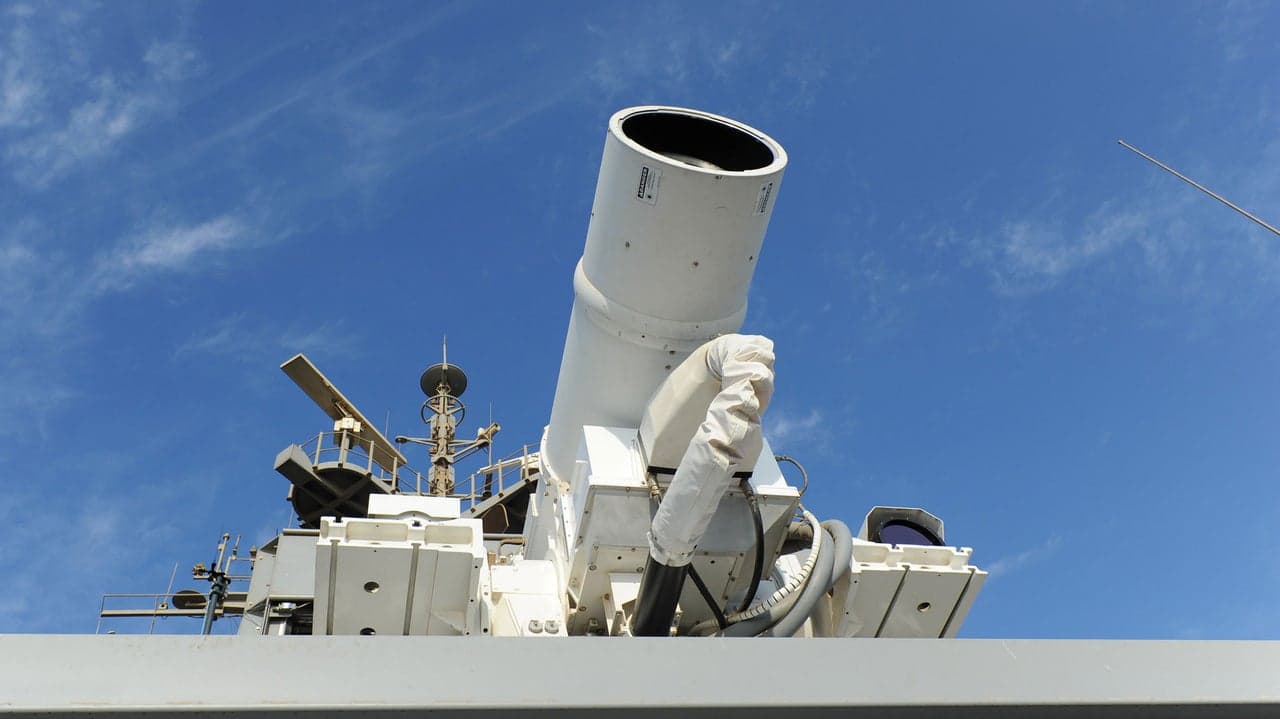
The Laser Threat the U.S. Military Can No Longer Ignore
For decades, the United States military has poured billions of dollars into developing high-energy laser weapons capable of incinerating enemy drones from miles away. The logic was straightforward: lasers are fast, precise, and cheap to fire compared to conventional missiles. But there has always been a glaring blind spot in this strategy. While the U.S. was busy building laser weapons to shoot down adversaries' drones, it was spending far less time and money figuring out what happens when someone points a laser right back.
That blind spot is now becoming impossible to ignore. China has assembled a rapidly expanding arsenal of military laser weapons reportedly capable of destroying drones at ranges of up to 25 kilometers. Russia's Peresvet laser system is reported to be in active service. And laser technology is spreading globally through indigenous development programs, international proliferation, and a fast-growing export market. The era of directed energy warfare is no longer a distant future scenario — it is unfolding right now, and U.S. drones are squarely in the crosshairs.
What Are Counter-Directed Energy Weapons?
The U.S. military's formal answer to this emerging threat carries a specific name: counter-directed energy weapons, or CDEW. As the name suggests, CDEW encompasses the strategies, technologies, and systems designed to detect, defeat, or survive attacks from enemy laser weapons and other directed energy systems.
It is still a nascent field. No dedicated CDEW system is publicly known to have been operationally fielded by U.S. forces, and the majority of research and development work in this area remains at the conceptual or early experimental stage. However, the seriousness with which the military is now approaching the problem is becoming increasingly apparent. The Office of Naval Research maintains a dedicated program area covering directed energy weapons and counter-directed energy capabilities, signaling institutional recognition that defense against laser threats demands structured investment.
A landmark 2023 study published in the Journal of Directed Energy by researchers at the U.S. Naval Postgraduate School (NPS) provided one of the clearest public snapshots yet of what defending against a laser weapon actually looks like in practice. The research examined the physical and engineering challenges involved in protecting drone platforms from high-energy laser attack, and began to define what a viable CDEW architecture might require.
How Lasers Destroy Drones — and Why Defense Is So Difficult
Understanding why counter-directed energy weapons are so challenging to develop requires understanding how lasers kill drones in the first place. A high-energy laser weapon works by focusing an intense beam of light onto a target, depositing thermal energy faster than the material can dissipate it. Within seconds — or even fractions of a second at close ranges — critical components such as sensors, electronics, structural airframe sections, or fuel systems can be damaged or destroyed entirely.
The attack happens at the speed of light, giving the targeted drone virtually no reaction time. There is no incoming missile to detect on radar, no projectile with a ballistic arc to calculate. The beam arrives and the damage begins simultaneously. This makes CDEW fundamentally different from defending against conventional kinetic threats, and it is a primary reason why the field has lagged behind offensive laser development.
Effective defense against a laser attack generally falls into a few broad categories, each with its own engineering trade-offs.
- Hard kill avoidance: Maneuvering the drone out of the laser's field of engagement, either through autonomous evasion algorithms or rapid repositioning. This requires advanced threat detection systems capable of identifying a laser lock in real time — itself a significant technical challenge.
- Active or passive shielding: Applying specialized coatings, materials, or structural designs to the drone's exterior that reflect, scatter, or absorb laser energy without allowing it to penetrate to critical systems. Highly reflective surfaces can dramatically reduce the energy deposited by a laser beam, but maintaining that reflectivity under operational conditions is a persistent engineering problem.
- Redundant and hardened electronics: Designing drone systems so that sensors and avionics can survive short-duration laser exposure or can fail gracefully without causing a catastrophic loss of the platform.
- Threat warning systems: Equipping drones with laser warning receivers (LWRs) that can detect when a directed energy weapon has locked onto the platform, triggering automated defensive responses.
The Global Race That Is Forcing U.S. Action
The urgency behind CDEW development is not happening in a vacuum. China's military laser program has advanced with remarkable speed, and Chinese-designed systems are increasingly available on the international arms market. Several nations across the Middle East, Asia, and beyond have acquired or are actively pursuing domestic laser weapon programs. The result is a global proliferation of directed energy threats that U.S. drone operators could encounter in virtually any future conflict theater.
Russia's Peresvet system adds another dimension to the threat landscape. Though details about its full capabilities remain classified or disputed, its reported active deployment means U.S. platforms operating near Russian forces in contested regions must already account for the possibility of laser attack.
For U.S. military planners, this creates a sobering strategic reality. Drones have become central to modern warfare — used for reconnaissance, strike missions, logistics, communications relay, and electronic warfare. Losing them to cheap, reusable laser shots would represent both a tactical and economic asymmetry that adversaries are clearly working to exploit.
What Comes Next for CDEW Development
While the field remains young, there are clear signals that the U.S. military is beginning to take counter-directed energy weapons seriously as a standalone discipline rather than an afterthought. The Naval Postgraduate School research represents the kind of foundational academic work that typically precedes formal acquisition programs. Defense contractors with expertise in survivability, coatings technology, and electronic warfare are well-positioned to play a central role as requirements mature.
The broader lesson is one of strategic symmetry. Laser weapons do not exist in isolation — every offensive directed energy capability that a nation deploys implicitly creates a defensive requirement for every potential adversary. The U.S. spent decades building the sword. Now, as the shield becomes just as critical, counter-directed energy weapons are moving from the margins of defense research toward the center of military planning for the drone-dominated conflicts of the near future.