
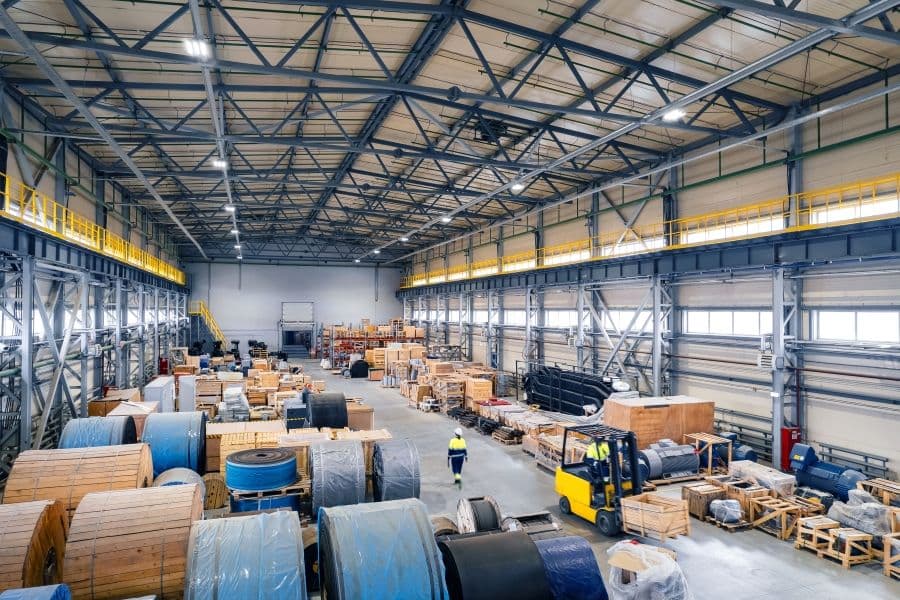
US Warehousing Is Expanding Fastest at Key Inland Hubs — Here's Why
Something significant is happening beneath the surface of the American logistics landscape. While coastal port markets have long dominated the conversation around industrial real estate, a new wave of warehouse demand is quietly reshaping the heartland. Vacancy rates at key inland distribution hubs — most notably Chicago and Indianapolis — are falling at an accelerated pace, driven by a powerful combination of import frontloading strategies and surging data center construction. For businesses that rely on supply chain efficiency, understanding this shift is no longer optional. It is essential.
The Rise of Inland Warehousing as a Strategic Priority
For decades, the logic of warehouse placement leaned heavily toward coastal proximity. Being close to ports like Los Angeles, Long Beach, or New York meant faster access to incoming goods and quicker turnaround times. That calculus is changing. Inland hubs now offer something coastal markets increasingly cannot: affordable space, room to scale, and multimodal transport connectivity that ties rail, road, and air freight together in ways that optimize both cost and speed.
Chicago and Indianapolis sit at the center of this realignment. Chicago's position as North America's largest rail hub makes it a natural consolidation point for goods moving from both coasts into the broader Midwest and beyond. Indianapolis, meanwhile, has emerged as one of the most strategically located distribution cities in the country, within a single day's drive of roughly 80 percent of the US population. These geographic advantages have always existed — but current market pressures are finally turning latent potential into measurable real estate activity.
Import Frontloading: The Demand Surge Driving Vacancy Down
One of the most significant forces behind the warehousing boom at inland hubs is the practice of import frontloading — the deliberate acceleration of goods shipments into the United States ahead of anticipated tariff increases, trade policy changes, or supply chain disruptions. This is not a new concept, but it has become a defining feature of inventory strategy for a wide range of importers over the past several years, and it shows no signs of slowing down.
When businesses frontload imports, they need somewhere to store the goods they have pulled forward. Port-adjacent facilities are often the first to fill up, pushing demand inland. Retailers, manufacturers, and third-party logistics providers have responded by securing industrial space in secondary and tertiary markets — and inland powerhouses like Chicago and Indianapolis are absorbing much of that overflow.
The result is a steady tightening of available industrial space. Vacancy rates in these markets have been falling for consecutive quarters, with available Class A warehouse space becoming particularly scarce. Asking rents have responded accordingly, rising in step with shrinking supply. For tenants who delayed their search, the window for securing favorable lease terms is closing fast.
Data Center Construction: An Unexpected Catalyst for Industrial Real Estate
Alongside the logistics story, a parallel development is reshaping industrial land use: the explosive growth of data center construction. The artificial intelligence boom, cloud computing expansion, and the increasing digitization of nearly every sector of the economy have created an insatiable appetite for large-footprint, power-intensive facilities.
Inland markets have become prime targets for data center development for several reasons. They offer lower land costs compared to gateway cities, access to power infrastructure that can be scaled to meet enormous energy demands, and a lower risk profile for natural disasters relative to some coastal regions. The presence of fiber optic networks, cooling resources, and skilled labor pools in markets like Chicago and the broader Midwest corridor adds further appeal.
The connection to warehousing vacancy rates is direct. Data center projects compete with logistics tenants for industrial-zoned land. As developers acquire parcels for hyperscale facilities, the pool of available sites suitable for conventional warehouse use shrinks. This competition is accelerating vacancy declines in ways that pure logistics demand alone would not produce.
What This Means for Logistics Operators and Supply Chain Planners
The tightening of industrial real estate at inland hubs carries concrete implications for any business that moves physical goods through the American market.
- Lease decisions need to happen sooner. Waiting for market conditions to soften before committing to space is a strategy that is becoming increasingly costly. Markets that showed flexibility even two years ago are now operating with much less room for negotiation.
- Multi-hub strategies are worth revisiting. Businesses that have historically concentrated distribution in one or two locations may find resilience in diversifying across several inland nodes. Indianapolis, Columbus, Memphis, and Kansas City each offer distinct connectivity advantages that can complement a Chicago anchor.
- Build-to-suit may become a more viable path. As existing inventory tightens, companies with sufficient scale and certainty about their footprint may find that commissioning a new facility offers better long-term economics than competing for shrinking leasable space.
- Rate environments deserve close attention. Asking rents at Class A inland facilities are rising, but they remain meaningfully below coastal equivalents. Companies benchmarking total occupancy cost should account for transportation savings when evaluating the economics of an inland location.
The Broader Signal for Industrial Real Estate Investors
For capital allocators watching the industrial real estate sector, the inland hub story represents one of the more compelling structural narratives in the current market cycle. Unlike some previous demand spikes that were driven by short-term inventory panic — the pandemic stockpiling era being the clearest example — today's demand appears to rest on more durable foundations. Frontloading behavior reflects genuine uncertainty about the long-term trade policy environment, and data center demand is driven by secular technology adoption trends that carry multi-decade momentum.
Markets like Chicago and Indianapolis have historically traded at a discount to coastal counterparts on a per-square-foot basis. That discount is narrowing. Investors who move early, particularly in well-located submarkets with strong transport infrastructure, stand to benefit as the repricing continues.
Looking Ahead: Inland Hubs Are Not a Temporary Story
The expansion of warehousing capacity at US inland hubs is not a short-cycle correction or a speculative bubble. It reflects deeper structural changes in how American businesses think about inventory, supply chain risk, and the geographic distribution of operational assets. The combination of import frontloading, data center competition, and sustained e-commerce fulfillment demand has created a demand environment that inland markets were uniquely positioned to absorb — and they are doing so at a pace that is surprising even seasoned observers of the industrial real estate sector.
For logistics operators, retailers, manufacturers, and investors alike, the message from Chicago, Indianapolis, and the broader inland corridor is the same: the center of gravity in American warehousing is shifting, and the time to act on that insight is now.