
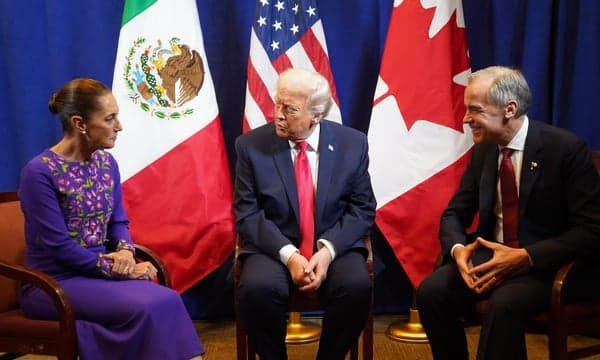
The USMCA Review Is Coming — and China Is at the Center of It
When the United States-Mexico-Canada Agreement (USMCA) comes up for its scheduled review in 2026, the conversation will be about far more than tariff schedules and rules of origin. It will be, at its core, a test of whether Mexico has truly committed to a North American-first trade posture — or whether it remains, in the eyes of Washington, a convenient back door for Chinese goods and investment to enter the U.S. market duty-free.
The stakes could not be higher. For Mexico, the USMCA is the backbone of its export economy. For the United States, the review is an opportunity to demand concrete assurances that preferential trade access is not being used to circumvent the sweeping tariffs Washington has placed on Chinese imports. And for China, Mexico represents one of the most strategically valuable manufacturing corridors in the Western Hemisphere.
Understanding this three-way tension is essential for any business, investor, or policymaker trying to anticipate how North American trade will evolve over the next decade.
Why Washington Is Worried About the "China Backdoor"
The concern from the U.S. side is straightforward, even if the solution is not. American officials have watched with growing unease as Chinese companies, facing steep tariffs on exports to the United States, have rushed to establish or expand manufacturing operations in Mexico. By producing goods in Mexico — even partially — Chinese firms can potentially qualify those products for preferential USMCA treatment, effectively sidestepping the tariff walls Washington spent years building.
This phenomenon is not hypothetical. Investment flows from China into Mexico have accelerated noticeably since the first round of U.S.-China trade tensions began in 2018. Industrial parks in states like Nuevo León, Coahuila, and Querétaro have attracted Chinese manufacturers across sectors including electronics, automotive components, textiles, and solar panels. From Washington's perspective, this is exactly what the rules-of-origin provisions in USMCA were designed to prevent — and exactly what the review process needs to address.
U.S. lawmakers and trade officials have been increasingly vocal about demanding that Mexico demonstrate measurable progress in reducing the Chinese footprint in its export supply chains. Some have floated the idea of stricter content requirements, enhanced verification mechanisms, or even sector-specific carve-outs that would deny USMCA benefits to goods with significant Chinese-origin components.
Mexico's Dilemma: Nationalism Meets Supply Chain Reality
Mexico's government faces a genuinely difficult balancing act. On one hand, Mexican officials understand that the country's continued preferential access to the American market — the destination for roughly 80 percent of Mexico's exports — depends on maintaining Washington's goodwill heading into the review. On the other hand, the structural realities of Mexican manufacturing make a rapid decoupling from Asian inputs deeply impractical.
The problem is embedded in the production lines themselves. Mexico's export industries, from automobiles to appliances to electronics, rely heavily on components sourced from Asia — and from China in particular. Semiconductors, display panels, lithium batteries, precision fasteners, specialty chemicals: these are not goods that Mexico produces at scale domestically, and alternative suppliers in North America either do not exist or cannot yet meet demand in terms of volume, specification, or price.
Telling Mexican manufacturers to simply swap out their Chinese inputs for American or Canadian ones is, in many cases, telling them to produce goods that either do not exist in North America or cost dramatically more. That equation ultimately affects the competitiveness of finished products sold into the U.S. market — which is a problem for American consumers and businesses as much as it is for Mexican exporters.
Nearshoring's Double-Edged Promise
The nearshoring boom that has brought billions of dollars in foreign direct investment to Mexico over the past several years adds another layer of complexity. Global companies — including many American firms — have relocated or expanded manufacturing in Mexico precisely because it offers competitive labor costs, geographic proximity to the U.S. market, and USMCA preferential access. This has been widely celebrated as a win for North American economic integration.
But not all of that nearshoring investment is American, European, or Japanese. A meaningful share comes from Chinese companies doing exactly what critics fear: using Mexican soil as a platform to serve the U.S. market while minimizing exposure to tariffs. Distinguishing between legitimate nearshoring that deepens North American value chains and strategic tariff circumvention is technically and politically complicated — yet that distinction is precisely what U.S. negotiators will demand Mexico make credibly during the review process.
What Mexico Needs to Do Before the Review
If Mexico wants to emerge from the USMCA review with its preferential access intact and its relationship with Washington strengthened, it will need to move beyond rhetoric and demonstrate concrete policy actions. Several priorities stand out.
- Stronger enforcement of rules of origin: Mexico must invest in customs and verification capacity to ensure that goods claiming USMCA benefits genuinely meet content requirements, and that Chinese-origin inputs are accurately declared and accounted for.
- Transparency around Chinese investment: Publishing clearer data on the origin of foreign direct investment, the sectoral distribution of Chinese-linked manufacturing, and the supply chain composition of key export industries would help establish credibility with U.S. counterparts.
- Domestic supply chain development: Mexico needs a credible medium-term strategy for developing domestic or North American sources for critical inputs, reducing dependency on Asian suppliers over time even if full substitution is not immediately feasible.
- Diplomatic clarity: Mexican officials will need to articulate clearly and consistently that the country's economic future lies within the North American framework — without unnecessarily antagonizing China, which remains an important trade and investment partner in its own right.
The Broader Geopolitical Stakes
The USMCA review is arriving at a moment when the broader contest between Washington and Beijing for economic influence is intensifying on every continent. Latin America, and Mexico in particular, has become a front line in that contest. How Mexico navigates the review will send a signal not only to the United States and China, but to every multinational corporation currently deciding where to place its next factory, its next logistics hub, or its next R&D center.
A Mexico that emerges from the review with its USMCA access secured and its credibility with Washington enhanced will be positioned to attract a new generation of genuinely North American-oriented investment. A Mexico that stumbles — either by failing to satisfy U.S. concerns or by alienating Chinese partners without building alternative economic relationships — risks finding itself caught between two superpowers with neither fully on its side.
The USMCA review is, in the end, much more than a trade negotiation. It is a strategic inflection point for Mexico's role in the global economy — and the decisions made in the months ahead will shape that role for a generation.