
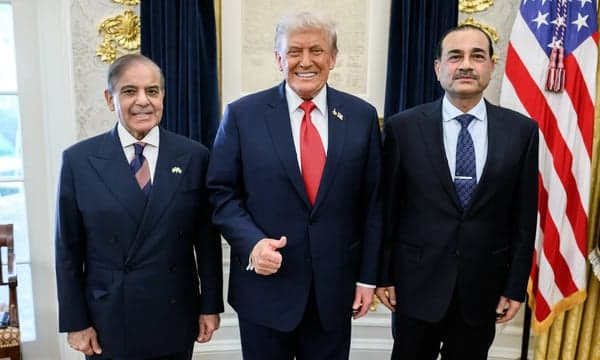
Who Is Asim Munir? Getting to Know Pakistan's Most Powerful General
In a world where military figures rarely make headlines for diplomatic triumphs, General Asim Munir has managed to carve out a profile that goes well beyond the traditional role of an army chief. Described informally by U.S. President Donald Trump as his "favorite Field Marshal," Munir has emerged as one of the most consequential figures in Pakistani — and regional — geopolitics today. But who exactly is this man, and how did he come to hold such an outsized influence on Pakistan's standing in the world?
Early Life and Military Career
Asim Munir Ahmed Shah was born in 1966 and is a graduate of the Pakistan Military Academy at Kakul. His early military career was largely conventional, working his way up the ranks of the Pakistani Army through a combination of field experience and institutional acumen. What set him apart from many of his peers, however, was his extensive background in intelligence. Before becoming Chief of Army Staff (COAS), Munir had served as both the Director General of Inter-Services Intelligence (ISI) — Pakistan's primary intelligence agency — and the Director General of Military Intelligence (DGMI). He holds the distinction of being the only individual in Pakistan's history to have led both of these agencies.
This dual intelligence background gave Munir a rare, panoramic view of Pakistan's internal security landscape, its relationships with neighboring countries, and the complex web of non-state actors that have long defined South Asian geopolitics. It also gave him access — and relationships — that few military figures in the region can match.
Rise to the Top: Becoming COAS
Asim Munir was appointed Chief of Army Staff in November 2022, a move that came amid significant political turbulence in Pakistan following the ouster of Prime Minister Imran Khan earlier that year. His appointment was seen as a signal of the establishment's desire for stability and a recalibration of Pakistan's internal and external posture. Almost immediately, Munir began making his presence felt — not just within the military hierarchy, but in shaping the broader narrative of what Pakistan could and should be.
His approach has been notably different from some of his predecessors. While Pakistani army chiefs have historically wielded enormous behind-the-scenes influence, Munir has increasingly operated in public-facing and internationally visible ways, positioning himself — and Pakistan — as a constructive player on the global stage.
The Image Overhaul: Rebranding Pakistan
One of Munir's most notable projects has been spearheading a strategic rebranding of Pakistan's international image. For years, Pakistan struggled with a perception problem: a country associated in Western media with terrorism, instability, and nuclear brinkmanship. Under Munir's guidance, there has been a deliberate and sustained effort to shift that narrative.
This image overhaul has taken several forms:
- Economic diplomacy: Munir has actively courted foreign investment, particularly from Gulf states and China, framing Pakistan as an emerging market with strategic value in a shifting global order.
- Counterterrorism messaging: Pakistan's military, under his leadership, has emphasized its role as a frontline state fighting extremism, seeking to reframe the international conversation around Pakistan's contributions rather than its vulnerabilities.
- Soft power engagement: There have been increased efforts to project a more modern, reform-oriented Pakistan to international audiences, including outreach to diaspora communities and Western policymakers.
Whether this rebranding effort will translate into lasting change remains a subject of debate among analysts. But few dispute that it represents one of the most ambitious and coordinated public relations campaigns in Pakistan's modern history, and Asim Munir is firmly at its center.
Pakistan's Mediator Role in the Iran Crisis
Perhaps the clearest demonstration of Munir's new-look Pakistan has been the country's role in mediating tensions surrounding Iran. As relations between Iran and Western powers — and Gulf states — have remained fraught, Pakistan has positioned itself as a rare interlocutor with credibility on multiple sides of the divide.
Munir's intelligence background has proven invaluable here. His understanding of regional dynamics, combined with Pakistan's unique geographic and political position — bordering Iran while maintaining close ties with Saudi Arabia and the United States — has allowed him to help facilitate dialogue at a time when direct communication has been limited. Pakistan's engagement in the Iran crisis has elevated its diplomatic profile considerably, signaling to global powers that Islamabad can be a useful and reliable partner, not merely a recipient of aid or a subject of concern.
Trump's 'Favorite Field Marshal': What Does It Mean?
The informal characterization of Asim Munir as Trump's "favorite Field Marshal" speaks volumes about the shift in U.S.-Pakistan relations during this period. Historically, the relationship between Washington and Islamabad has been fraught with mistrust, transactional disappointments, and strategic miscalculations on both sides. The warm framing suggests a degree of personal rapport and strategic alignment that has not always characterized the bilateral relationship.
For the Trump administration, a Pakistan that is actively engaged in regional diplomacy, presenting itself as a stabilizing force, and led by a pragmatic military figure is an asset worth cultivating. For Munir, the relationship with Washington provides legitimacy, investment opportunities, and a counterbalance to pressures from India and Afghanistan.
A Complex Figure in a Complex Region
Asim Munir is not without his critics. Domestically, his tenure has coincided with a crackdown on political opposition, and his relationship with former Prime Minister Imran Khan has been openly adversarial. Questions around civil-military balance in Pakistan — a perennial issue — remain very much alive under his watch.
Nevertheless, on the international stage, Munir has proven himself a formidable operator. He understands the language of geopolitics, he has the intelligence contacts to back it up, and he has demonstrated a willingness to project Pakistan outward in ways that serve both the country's interests and his own considerable ambitions. Whether those ambitions ultimately benefit the Pakistani people as much as they benefit the Pakistani establishment remains the most important question of all.
Conclusion
Asim Munir is, by any measure, one of the most significant military figures in Asia today. From his unprecedented dual intelligence career to his role as Pakistan's chief image manager and regional diplomat, he has built an influence that extends far beyond the borders of his country. As global attention continues to focus on South Asia and the broader Muslim world, understanding who Asim Munir is — and what he wants — is essential for anyone seeking to make sense of the region's rapidly shifting power dynamics.