
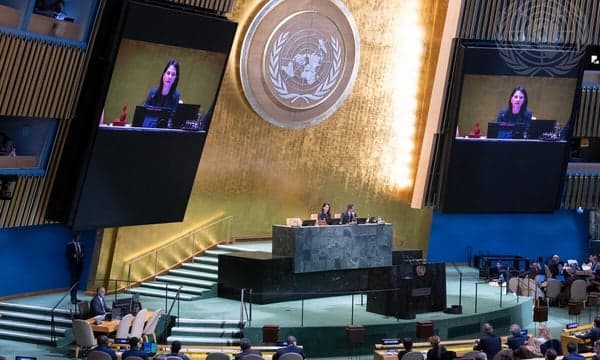
Why the Philippines Lost the UN Security Council Election to Kyrgyzstan
In a result that surprised many diplomatic observers, the Philippines failed to secure a non-permanent seat on the United Nations Security Council, losing the election to Kyrgyzstan. The outcome was not merely an electoral setback — it was a revealing moment that exposed the fragile nature of alliance politics in multilateral institutions and signaled a broader realignment of coalitions within the United Nations General Assembly. Understanding why the Philippines lost requires looking beyond campaign missteps and examining the structural forces reshaping how smaller and middle-income nations navigate global diplomacy.
The UN Security Council Non-Permanent Seat: What Was at Stake
The United Nations Security Council is the most powerful body within the UN system, holding the authority to authorize sanctions, peacekeeping missions, and binding resolutions on matters of international peace and security. Of its fifteen members, five are permanent — the United States, the United Kingdom, France, Russia, and China — while ten seats rotate among UN member states on two-year terms. These non-permanent seats are allocated by regional group, meaning countries compete within their designated blocs rather than against the full UN membership.
For the Philippines, winning a Security Council seat would have represented a significant diplomatic achievement, amplifying Manila's voice on issues directly relevant to its national interests — including the ongoing maritime disputes in the South China Sea, regional security arrangements, and its relationships with major powers. A seat would have provided a platform to shape international responses to some of the most consequential security questions affecting Southeast Asia.
For Kyrgyzstan, the victory marked an equally meaningful milestone, reflecting its sustained diplomatic investment in building relationships across the sprawling Asian and Pacific regional group. The Central Asian nation's win was not accidental — it was the product of years of quiet coalition-building that ultimately proved more effective than the Philippines' more high-profile campaign.
Shifting Coalitions: The Changing Geometry of UN Politics
One of the most significant takeaways from the Philippines' defeat is what it reveals about evolving coalitions inside the United Nations. The Asia-Pacific Group, which nominates candidates for seats allocated to that region, is one of the most geopolitically diverse blocs in the UN. It spans countries with vastly different foreign policy orientations — from close U.S. allies to members of China's Belt and Road Initiative, from Pacific island states deeply concerned about climate change to Central Asian republics with close ties to Russia.
In such a heterogeneous environment, traditional alliance structures do not automatically translate into voting blocs. Countries that maintain strong bilateral ties with the Philippines in trade, security, or development assistance may nonetheless cast their General Assembly votes based on entirely different calculations — regional solidarity, reciprocal support agreements struck years earlier, or quiet pressure from larger powers.
Kyrgyzstan, despite being a smaller and less globally prominent nation, appears to have mobilized support more effectively within this complex landscape. Central Asian states have cultivated dense networks of mutual support within the UN, particularly among developing nations that prioritize non-interference norms, south-south cooperation frameworks, and multilateral financial institutions. These networks, often invisible to outside observers, can be decisive in close UN elections.
The Limits of Alliance Politics in Multilateral Settings
The Philippines' loss underscores a hard lesson in multilateral diplomacy: bilateral alliances and formal partnerships do not reliably transfer into UN voting outcomes. A country may enjoy strong defense ties with Washington, robust trade relationships across Asia, and active engagement in ASEAN, yet still find that these relationships carry little weight in a secret ballot at the General Assembly.
This disconnect exists for several reasons. UN votes are conducted by secret ballot, which reduces the ability of powerful countries to enforce compliance among their partners. Smaller states frequently use their UN votes as bargaining chips in entirely separate negotiations — energy deals, debt relief discussions, or infrastructure financing agreements that have nothing to do with regional security. Additionally, the norm of sovereign equality in the UN system means that every member state's vote carries equal formal weight, empowering even the smallest nations to exercise independent judgment.
For the Philippines, this reality meant that a campaign that may have looked strong on paper — backed by a well-regarded diplomatic corps and solid relationships with Western democracies — could not overcome a rival that had quietly assembled a more resilient voting coalition through years of patient, under-the-radar diplomacy.
What This Means for Philippine Foreign Policy Going Forward
The defeat is a moment that Philippine foreign policy planners should examine carefully. It does not indicate that Manila lacks influence — the Philippines remains one of Southeast Asia's most strategically significant nations, with an active diaspora, growing economic weight, and a central role in U.S. Indo-Pacific strategy. However, it does suggest that multilateral diplomacy requires a different kind of investment than bilateral alliance management.
Winning at the UN requires cultivating relationships with countries that may not be top-tier bilateral partners — smaller African states, Pacific island nations, landlocked Central Asian republics — whose votes collectively determine outcomes in close elections. It requires sustained engagement, reciprocal support commitments, and the kind of long-term institutional memory that transforms transactional relationships into genuine partnerships.
A Broader Signal About UN Dynamics
Beyond the Philippines specifically, this election result reflects a broader trend in which the assumed hierarchies of international politics are becoming less reliable predictors of UN outcomes. Middle powers are finding that influence at the United Nations must be earned through multilateral engagement on its own terms — not simply assumed as an extension of existing alliances.
As geopolitical competition intensifies and new groupings of states assert themselves in multilateral forums, elections like this one will become increasingly important indicators of where real diplomatic influence lies. The Philippines' loss to Kyrgyzstan is not a story about failure alone — it is a story about the evolving rules of a multilateral world where every vote, and every relationship, genuinely counts.