
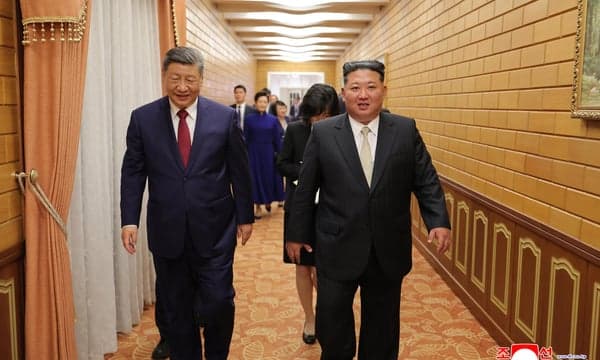
Xi's Summit with Kim Jong-un: Who Really Won?
When Chinese President Xi Jinping made his high-profile visit to Pyongyang to meet North Korean leader Kim Jong-un, the world watched closely. Heads of state summits between China and North Korea are rare enough to command serious geopolitical attention. Yet as the dust settled and diplomatic statements were filed away, a striking picture emerged: it was Kim Jong-un, not Xi Jinping, who appeared to walk away with the upper hand. By keeping his neighbors guessing about his true intentions and refusing to offer any meaningful concessions, Kim leveraged the visit to his distinct advantage — a masterclass in asymmetric diplomacy that reverberated across the entire Asia-Pacific region.
The Strategic Significance of the Xi-Kim Meeting
To understand why this summit matters, it helps to appreciate the broader strategic context in which it took place. The Korean Peninsula remains one of the most heavily militarized and diplomatically complex regions on earth. North Korea's nuclear weapons program continues to be a source of deep anxiety for its neighbors — South Korea, Japan, and even China itself — as well as for the United States and its allies. Any direct engagement between Beijing and Pyongyang carries enormous weight, signaling shifts in alliances, security calculations, and the broader balance of power in Northeast Asia.
Xi Jinping's visit was framed publicly as an affirmation of the longstanding friendship between the Chinese Communist Party and North Korea's ruling Workers' Party. Official communiqués spoke warmly of "strategic cooperation" and "brotherly ties." But beneath the ceremonial surface, observers across the region were parsing every detail for clues about what had actually been agreed upon — and, crucially, what had not.
Kim Jong-un's Diplomatic Calculus
What made Kim's position so strong going into the summit was precisely his willingness to offer nothing in return for China's diplomatic attention. North Korea did not signal any intention to slow its weapons development. There were no announced steps toward denuclearization, no gestures of restraint, and no commitments to multilateral dialogue. Kim essentially accepted the prestige and visibility of a summit with the leader of the world's second-largest economy while conceding nothing of substance.
This approach is not accidental. Kim Jong-un has consistently demonstrated a shrewd understanding of his own leverage. North Korea's nuclear arsenal, paradoxical as it sounds, is both a liability and an asset. It makes Pyongyang a pariah in the eyes of the international community, but it also makes Kim indispensable to any serious conversation about regional security. No major power can afford to simply ignore North Korea — and Kim knows it.
How Neighboring Countries Reacted
The reactions from regional neighbors were telling, and in many ways reflected a shared anxiety about what the summit signaled for the future.
- South Korea watched the meeting with particular unease. Seoul has long sought to draw Pyongyang into meaningful dialogue, and a closer Beijing-Pyongyang alignment makes that task considerably harder. If China is seen as providing North Korea with a diplomatic shield, it reduces the pressure on Kim to engage constructively with the South.
- Japan responded with characteristic caution but evident concern. Tokyo has its own unresolved disputes with North Korea — including the abduction issue — and any warming of Sino-North Korean ties complicates Japan's security posture and its relationship with Washington.
- The United States, while not a geographic neighbor, remains the dominant external security actor in the region. American analysts noted that the summit seemed to reinforce North Korea's resistance to denuclearization talks, undermining years of diplomatic effort and sanctions pressure.
- Russia, meanwhile, has been cultivating its own closer relationship with Pyongyang, particularly in the context of the war in Ukraine. The Xi-Kim summit took place against a backdrop of a shifting triangular dynamic between Beijing, Moscow, and Pyongyang — one that increasingly challenges the Western-led international order.
China's Uncomfortable Position
For Xi Jinping, the summit carried its own complications. China has historically sought to use its relationship with North Korea as a form of strategic leverage — a card to be played in dealings with Washington and Seoul. But that leverage only works if Beijing can actually influence Pyongyang's behavior. If Kim continues to develop nuclear and ballistic missile capabilities regardless of Chinese preferences, it raises uncomfortable questions about how much influence Xi actually has over his nominal ally.
There is also the matter of regional perception. By visiting Pyongyang and lending the summit a celebratory tone, Xi risked signaling to South Korea, Japan, and the United States that China has chosen sides in a way that forecloses productive multilateral diplomacy. That perception, whether accurate or not, has real consequences for China's broader diplomatic standing in Asia.
The Art of Strategic Ambiguity
Perhaps the most important takeaway from the Xi-Kim summit is what it reveals about North Korea's long-term strategy. Kim Jong-un has perfected the art of strategic ambiguity — keeping all parties uncertain about his next move while extracting maximum diplomatic and symbolic value from each interaction. By receiving Xi without offering concessions, he demonstrated that North Korea is not merely a client state of China, but an independent actor with its own agenda.
This posture makes the path toward Korean Peninsula stability considerably more complex. Sustainable peace requires trust-building, dialogue, and verifiable commitments. When one party consistently engages without reciprocating, the entire diplomatic architecture becomes structurally unstable.
What Comes Next for Regional Security?
The Xi-Kim summit is unlikely to be the last high-profile diplomatic encounter involving North Korea in the near term. With geopolitical tensions running high across the Indo-Pacific, all major players are reassessing their strategic positions. For regional neighbors, the core challenge remains the same: how to manage a nuclear-armed North Korea whose leader has shown himself to be a far more capable diplomat than many outsiders once assumed.
Kim Jong-un entered the summit with little to lose and emerged with his position strengthened. That outcome alone should give policymakers in Seoul, Tokyo, Washington, and even Beijing pause — and prompt a serious rethinking of how the international community approaches engagement with Pyongyang in the years ahead.