
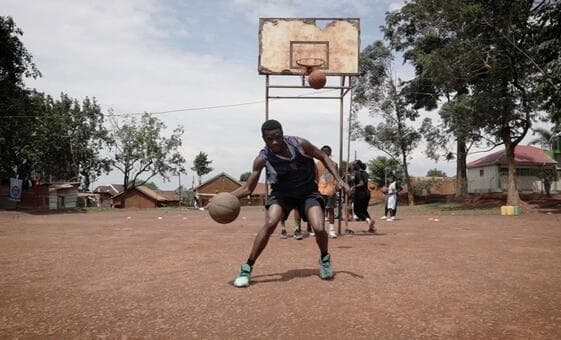
When Basketball Becomes a Lifeline: The Story of Stephane Kulimushi
In the heart of Kampala, Uganda, a basketball court has become something far greater than a playing surface. For 19-year-old Stephane Kulimushi, every dribble, every pass, and every layup represents an act of defiance against despair. As a young refugee who has experienced the upheaval and uncertainty that displacement brings, Stephane now channels his own hardship into something extraordinary — coaching and mentoring other young refugees through the transformative power of sport.
When Stephane looks around the court where he trains his players, he does not simply see athletes. He sees survivors. He sees potential. He sees young people who, like himself, are searching for stability, belonging, and a reason to believe that tomorrow can be better than today. In a world where the number of forcibly displaced people continues to break records, stories like Stephane's remind us that resilience is not just a word — it is a daily practice.
Uganda: A Nation at the Forefront of Refugee Hosting
Uganda is one of the most generous refugee-hosting nations on earth. Home to well over 1.5 million refugees and asylum seekers, the country has adopted an open-door policy that grants displaced individuals relatively significant freedoms, including the right to work and to move. Refugees in Uganda come predominantly from South Sudan, the Democratic Republic of the Congo, Burundi, Somalia, and Rwanda — nations scarred by conflict, political instability, and human rights abuses.
Yet welcoming refugees does not automatically mean providing them with opportunity, community, or purpose. For young refugees in particular — many of whom arrive having witnessed violence, lost family members, or spent years in transit — the psychological and social toll of displacement can be immense. That is precisely where initiatives built around sport and youth leadership become not just valuable, but vital.
The Power of Sport in Refugee Communities
Across the globe, sport has repeatedly proven itself as one of the most effective tools for healing, integration, and community-building among displaced populations. Organizations such as the United Nations High Commissioner for Refugees (UNHCR) have long recognized sport as a vehicle for psychosocial support, conflict resolution, and the development of leadership skills in refugee settings.
Basketball, in particular, carries unique advantages. It requires teamwork, communication, discipline, and mutual trust — all qualities that are essential not only on the court but in navigating the complex challenges of refugee life. The sport is accessible, requires minimal equipment compared to many alternatives, and can be played in urban environments like Kampala, where large numbers of refugees have settled.
For young people who may feel invisible to the societies around them, stepping onto a basketball court and being coached — or becoming a coach themselves — can be a profound affirmation of their worth and capability.
Stephane Kulimushi: Leading by Example at 19
What makes Stephane's story particularly remarkable is his age. At just 19, he has already assumed the role of mentor, coach, and community builder. Rather than waiting for systems to support him, he has chosen to create support for others. This kind of youth-led leadership is increasingly recognized as one of the most sustainable and culturally resonant approaches to community development in refugee settings.
Stephane understands the struggles his players face because he has faced them himself. He knows what it means to feel unmoored, to question your future, and to wonder whether the world sees you as a person or merely as a statistic. That shared experience is not a weakness in his coaching — it is his greatest strength. It builds trust, fosters openness, and creates the psychological safety that young people need to grow.
When he coaches, he is not just teaching basketball fundamentals. He is modeling what it looks like to take ownership of your circumstances, to serve your community, and to pursue a goal with discipline and heart. Every training session is a lesson in far more than sport.
Basketball as Mental Health Support and Social Integration
The mental health dimensions of Stephane's work cannot be overstated. Refugee youth face disproportionately high rates of anxiety, depression, and post-traumatic stress. Access to formal mental health services in refugee-hosting contexts is often severely limited. Sport, however, offers an informal but powerful complement to clinical support.
Regular physical activity reduces stress hormones, boosts mood-regulating neurotransmitters, and creates routine — all of which are particularly beneficial for individuals who have experienced trauma. Beyond the physiological benefits, being part of a team provides social connection, accountability, and a sense of belonging that can counter the isolation many refugees experience.
For the young players Stephane trains, showing up to practice is an act of community. It means they are expected somewhere. It means someone is counting on them. That simple truth — that they matter — can be quietly revolutionary.
Why Stories Like Stephane's Matter for Global Advocacy
In public discourse, refugees are far too often defined by what they have lost rather than by what they continue to offer. Stephane Kulimushi's story challenges that narrative directly. He is not a passive recipient of aid. He is an active contributor to his community, a leader, a coach, and an inspiration to everyone who steps onto that Kampala court.
Amplifying stories like his matters for several reasons:
They shift narratives: Humanizing refugee experiences moves public and policy conversations away from fear and toward empathy, paving the way for more inclusive and effective responses to displacement.
They highlight youth agency: Young refugees are not simply problems to be solved. They are change-makers who, when given even modest support and opportunity, can lead transformative initiatives in their own communities.
They make the case for investment in sport: Funding sport programs in refugee settings is not a luxury — it is a high-return investment in mental health, social cohesion, and youth development that pays dividends across entire communities.
They inspire peer action: When young people see someone their own age doing something remarkable, it expands their sense of what is possible for themselves.
The Broader Movement: Sport as a Tool for Refugee Empowerment
Stephane is part of a growing global movement that recognizes sport as a legitimate and powerful vehicle for refugee empowerment. From football leagues in Kenyan camps to swimming programs in European reception centers, organizations and individuals around the world are using athletic engagement to address some of the deepest needs of displaced communities.
The Olympic Refugee Team, fielded at every Games since Rio 2016, has brought extraordinary visibility to this movement. But the real work happens not on the world's largest stages — it happens on courts like Stephane's in Kampala, where no cameras are guaranteed and the only audience that truly matters is the group of young people looking to their coach for guidance.
How You Can Support Refugee Youth Through Sport
If Stephane's story has moved you, there are concrete ways to support the broader ecosystem of sport-based refugee programming. Donating to organizations like UNHCR, Right To Play, or Generations For Peace helps fund the kind of grassroots athletic initiatives that change lives. Advocating for inclusive sport policies in your own country — policies that allow refugee youth to participate in national leagues and sporting bodies — can open doors that are currently closed.
And perhaps most importantly, listening to and sharing stories like Stephane's contributes to a cultural shift in how the world sees and treats displaced people. Every story told well is a small act of justice.
Conclusion: More Than a Game, More Than a Court
When Stephane Kulimushi steps onto that basketball court in Kampala, he carries with him the weight of his own journey and the hope of everyone he coaches. He has turned personal hardship into collective strength, and in doing so, he has demonstrated something that no statistic can fully capture: that young refugees are not defined by their displacement, but by their extraordinary capacity to rise, to lead, and to lift others along with them.
Basketball, for Stephane, is many things at once — a passion, a platform, a language of belonging, and a daily act of hope. And in that crowded, sun-warmed court in Kampala, those things are more than enough to change the world, one player at a time.