
Amazon Enters the LTL Market — But There's a Gap
Amazon made a significant move this week, opening its less-than-truckload (LTL) freight network to all businesses. The market noticed, but didn't panic. Shares of publicly traded LTL carriers dipped roughly 5% on the announcement — a modest pullback for a group that had already surged more than 60% year to date. Analyst notes that followed were largely reassuring to incumbent carriers, with the broad consensus landing in the same place: Amazon has built a compelling economy-tier LTL offering, but it is not yet a hub-and-spoke carrier in the mold of Old Dominion (NASDAQ: ODFL) or FedEx Freight (NYSE: FDFX).
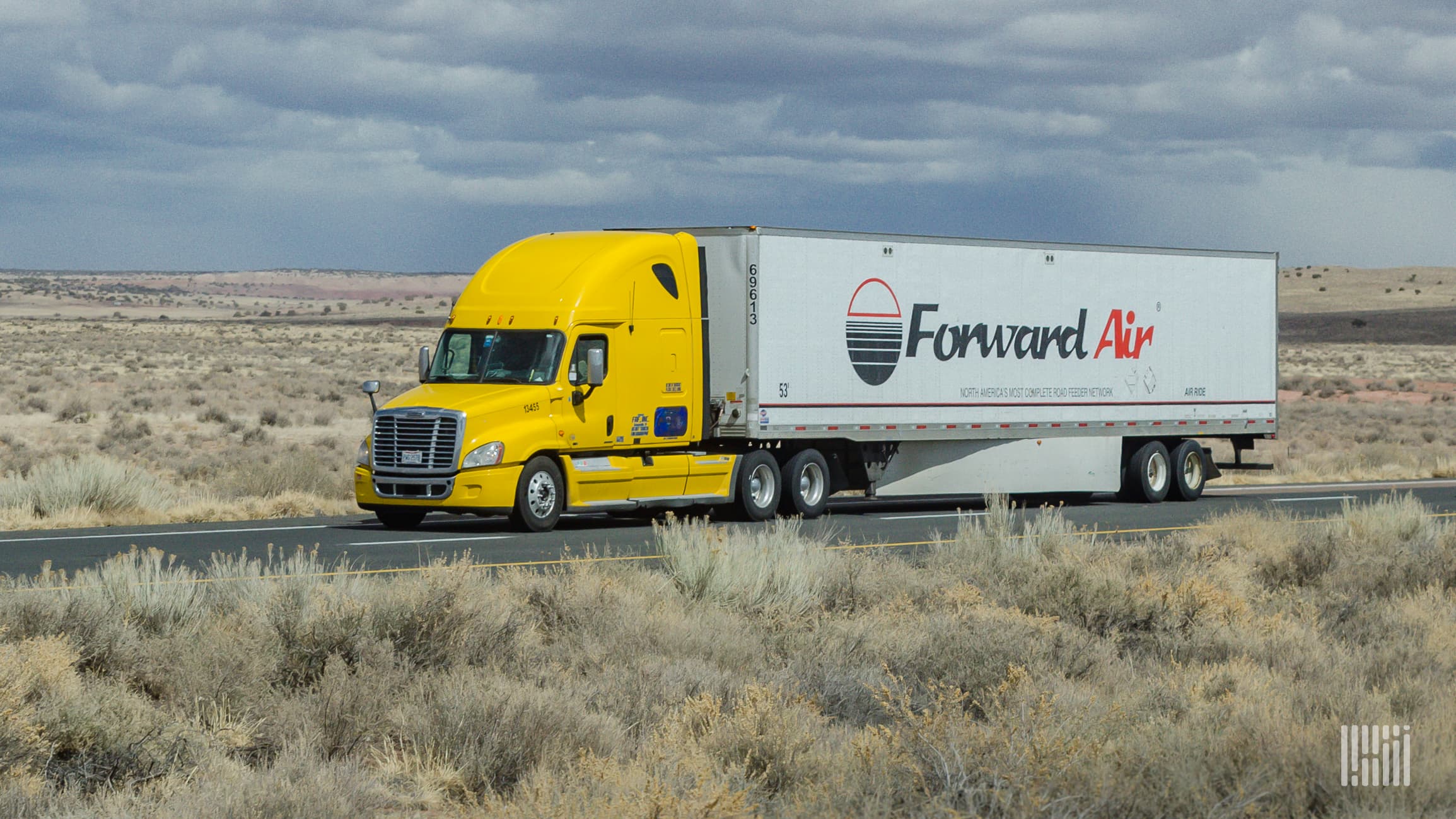
That consensus is accurate as a snapshot of where Amazon's network stands today. But it may be missing the bigger picture — specifically, where Amazon could take this network next. The launch establishes a credible national economy LTL platform, but what it conspicuously lacks is a premium expedited tier. If Amazon wants to add one quickly, there may be no faster path than acquiring a carrier that is already built for it, already in strategic review, and already trading at a depressed valuation: Forward Air (NASDAQ: FWRD).
What Amazon Actually Launched
Amazon's new LTL service is purpose-built for a specific segment of the market. The expanded offering handles shipments ranging from one to six pallets — roughly 150 to 15,000 pounds — with pickup, terminal transfer, and intact delivery all marketed at a lower price point than legacy carriers. The network runs on an asset-light model anchored by approximately 30 terminals, woven into Amazon's existing package-delivery infrastructure. Density is strongest in the Eastern United States, with growing coverage across Western metro areas.
For the cost-sensitive, economy end of the LTL market, this is a credible national entry from day one. Shippers looking to move freight at competitive rates without requiring guaranteed windows or specialized handling now have a legitimate Amazon alternative to traditional carriers.
What this network is not, at least not yet, is a premium expedited service. A truly full-service national LTL carrier typically operates 200 to 300 service centers capable of reaching nearly every U.S. ZIP code. FedEx Freight alone operates at that scale. Amazon's current footprint, while impressive for a new entrant, falls well short of that coverage density — and coverage density is precisely what separates economy freight from premium expedited freight.
The Two-Tier LTL Market Amazon Is Missing
The LTL industry isn't monolithic. It operates across two largely distinct value propositions. The first is economy freight: lower cost, flexible transit times, suitable for shippers whose primary concern is price over speed. The second is expedited, premium freight: tighter delivery windows, specialized handling, higher reliability guarantees, and the terminal density required to make those promises stick.
Amazon's new network competes squarely in the first category. That is a smart and logical starting point — economy LTL is where price-sensitive shippers are easiest to win over, and it maps naturally to Amazon's existing logistics strengths. But enterprise shippers, manufacturers, and time-sensitive supply chains operate in the second category. Without a premium expedited tier, Amazon cannot serve that portion of the market, and it leaves the most defensible and highest-margin segment of LTL untouched.
Building a premium expedited network organically would take years. It would require acquiring real estate for service centers, hiring specialized freight professionals, building carrier relationships, and earning the operational reputation that shippers pay a premium to rely on. The faster path, by a wide margin, is acquisition.
Why Forward Air Fits the Gap
Forward Air was not built as a conventional LTL carrier. It was built specifically around the expedited, time-definite freight niche — airport-to-airport and hub-to-hub freight movement that demands precision transit times. Its network was designed for speed and reliability, not necessarily volume and density in the traditional hub-and-spoke sense. That makes it structurally different from the economy-tier players Amazon would be displacing, and structurally complementary to what Amazon has just launched.
The timing also aligns. Forward Air is currently mid-strategic review, with its equity trading at a depressed value relative to its operational footprint. A motivated seller, a specialized asset set, and a buyer with deep capital resources and a clear strategic rationale form a rare combination. For Amazon, which has demonstrated a willingness to make large, infrastructure-oriented acquisitions when the strategic logic is strong, Forward Air represents an unusually direct path to filling a well-defined gap.
What an Acquisition Would Mean for the LTL Market
If Amazon were to acquire Forward Air, the implications for the broader LTL industry would be substantially larger than the market's 5% reaction to this week's network launch suggested. It would no longer be a question of whether Amazon can compete in economy freight. It would be a question of whether Amazon is building a two-tier national LTL platform capable of competing across the full market spectrum.
Incumbent carriers would face a fundamentally different competitive picture. Old Dominion, FedEx Freight, XPO, and Saia have built durable competitive positions around service quality, network density, and customer relationships built over decades. Those advantages don't evaporate overnight. But an Amazon-Forward Air combination would compress the timeline for a credible premium challenge from years to months.
- Amazon would gain an established expedited freight network without the multi-year build timeline.
- Forward Air's existing customer relationships would give Amazon an immediate foothold in enterprise and time-sensitive freight segments.
- The combined operation would position Amazon as a genuine full-spectrum LTL competitor, not just an economy-tier alternative.
- Competitive pressure on incumbent carriers would intensify well beyond what this week's launch alone implied.
The Bigger Picture for Amazon Logistics
Amazon has spent years building logistics infrastructure that began as a means to serve its own retail operation and has progressively become a business in its own right. Amazon Freight, its truckload brokerage, already moves significant third-party volume. The new LTL network is the next logical layer. A premium expedited tier would complete a full-service freight offering that spans the cost-to-speed spectrum that shippers actually navigate.
The market's muted reaction to this week's announcement may reflect an accurate read of Amazon's network today. It may also reflect a lack of imagination about where Amazon's network is heading. Forward Air is on the auction block. Amazon has the capital, the strategic need, and the platform to use it. The gap in Amazon's LTL strategy has a name — and right now, that name is still available.