
Can Central Asia Speak? The Region's Rise as an Independent Geopolitical Voice
For decades, Central Asia has been described in the vocabulary of others. It has been called a "buffer zone," a "transit corridor," and most famously, the arena of a revived "Great Game" — a competition between external powers seeking influence over its vast steppes, energy reserves, and strategic geography. But a more accurate and more honest question is increasingly being asked by analysts, policymakers, and the region's own leaders: Can Central Asia speak for itself? The answer, with growing conviction, appears to be yes.
Central Asia — comprising Kazakhstan, Kyrgyzstan, Tajikistan, Turkmenistan, and Uzbekistan — is not merely a geographical footnote between Russia, China, and the broader Middle East. It is a geopolitical space with its own actors, its own priorities, and its own evolving sense of regional identity. Understanding this shift is essential for anyone seeking to make sense of Eurasian politics in the 21st century.
Beyond the Corridor Narrative
The "corridor" framing has long dominated Western and even regional analyses of Central Asia. Under this lens, the five republics exist primarily as conduits — for Chinese goods moving westward under the Belt and Road Initiative, for Russian energy pipelines heading to European markets, or for NATO supply routes into Afghanistan. The implication is passive: Central Asia as geography, not as agency.
This framing is not only reductive — it is increasingly inaccurate. The countries of Central Asia have spent the post-Soviet decades building state institutions, negotiating bilateral and multilateral agreements on their own terms, and carefully balancing relationships with major powers without subordinating themselves to any single one. Kazakhstan's multi-vector foreign policy, for instance, has long been cited as a model of pragmatic diplomacy — maintaining productive ties with Moscow, Beijing, Washington, and Brussels simultaneously, without becoming a vassal of any.
Uzbekistan under President Shavkat Mirziyoyev has undergone a remarkable foreign policy reorientation since 2016, reopening borders with neighbors, prioritizing regional connectivity, and positioning Tashkent as a hub for intra-regional diplomacy. These are not the actions of a passive corridor. These are the choices of a state with strategic intent.
Not a Prize, but a Player
The second dominant misreading of Central Asia frames it as a "prize" — something to be won by whichever great power exercises the most leverage. This Cold War residue persists in much commentary about Chinese infrastructure investment or Russian security guarantees. But it misunderstands the nature of the relationships these states have actually forged.
Central Asian governments are not passive recipients of external patronage. They negotiate. They hedge. They play competing suitors against one another with considerable sophistication. When Russia launched its full-scale invasion of Ukraine in February 2022, every Central Asian government conspicuously refused to endorse Moscow's position at the United Nations. Kazakhstan, Kyrgyzstan, and others made clear they would not help Russia circumvent Western sanctions — a posture that would have been unthinkable under older assumptions about Russian dominance in the region.
This was not a pivot to the West. It was an assertion of independent judgment. Central Asian states were signaling, loudly and clearly, that their foreign policies would be governed by their own interests — including their deep economic interdependence with global markets — rather than by reflexive loyalty to any patron.
Disparate Yet Collaborative: Understanding Regional Dynamics
Central Asia is not a monolith. The five republics differ enormously in population, economic structure, political system, and strategic orientation. Kazakhstan is an oil-rich middle power with global aspirations. Kyrgyzstan and Tajikistan are smaller, poorer, and more dependent on remittances and external support. Turkmenistan remains one of the world's most isolated states. Uzbekistan is the demographic giant and is rapidly emerging as the region's diplomatic engine.
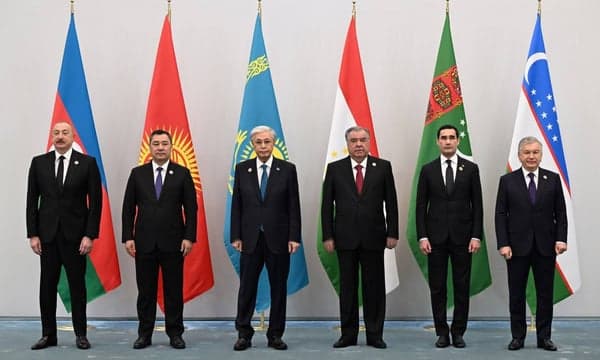
Yet despite these disparities, the past several years have seen a notable uptick in intra-regional collaboration. C5 summits — bringing together the heads of state of all five republics — have become more substantive. Uzbekistan has worked to resolve long-standing border disputes with Kyrgyzstan and Tajikistan. Regional water-sharing agreements, historically a flashpoint, are being revisited with greater pragmatism. The logic of shared geography and shared vulnerability to climate change, economic disruption, and instability in neighboring Afghanistan is slowly, imperfectly, but genuinely fostering a regional consciousness.
The Question of Voice on the World Stage
Can Central Asia speak collectively on the world stage? This remains the harder question. The region lacks a strong supranational institution with genuine authority. The Shanghai Cooperation Organisation and the Collective Security Treaty Organisation are both Russian- and Chinese-dominated frameworks that do not give Central Asian states independent platforms. The EU's engagement, while growing, remains episodic.
What Central Asian states have instead is a growing willingness to articulate their own positions — at the UN General Assembly, in bilateral dialogues, in regional forums, and increasingly in the language of economic sovereignty and climate justice. They are calling for connectivity on their terms, not only as transit routes for others' ambitions.
Why This Matters
The question of Central Asian agency is not merely academic. As great-power competition intensifies and global supply chains are redrawn, Central Asia's choices will shape Eurasian stability in profound ways. A region that is understood only as a corridor or a prize will be mismanaged by outside actors and underestimated in policy circles. A region understood as a geopolitical space with its own voice will be engaged with far more productively.
Central Asia can speak. The more important question now is whether the rest of the world is finally ready to listen.