
How China's 'Red Lines' Are Quietly Shaping Global News Reporting
There is a particular kind of silence that has settled over international newsrooms in recent years — not the silence of nothing happening, but the silence of careful omission. Words get softened, phrases get restructured, and certain topics are approached with a caution that was not always there. Much of this shift traces back to Beijing, and to the expanding set of political boundaries that the Chinese Communist Party (CCP) under Xi Jinping has drawn around how China can be described, discussed, and reported on. These boundaries — commonly referred to as "red lines" — are no longer confined to Chinese state media. They are quietly reshaping how global journalism operates.
What Are China's Red Lines in Media?
China's red lines are not always written down in a formal document that journalists can reference. They are instead a diffuse, shifting set of political sensitivities that Beijing enforces through a combination of diplomatic pressure, economic leverage, visa denials, and the threat of being expelled from the country entirely. At their core, they prohibit any framing that challenges CCP authority, questions Xi Jinping's leadership, or presents alternative narratives about events the party considers closed matters.
Key subjects that consistently trigger these boundaries include the status of Taiwan, the situation in Xinjiang and Tibet, the origins of the COVID-19 pandemic, the 1989 Tiananmen Square massacre, and the ongoing protests and political crackdown in Hong Kong. For international journalists, reporting on any of these topics with the kind of directness that would be standard in coverage of other countries carries real professional and sometimes personal risk.
The Mechanism of Influence: How Beijing Reaches Beyond Its Borders
The CCP's ability to shape news coverage outside China operates through several distinct but overlapping mechanisms, each effective in its own right and collectively powerful.
Economic Leverage Over Media Organizations
Large media conglomerates with significant business interests in China — whether through advertising revenue, distribution rights, or corporate ownership — face structural incentives to self-censor. Editors may not receive explicit instructions to avoid certain topics; the awareness of potential consequences is enough. This is what researchers call anticipatory compliance, and it is one of the most difficult forms of censorship to document or challenge precisely because it leaves no fingerprints.
Visa Restrictions and Press Credential Denial
China has become increasingly aggressive in using journalist visas as a political tool. Foreign correspondents who file reports Beijing finds objectionable risk having their press credentials revoked, their visa applications denied, or being expelled outright. Between 2020 and 2023, dozens of foreign journalists were forced to leave China, many in direct response to their reporting. For news organizations that value boots-on-the-ground access in the world's second-largest economy, the calculus becomes uncomfortable: report accurately and lose access, or moderate coverage and stay in.
Language Normalization Through State Media Reach
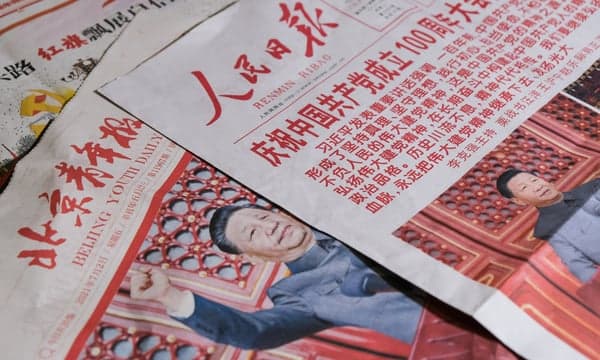
Beijing has invested enormously in expanding the global footprint of its state-controlled media outlets, including CGTN, China Daily, and Xinhua. These outlets operate in dozens of countries and languages, and their framing of events — referring to Xinjiang's detention facilities as "vocational training centers," or describing Taiwan as a "renegade province" — gradually bleeds into broader media discourse. When authoritative-sounding language is repeated consistently across many platforms, it begins to feel like established terminology, nudging even independent journalists toward phrasing that aligns with Beijing's preferred narrative.
The Impact on Journalism's Core Function
Journalism's essential job is to describe the world accurately — to give events their proper names, to place facts in honest context, and to hold power to account. China's red lines directly threaten this function, and not merely for reporters covering Asia. The influence extends to how international organizations phrase their communications, how academic researchers frame their findings, and how documentary filmmakers approach sensitive subjects. The chilling effect radiates outward well beyond any single newsroom.
One of the most telling examples is the language surrounding Taiwan. Journalistic best practice would suggest describing Taiwan as a self-governing democratic island with its own government, military, and economy — which is factually accurate. Yet many mainstream international outlets now routinely add qualifiers that echo Beijing's territorial claims, even when those claims are contested and unrecognized under international law. The language has shifted not because the facts changed, but because the pressure environment changed.
The Self-Censorship Problem
Self-censorship is particularly insidious because it is largely invisible. Journalists themselves are not always aware they are doing it. Over time, the mental habit of steering around certain subjects, softening certain descriptions, or avoiding certain sources can become so ingrained that it no longer feels like a compromise — it simply feels like professional judgment. This normalization is precisely what makes China's red lines so effective as a long-term tool of narrative influence.
Why This Matters for Global Press Freedom
China consistently ranks among the worst countries in the world for press freedom, according to organizations such as Reporters Without Borders and the Committee to Protect Journalists. But the implications of Beijing's approach to media control no longer stay within China's borders. As the country's global economic and political weight grows, so does its capacity to export its standards — or rather, its restrictions — onto the international information environment.
Democracies that have long relied on a free and independent press as a pillar of informed public life are increasingly navigating a media landscape that has been subtly contoured by an authoritarian power's definition of what is permissible to say. Recognizing that influence, naming it clearly, and resisting it where possible is not a political act — it is a journalistic one, and perhaps one of the most important the profession faces today.