
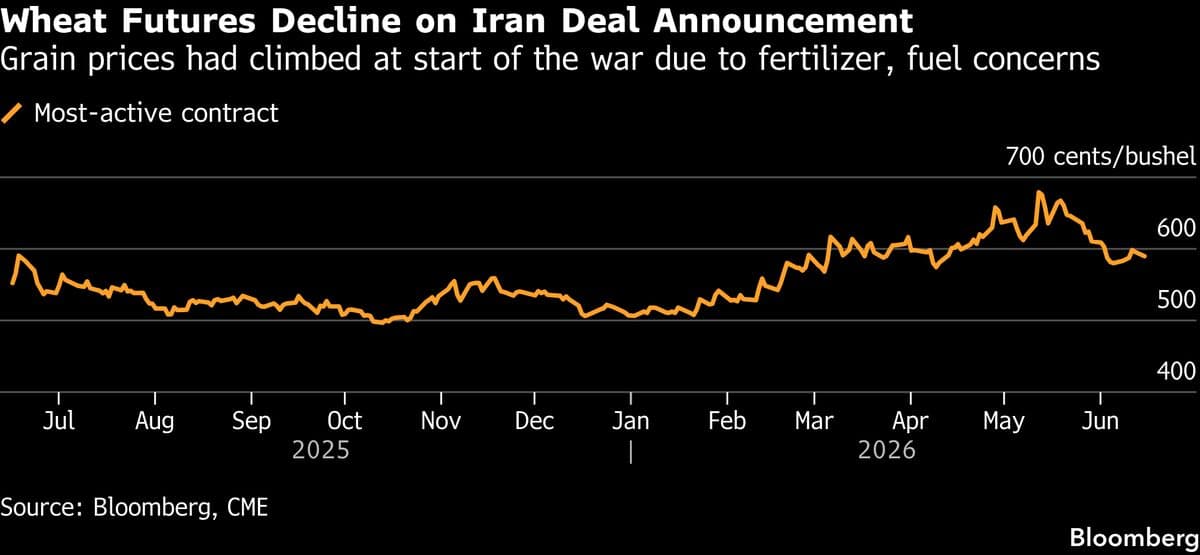
Grain Futures Fall as Strait of Hormuz Reopening Hopes Ease Agricultural Pressures
Commodity markets breathed a tentative sigh of relief this week as grain futures declined on the Chicago Board of Trade, driven by growing optimism that the Strait of Hormuz — one of the world's most strategically critical waterways — could soon reopen to commercial shipping. For farmers, food producers, and consumers around the globe, the development carries enormous implications. A resumption of normal traffic through the strait would help restore the flow of essential agricultural inputs that have been disrupted by months of conflict in the region, potentially putting a floor under spiraling food inflation and stabilizing crop production cycles heading into the next growing season.
Why the Strait of Hormuz Matters So Much to Global Agriculture
The Strait of Hormuz is best known as the narrow chokepoint through which roughly 20 percent of the world's traded oil passes. But its significance to agriculture runs far deeper than petroleum. The waterway is a critical conduit for the shipment of fertilizers — particularly those derived from natural gas, such as urea and ammonia — as well as other chemical inputs that modern large-scale farming depends upon. When access to the strait is restricted or closed entirely, the ripple effects move quickly through global supply chains, driving up input costs and creating genuine uncertainty about whether crops can be grown and harvested at commercially viable prices.
Over the past several months, the ongoing conflict in the region has placed sustained pressure on these supply lines. Shipping insurers have attached war-risk premiums to voyages through the area, and some vessels have rerouted entirely, adding days or weeks to delivery schedules and compounding costs at every step. For farmers already coping with elevated energy prices and tight credit conditions, the additional burden on input availability has been severe.
How Farm Input Shortages Translate Into Higher Food Prices
The relationship between farm inputs and food prices is direct and well-documented. Fertilizer is the single largest variable cost for most grain and oilseed producers. When fertilizer prices spike — whether due to supply disruptions, energy shocks, or geopolitical instability — farmers face a difficult choice: absorb the higher costs and squeeze their margins, reduce application rates and accept lower yields, or pass costs forward to buyers and ultimately to consumers.
Over the course of the Hormuz disruption, all three responses have been visible in markets. Profit margins for grain producers in import-dependent countries have thinned considerably. In some regions, reduced fertilizer application has already prompted analysts to revise yield forecasts downward. And at the retail level, food inflation has remained persistently elevated in markets that depend on imported grains and oilseeds, from Southeast Asia to parts of Sub-Saharan Africa and Latin America.
The prospect of a Hormuz reopening therefore does more than simply improve a shipping route. It represents a potential reset for an agricultural input market that has been badly distorted by months of conflict-driven uncertainty.
Chicago Grain Futures React to Reopening Signals
Futures markets are forward-looking by nature, and traders responded quickly to signals that diplomatic or military developments might restore Hormuz access. Corn, wheat, and soybean futures all softened in Chicago trading, reflecting an expectation that supply chain pressures could ease in the months ahead. When inputs become more accessible and affordable, production costs fall, which typically translates into lower futures prices as market participants price in greater crop supply potential.
It is worth noting that futures declines of this kind are not inherently bad news. For consumers and food-importing nations, lower grain prices represent meaningful relief. For producers, stabilized input costs — even if accompanied by somewhat softer commodity prices — can actually improve planning certainty and encourage investment in the coming season's plantings. The volatility itself is often more damaging to agricultural systems than any particular price level, so a return to more predictable conditions along a key shipping lane would be broadly welcomed by the industry.
The Broader Food Security Picture
Food security analysts have been watching the Hormuz situation closely throughout the conflict. The strait's role as a fertilizer transit corridor places it alongside other critical chokepoints — such as the Black Sea and the Suez Canal — that have become flashpoints for global food system vulnerability in recent years. Each disruption has reinforced a growing consensus among policymakers and agricultural economists: the world's food supply chains are more fragile and more geographically concentrated than they once appeared.
A reopening of the Hormuz Strait would offer short-term relief, but the structural lesson will likely outlast the immediate crisis. Many governments and agribusinesses are already accelerating investments in domestic fertilizer production capacity, diversified sourcing strategies, and alternative shipping routes — precisely because the cost of dependence on a single corridor has been made painfully clear.
What Farmers and Agribusinesses Should Watch Next
For producers and buyers tracking this situation, several indicators will signal whether the anticipated easing of input conditions actually materializes. Shipping insurance premiums in the Persian Gulf region will be among the first to move, reflecting real-time assessments of risk from underwriters with direct financial exposure. Fertilizer spot prices at key import terminals in Europe, South Asia, and East Africa will follow, typically within four to eight weeks of any meaningful change in transit conditions.
- Monitor urea and ammonia spot prices at major import hubs for early signs of easing
- Track war-risk insurance premiums on Gulf shipping routes as a leading indicator of reopening confidence
- Watch grain futures in Chicago and Paris for sustained directional moves that confirm improved input availability
- Follow United Nations Food and Agriculture Organization updates on global fertilizer supply and food price indices
- Assess domestic crop input inventory levels in import-dependent countries, which may provide a buffer if maritime access improves gradually rather than immediately
A Cautious but Real Reason for Optimism
The decline in grain futures following signals of a potential Hormuz reopening reflects a market that is, for the first time in months, pricing in a more benign scenario for agricultural inputs and food inflation. That optimism is still conditional. Diplomatic and military situations can shift quickly, and the history of the region counsels caution about premature confidence. But the direction of movement in commodity markets tells a clear story: if the Strait of Hormuz can be restored to reliable commercial operation, the benefits for global agriculture — from farm economics to consumer food costs — would be substantial, timely, and wide-reaching. For an interconnected global food system that has absorbed one shock after another in recent years, that possibility is genuinely significant.