
DHL Takes Autonomous Logistics to the Next Level with Zelostech in Singapore
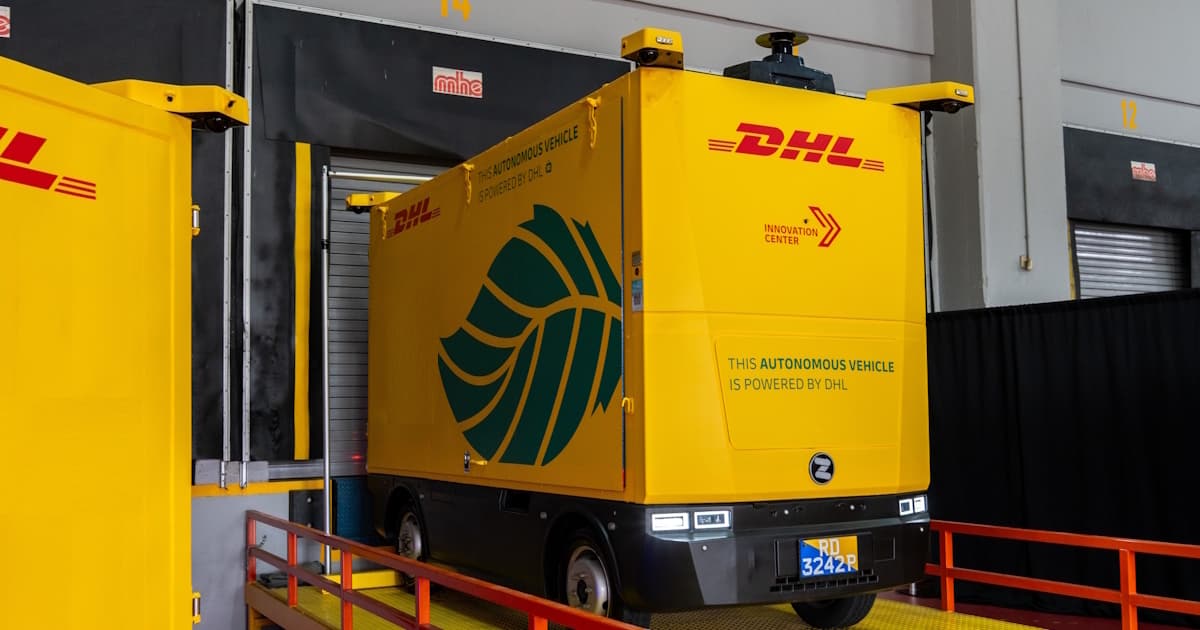
The logistics industry is undergoing one of its most significant transformations in decades, and DHL is helping lead the charge. The global supply chain giant has officially transitioned autonomous vehicles developed through its Fast Forward Challenge into full daily operations at its Advanced Regional Center (ARC) in Singapore. In partnership with innovative autonomous vehicle company Zelostech, DHL is now running fully electric, driverless vehicles for point-to-point transfers between logistics facilities on campus — a milestone that signals how seriously the industry is embracing automation at scale.
This deployment is not a pilot program or a proof-of-concept trial. It is live, operational logistics technology at work, moving real pallets, serving real customers, and doing so around the clock. For businesses shipping goods through Singapore, that distinction matters enormously.
What Are the Zelostech Autonomous Vehicles and How Do They Work?
The Zelostech autonomous vehicles deployed at DHL's Singapore Advanced Regional Center are fully electric, driverless shuttles engineered specifically for repetitive hub-to-hub logistics movements. These are exactly the kinds of transfers that can create bottlenecks in a busy distribution network — short-distance, high-frequency routes where timing and reliability are everything.
Each vehicle can carry up to three pallets or a maximum load of 1.5 tons per trip. Employees load the vehicles on-site and dispatch them using a mobile application that provides real-time tracking throughout the journey. Once dispatched, the vehicles take over entirely. Using a sophisticated combination of sensors, high-definition mapping, and artificial intelligence, they navigate the campus autonomously — managing traffic interactions, adapting to obstacles, and finding safe, efficient paths without any human driver involved.
The operational numbers are impressive. Each vehicle completes an average of 40 trips per day and covers approximately 28 kilometers in the process. A small fleet of these vehicles collectively moves dozens of pallets daily, maintaining throughput that would otherwise require dedicated driver resources. Staff remain engaged at destination points to handle unloading, allowing human effort to be concentrated where it adds the most value.
Why Singapore? The Strategic Importance of the Advanced Regional Center
Singapore has long been one of Asia's most critical logistics and trade hubs, and DHL's Advanced Regional Center is a flagship facility in that ecosystem. The ARC serves as a major node for regional supply chain operations, making it an ideal testbed — and now a proving ground — for next-generation logistics technology.
The hub-to-hub movements handled by the Zelostech vehicles are particularly sensitive to disruption. In a high-volume environment like the ARC, delays caused by traffic congestion, staffing gaps, or coordination failures can cascade quickly, affecting shipper timelines and customer service levels. Autonomous vehicles that operate predictably and continuously offer a structural solution to this vulnerability, removing human variability from the equation without sacrificing safety or reliability.
The 24/7 operating capability of the Zelostech fleet is especially significant in this context. Logistics does not pause at the end of a shift, and having autonomous vehicles that can keep moving goods through the night — without overtime costs, fatigue-related errors, or scheduling complexity — changes the economics and reliability of hub operations in meaningful ways.
The Business Case: Cost Savings, Sustainability, and Safety
For logistics operators evaluating autonomous vehicle technology, the numbers behind DHL's Singapore deployment make a compelling case. The Zelostech vehicles deliver consistent performance at roughly half the operating cost of equivalent diesel trucks. That cost differential alone represents a powerful financial justification for deployment, particularly in high-frequency, repetitive-route environments where the savings accumulate rapidly.
Beyond direct cost reduction, the fully electric nature of these vehicles contributes meaningfully to DHL's sustainability commitments and supports customers' own environmental, social, and governance (ESG) goals. Eliminating diesel consumption on intra-campus routes reduces emissions, lowers noise pollution, and helps DHL demonstrate measurable progress toward greener supply chain operations — an increasingly important factor for corporate shippers managing their own carbon footprints.
Safety is another dimension where the autonomous vehicles offer clear advantages. The ARC is a busy operational environment with multiple logistics activities happening simultaneously. The Zelostech vehicles are equipped with advanced sensor arrays specifically designed to operate safely in these congested zones, detecting obstacles and responding in real time with a level of consistency that human drivers cannot always match during long shifts or in low-visibility conditions.
A Shift in How Logistics Teams Work
One of the less obvious but highly significant outcomes of this deployment is how it changes the role of DHL's on-site workforce. By removing the need for driver supervision on intra-campus routes, the autonomous vehicle program frees employees to shift toward higher-value responsibilities — specifically, system monitoring and data management. Rather than coordinating driver schedules and managing vehicle dispatch manually, teams now oversee an intelligent fleet through digital interfaces, analyzing performance data and optimizing operations at a systems level.
This evolution in job roles reflects a broader trend in logistics automation: technology does not simply replace workers, it redefines how skilled people contribute to operational performance.
DHL's Vision for Smarter, Greener Logistics
Wei Kieng Eunis Hew, Managing Director of DHL Supply Chain Singapore, captured the significance of the deployment clearly. "We're excited to see autonomous technology in full-scale operation here in Singapore and explore how it can transform the way we move goods between sites. It's an important step in strengthening our ability to deliver smarter, greener logistics solutions for our customers."
That statement points toward where this is heading. The Singapore ARC deployment is not the end of DHL's autonomous vehicle journey — it is an accelerating start. As the Zelostech fleet accumulates operational data and demonstrates sustained reliability, the case for expanding similar deployments to other DHL facilities across the region becomes stronger with every kilometer traveled.
What This Means for the Future of Logistics Automation
DHL's live deployment of Zelostech autonomous vehicles in Singapore represents a practical, scalable model for how autonomous technology can integrate into existing logistics infrastructure without requiring a full reinvention of operations. The vehicles work alongside existing teams, fit into established workflows, and deliver measurable improvements in cost, sustainability, and reliability from day one.
For shippers, freight forwarders, and supply chain operators watching this space, the message is clear: autonomous logistics is no longer a future concept. It is operational today, at scale, in one of the world's most demanding logistics environments. The question for the rest of the industry is not whether autonomous vehicles belong in logistics — it is how quickly everyone else will follow DHL's lead.