
The Man Who Stole the Gods: How One Trader Stripped Cambodia of Its Sacred Heritage
For decades, museum visitors across the world stood in quiet admiration before towering Khmer sculptures — serene deities, warrior kings, and celestial dancers carved from ancient sandstone. Few paused to ask where these objects truly came from, or what trail of destruction had been carved through the Cambodian jungle to place them on those pedestals. A sweeping new book by journalist Matthew Campbell is changing that, shining a long-overdue light on Douglas Latchford, the British antiquities trader at the center of one of the most audacious cultural heritage crimes of the twentieth century.
Who Was Douglas Latchford?
Douglas Latchford was a Bangkok-based British dealer who, over the course of several decades spanning the late twentieth and early twenty-first centuries, became one of the most influential — and most controversial — figures in the global antiquities trade. Charming, well-connected, and deeply knowledgeable about Khmer art and history, Latchford cultivated relationships with the world's most prestigious museums, private collectors, and auction houses. He presented himself as a passionate scholar and benefactor of Cambodian culture, co-authoring lavishly illustrated books on Khmer art and donating objects to institutions that celebrated him in return.
Behind this cultivated image, however, investigators and journalists would eventually allege something far darker: that Latchford had been the linchpin of a sophisticated smuggling network responsible for stripping Cambodia's ancient temple sites of thousands of irreplaceable artifacts, many of them looted during the chaos of the Khmer Rouge period and its violent aftermath.
The Scale of the Looting at Angkor and Beyond
Cambodia's Angkorian temple complexes — including the iconic Angkor Wat, Angkor Thom, and dozens of surrounding sites spread across the northwestern province of Siem Reap — represent one of humanity's greatest architectural and artistic achievements. Built between the ninth and fifteenth centuries by the Khmer Empire, these sites were adorned with thousands of sculptures depicting Hindu and Buddhist deities, mythological narratives, and royal iconography of extraordinary sophistication.
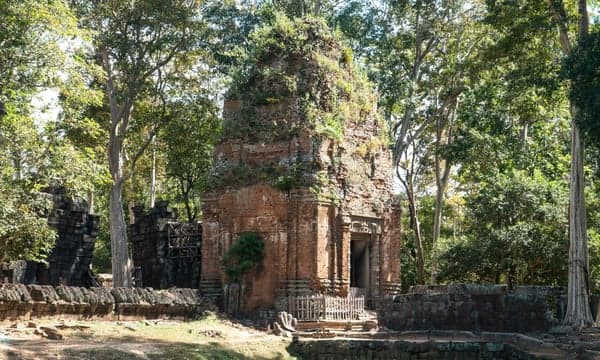
When civil war engulfed Cambodia from the 1970s onward, these remote jungle sites became devastatingly vulnerable. Armed looters, sometimes working in organized networks with connections to international dealers, systematically attacked temples across the country. Statues were sawed from their pedestals, lintels were hacked from doorways, and entire galleries were stripped bare. The resulting wounds — stumps of stone where legs and arms once stood, bare plinths that once supported divine figures — are still visible at sites like Koh Ker and Prasat Chen today.
Prosecutors, investigators, and journalists who have spent years examining the paper trail allege that Latchford was not merely an opportunistic buyer of objects that happened to pass through the market. Rather, he is accused of having actively facilitated, directed, and profited from this organized plunder on a massive scale.
Matthew Campbell's Investigation: Uncovering a Hidden History
Matthew Campbell's book brings rigorous journalistic investigation to bear on this complex and morally troubling story. Drawing on court documents, private correspondence, interviews with investigators, Cambodian officials, and those who knew Latchford personally, Campbell constructs a detailed portrait of a man who operated with near impunity for decades, shielded in part by the willingness of prestigious institutions to ask as few questions as possible about the provenance of objects they were eager to acquire.
The book arrives at a moment when the global cultural heritage community is grappling seriously — perhaps for the first time — with the provenance of its own collections. Major institutions including the Metropolitan Museum of Art in New York and the Norton Simon Museum in California have already returned Khmer artifacts linked to Latchford following investigations by the Manhattan District Attorney's office and Cambodian and Thai authorities. These repatriations, long resisted, have gathered pace in recent years and represent a meaningful, if incomplete, reckoning.
The Legal Case That Never Reached Its Conclusion
In 2019, Latchford was indicted by the United States Department of Justice on federal charges of wire fraud and conspiracy related to the trafficking of looted Cambodian antiquities. The indictment marked a historic moment — the first time a major Western antiquities dealer had faced criminal charges of this kind in the United States in connection with Cambodian looting. Latchford, however, died in Bangkok in August 2020 at the age of eighty-eight, before the case could come to trial. His death denied Cambodian authorities and heritage advocates the public legal reckoning many had hoped for.
Campbell's book, in a very real sense, serves as the accounting that the courtroom never provided.
Why This Story Matters Beyond Cambodia
The Latchford case is not simply a story about one man or one country. It is a story about systemic failures — the willingness of auction houses, dealers, and collecting institutions to prioritize acquisition over ethical scrutiny, and the ease with which wealth and social prestige could insulate a figure from accountability for decades. It raises uncomfortable questions about objects currently displayed in collections around the world and about what obligations institutions have toward source communities whose heritage they hold.
- Hundreds of Khmer artifacts linked to Latchford have been identified in collections worldwide.
- Multiple major museums have agreed to repatriate objects following investigations.
- Cambodia continues to formally request the return of looted cultural property from institutions globally.
- The case has prompted broader discussions about provenance standards across the international art market.
A Reckoning Long in Coming
For Cambodia, a country still processing the catastrophic trauma of the Khmer Rouge genocide and decades of subsequent conflict, the return of looted cultural property carries profound symbolic and spiritual weight. These are not merely decorative objects. They are gods, ancestors, and the embodied memory of a civilization. When they are brought home, something essential is restored alongside them.
Matthew Campbell's examination of the man who stole those gods is a vital contribution to one of the most important conversations in contemporary cultural heritage: who owns the past, who is responsible for protecting it, and what justice looks like when that responsibility has been catastrophically betrayed.