
The Faster Labor Contracts Act Has Passed the House — Here's What You Need to Know
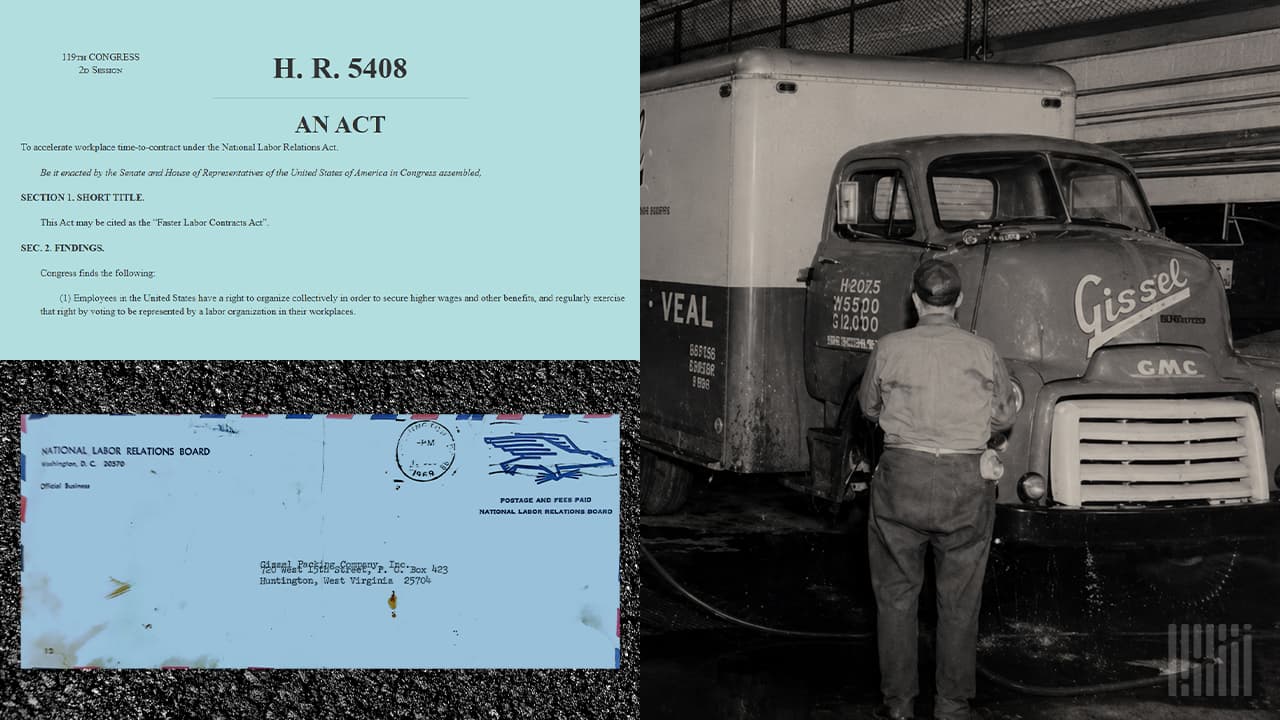
A significant shift in American labor law may be on the horizon. H.R. 5408, known as the Faster Labor Contracts Act, has passed the House of Representatives, setting the stage for what could be one of the most consequential amendments to the National Labor Relations Act (NLRA) in decades. For employers, newly certified unions, workers, and labor law practitioners alike, the implications are sweeping — and the timeline it introduces is anything but forgiving.
To understand why this legislation matters so deeply, it helps to understand where it fits in the long, contested history of American labor relations — a history that, for some, is deeply personal.
A Legacy That Shaped Labor Law: NLRB v. Gissel Packing Co.
No discussion of first-contract bargaining in the United States can begin without referencing NLRB v. Gissel Packing Co., the landmark 1969 Supreme Court decision that remains foundational case law in every labor law course taught in every law school in the country. The case established the legal framework for NLRB authorization card bargaining orders — a mechanism that allows the NLRB to order an employer to bargain with a union even without a formal election, based solely on union authorization cards signed by a majority of workers.
Roman Gissel, founder of Gissel Packing in Huntington, West Virginia, built a meatpacking company from virtually nothing. Rather than submit to NLRB-ordered bargaining, he chose to close his doors entirely — putting every employee out of work rather than operate a business on terms he did not accept. He lost the Supreme Court case. He had already made his choice. That story has echoed through labor law for over fifty years.
The Faster Labor Contracts Act, H.R. 5408, is designed to make that kind of defiance largely irrelevant by removing the procedural space in which employers have historically delayed or avoided first-contract agreements.
What the Faster Labor Contracts Act Actually Does
At its core, H.R. 5408 amends the National Labor Relations Act to impose a compressed, federally mandated timeline for first contract negotiations between an employer and a newly certified union. The sequence is mechanical and, critically, non-negotiable.
- Day 10: The employer must begin bargaining with the newly certified union within ten days of certification.
- Day 100: If no contract agreement has been reached within one hundred days, federal mediation is automatically triggered through the Federal Mediation and Conciliation Service (FMCS).
This structure is a direct response to a well-documented pattern in American labor relations: newly certified unions frequently face months or even years of delay before securing a first contract. Studies have consistently shown that a significant percentage of newly unionized workplaces never reach a first agreement at all. Supporters of the bill argue that this dynamic undermines the entire purpose of collective bargaining rights — that a worker's vote to unionize means little if it never translates into an actual contract.
Why First Contracts Matter So Much
First contracts are not merely symbolic. They establish wages, benefits, grievance procedures, work rules, and the foundational terms of the employment relationship under union representation. Without a first contract, workers remain in a state of legal uncertainty despite having exercised their right to organize. Employers retain significant unilateral authority over working conditions, and the union's practical power remains limited.
The delay problem is structural, not accidental. Under current law, an employer's obligation is to bargain "in good faith," but the definition of good faith has been litigated endlessly, and the NLRB's enforcement process is slow. A determined employer can extend first-contract negotiations for years through legal challenges, appeals, and procedural maneuvers — often long enough that worker enthusiasm wanes, union membership erodes, and the organizing effort effectively collapses without the employer ever having to formally reject unionization.
H.R. 5408 is an attempt to close that window.
The Employer Perspective: Concerns About Compressed Timelines
Business groups and employer-side labor attorneys have raised substantial objections to the bill. Their core argument is that complex first-contract negotiations involving wages, benefits, safety provisions, and operational logistics cannot be responsibly compressed into an arbitrary one-hundred-day window. They argue that mandatory mediation — and potentially binding arbitration if mediation fails — effectively removes the employer's right to reach or reject terms freely, substituting a federal process for genuine mutual agreement.
Critics also contend that the legislation tilts the balance of power toward unions at a moment when organizing activity is already rising across multiple sectors of the economy, from warehouses and logistics to healthcare and tech. From this perspective, the bill does not level the playing field so much as tilt it.
The Union and Worker Perspective: Closing the First-Contract Gap
Proponents of the Faster Labor Contracts Act argue that the current system is fundamentally broken for workers. Winning a union election is supposed to be the beginning of collective bargaining — not the end of the road. When employers can delay indefinitely, the election result is rendered meaningless in practice. Supporters view the mandated timeline not as government overreach but as a necessary correction to decades of structural imbalance that has allowed employers to defeat unions through attrition rather than negotiation.
For labor organizers, the bill represents a long-sought tool to ensure that a successful organizing campaign actually delivers something tangible to the workers who voted for representation.
What Happens Next: The Road to the Senate and Beyond
With the House vote complete, the Faster Labor Contracts Act now moves to the Senate, where its prospects are less certain. Labor legislation faces intense scrutiny in the Senate, and the bill's fate will depend heavily on the political composition of key committees and the willingness of members to engage in the procedural battles that major labor legislation typically generates.
Regardless of its immediate legislative fate, H.R. 5408 has already changed the conversation. It signals a renewed federal appetite for intervening directly in the mechanics of collective bargaining — not just at the certification stage, but at the contract stage as well. For employers, unions, and workers across every industry, that conversation is worth following closely.
Roman Gissel walked away from everything he built rather than bargain on terms not his own. The Faster Labor Contracts Act is, in many ways, a legislative answer to that choice — one that says the era of simply waiting workers out may be coming to a close.