
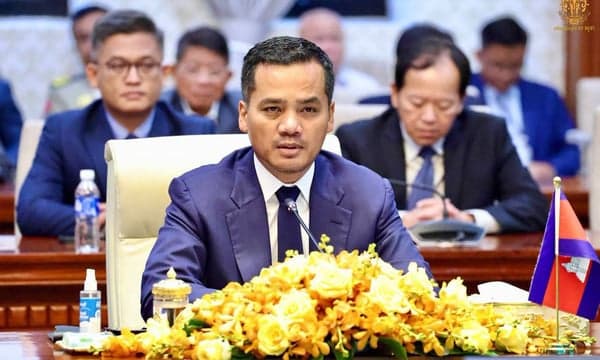
When the Threat Has Already Passed: Understanding Sar Sokha's Washington Fixation
There is something almost theatrical about a powerful government minister railing against a foreign policy weapon that has already been put back in its holster. Yet that is precisely the situation unfolding in Phnom Penh, where Cambodia's Interior Minister Sar Sokha appears consumed by anxiety over a Washington sanctions regime that no longer exists in the form he fears. His belated panic raises serious questions — not just about the minister himself, but about the broader political culture inside Cambodia's ruling establishment and what it truly fears from the international community.
To understand why this moment matters, it is worth stepping back and examining the anatomy of sanctions anxiety among Southeast Asian political elites, why the specter of U.S. Treasury designations carries such psychological weight, and what it tells us when a senior official directs energy at a threat that has effectively evaporated.
The Sanctions Architecture That Once Loomed Over Cambodia
For years, Cambodian officials with ties to alleged human rights abuses, corruption, and the systematic dismantling of democratic institutions had genuine reason to monitor Washington's policy toolkit carefully. The United States Treasury Department's Office of Foreign Assets Control, better known as OFAC, and related executive order mechanisms gave American policymakers the ability to freeze assets and impose travel restrictions on foreign nationals deemed to undermine democratic processes or engage in significant corruption.
During the height of tensions between Washington and Phnom Penh — particularly following the dissolution of the Cambodia National Rescue Party in 2017 and the deeply contested 2018 elections that returned the Cambodian People's Party to power without meaningful opposition — the threat of targeted sanctions felt very real inside the corridors of Cambodian power. Several Cambodian officials did face visa restrictions, and the broader bilateral relationship deteriorated sharply.
That environment created a generation of Cambodian officials acutely sensitive to signals from the U.S. State Department and Treasury. The problem, as Sar Sokha's behavior now illustrates, is that political anxiety, once internalized, does not always update itself when circumstances change.
Sar Sokha's Adversary: A List That No Longer Exists
What makes the Interior Minister's current posture so striking is its apparent disconnection from present reality. The specific sanctions architecture that Sar Sokha seems to be fighting against has either lapsed, been restructured, or no longer operates in the manner that would make his rhetorical response relevant. In essence, he has found a formidable adversary in Washington — and that adversary is a ghost.
This is not simply an embarrassing miscalculation on his part. It is a window into how political elites in authoritarian-leaning systems process external pressure. Sanctions threats, even when removed or modified, leave lasting imprints. They become part of the internal political vocabulary, useful for rallying nationalist sentiment domestically even when the external threat has been neutralized or transformed.
Sar Sokha's posture thus serves a dual function. Outwardly, it may appear to be defensive positioning against American interference. Inwardly, it functions as a performance of toughness aimed at a domestic audience — signaling that the Interior Minister is not cowed by foreign pressure and is vigilant in defending Cambodian sovereignty. The fact that the threat he is defending against is largely obsolete is, from this angle, almost beside the point.
The Deeper Pattern: Political Paranoia as Governance Strategy
Cambodia's political landscape under long-time strongman Hun Sen and his son Hun Manet, who assumed the premiership in 2023, has been characterized by a particular style of governance in which external enemies — real and imagined — are regularly invoked to justify internal consolidation of power. Civil society organizations have been shuttered, independent media outlets forced to close or flee, and opposition political figures exiled, imprisoned, or otherwise silenced, often with reference to foreign interference or destabilization narratives.
In this context, Sar Sokha's sanctions fixation fits neatly into an established playbook. By positioning himself as a defender of Cambodia against American pressure — even pressure that has effectively subsided — he reinforces the government's broader narrative that external forces are constantly conspiring against Cambodian stability and sovereignty. It is a narrative that has proven durable and domestically effective, even when the facts on the ground have shifted considerably.
What This Reveals About U.S.-Cambodia Relations
The episode also reflects the complicated and often misread state of U.S.-Cambodia relations. Washington's approach to Phnom Penh has shifted through multiple phases — from active engagement, to concern over Chinese military access to Ream Naval Base, to calibrated pressure through aid restrictions and diplomatic signaling. The relationship is neither as hostile as Cambodia's government sometimes portrays it, nor as warm as either side might prefer.
Sar Sokha's misreading of where that relationship currently stands — and specifically of what policy instruments Washington is or is not deploying — suggests an intelligence and analytical failure within Cambodia's government, or alternatively, a deliberate choice to misrepresent the situation for political gain. Neither interpretation reflects well on the administration.
The Cost of Fighting Phantom Threats
There is a practical cost to this kind of political theatrics beyond the immediate absurdity of the situation. When a senior minister invests political capital in combating a non-existent threat, it distorts the government's actual foreign policy priorities, poisons bilateral dialogue with unnecessary antagonism, and signals to the international community that Cambodian leadership is either poorly informed or willfully misleading.
It also consumes domestic political oxygen that could otherwise be directed toward genuine governance challenges — Cambodia's persistent poverty rates, its underdeveloped rule of law, its dependency on Chinese investment and the vulnerabilities that dependency creates. Fighting ghosts, however satisfying it may feel in the short term, does not move any of those needles.
Conclusion: Accountability in the Age of Performative Sovereignty
Sar Sokha's belated sanctions panic is ultimately a small but telling episode in the larger story of how Cambodia's ruling establishment manages its relationship with external scrutiny. The performance of defiance against a threat that no longer operates as feared says more about the minister's political insecurities — and the government's reliance on external bogeymen — than it does about any real confrontation with Washington.
For international observers, journalists, and human rights advocates watching Cambodia, the lesson is clear: pay less attention to the bluster, and more attention to what the bluster is designed to conceal. The ghosts Sar Sokha is fighting may not be real. The governance failures that make those ghosts useful certainly are.