
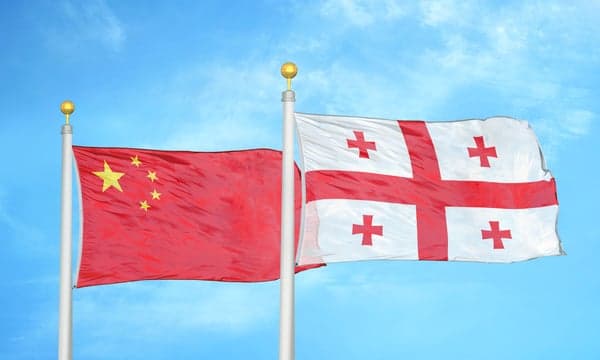
Georgia and China Upgrade Ties — But Is It Meaningful?
When Tbilisi and Beijing announced their new "comprehensive strategic partnership" in 2024, the headline sounded significant. A small South Caucasus nation — long considered a candidate for Euro-Atlantic integration — formally deepening its relationship with the world's second-largest economy. Foreign policy analysts took note. Western capitals raised eyebrows. And Georgian civil society, already locked in an exhausting standoff with the ruling Georgian Dream party, braced for another signal of democratic backsliding dressed up in the language of multilateral diplomacy.
But strip away the ceremony, the formal language, and the grandiose title, and what remains is far less consequential than it first appears. The Georgia-China comprehensive strategic partnership tells us considerably more about Georgian Dream's domestic political calculations than it does about any genuine, substantive deepening of bilateral relations between Tbilisi and Beijing.
What "Comprehensive Strategic Partnership" Actually Means
The phrase "comprehensive strategic partnership" is one of Beijing's most well-worn diplomatic tools. China has deployed this label with dozens of countries across Africa, Asia, Latin America, and now the South Caucasus. It is a tiered designation within China's broader foreign policy framework — sitting above a standard partnership but below the coveted "comprehensive strategic cooperative partnership" reserved for countries like Russia and Pakistan.
In practical terms, a comprehensive strategic partnership with China typically involves enhanced diplomatic dialogue, expressions of mutual respect for sovereignty, and commitments to deepen economic cooperation. What it rarely involves, at least immediately, is a dramatic surge in investment, trade volume, or security coordination. The label is diplomatic currency — valuable for optics, modest in operational content.
For Georgia, a country with relatively limited trade ties with China and no significant Chinese infrastructure investment to speak of, the upgrade is even more symbolic than it would be elsewhere. Beijing's interest in Tbilisi is real but measured. China values Georgia's position along the Middle Corridor — the Trans-Caspian International Transport Route connecting China to Europe via Central Asia and the South Caucasus — but Georgia is one node among many, and not the most critical one at that.
Georgian Dream's Political Calculus
To understand why Georgian Dream pursued this partnership upgrade so visibly and at this particular moment, one must look inward rather than outward. The ruling party has spent the past two years in an increasingly open confrontation with the European Union, the United States, and Georgia's own pro-Western civil society. The passage of the so-called "foreign agents" law — widely criticized as a replica of Russian legislation designed to suppress independent media and NGOs — effectively froze Georgia's EU accession process and triggered some of the largest street protests the country has seen in years.
Faced with Western condemnation and a restive population, Georgian Dream has been searching for a counter-narrative. The China partnership serves that purpose elegantly. It signals to domestic audiences and international observers alike that Tbilisi has options — that it is not dependent on Brussels or Washington, and that it can pursue a multi-vector foreign policy that hedges between West and East. In this context, the partnership is less a strategic reorientation and more a political pressure valve.
This is a pattern familiar from other governments that have found themselves in conflict with Western democratic norms. When formal relationships with Europe and the United States become strained, a high-profile engagement with Beijing or Moscow offers a useful counterweight in the public relations battle, even if the substantive benefits remain elusive.
Beijing's Interests: Opportunistic, Not Transformative
China, for its part, is happy to play along — up to a point. Beijing has a consistent interest in expanding its diplomatic footprint wherever Western alliances show cracks. A Georgian Dream government that is cooling on EU integration and antagonizing Washington is, from Beijing's perspective, a modest opportunity worth cultivating. Granting Tbilisi an upgraded partnership designation costs China very little and earns goodwill with a government that may prove useful in multilateral forums.
But China is also pragmatic. It is unlikely to pour significant economic resources into Georgia without clearer guarantees of stability, market access, and strategic return. The Middle Corridor remains attractive in theory, but Chinese investment tends to follow established relationships and bankable projects. Georgia's ongoing political volatility and its unresolved territorial conflicts — South Ossetia and Abkhazia remain occupied by Russian-backed forces — make it a complicated environment for large-scale Chinese commitment.
What This Means for Georgia's Future
For ordinary Georgians, the comprehensive strategic partnership with China is unlikely to translate into tangible improvements in daily life, economic opportunity, or security in the near term. The trade relationship between the two countries remains modest, Chinese tourism and investment have not surged dramatically, and Beijing has shown no appetite for the kind of deep political engagement that would make the partnership genuinely transformative.
What the partnership does do is further complicate Georgia's path back toward European integration. Every gesture toward Beijing is noted in Brussels and Washington, and trust, once eroded, is slow to rebuild. The Georgian people have consistently expressed strong pro-European sentiment in polling, making Georgian Dream's eastward signals a source of deep domestic tension as much as diplomatic repositioning.
A Signal Without a Destination
The Georgia-China comprehensive strategic partnership is best understood as a diplomatic gesture in search of a strategy. Georgian Dream has sent a signal — to the West, to its domestic critics, and to an international audience — but the signal points nowhere clearly defined. Beijing has accepted the gesture without committing to the substance. And Georgia, caught between its stated Euro-Atlantic aspirations and its ruling party's authoritarian instincts, remains at a crossroads with no easy exit.
Loud as the announcement was, it echoes in an empty room.