
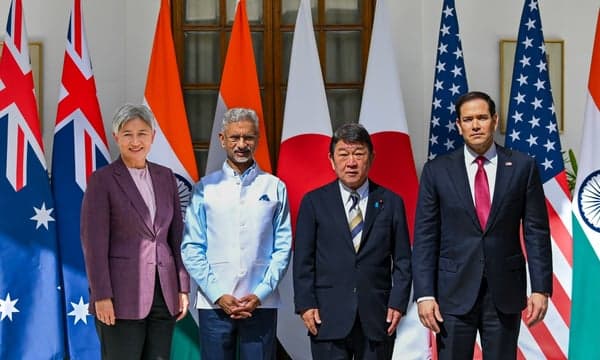
The Quad's Quiet Resilience in a Turbulent World
In an era defined by geopolitical uncertainty, shifting alliances, and the constant threat of great power competition, the Quad — the informal strategic grouping comprising the United States, India, Japan, and Australia — has emerged as one of the most discussed yet least understood security arrangements of the 21st century. Critics have long pointed to its relatively thin institutional structure as a fundamental weakness, arguing that without a formal treaty, binding commitments, or a permanent secretariat, the Quad is little more than a talking shop. But a closer look at what is actually happening on the ground tells a more nuanced and ultimately more optimistic story.
The regular tempo of practical, on-the-ground cooperation among Quad members suggests that this grouping may in fact be far more resilient than its institutional architecture implies. Rather than being undone by higher-level political volatility — changes in government, shifts in diplomatic tone, or competing national priorities — the Quad appears to have built a durable foundation through operational habits, shared exercises, and functional collaboration that continues largely regardless of what is happening in the headlines.
Understanding the Quad's Institutional Design
To appreciate why the Quad's informal structure might actually be a strategic asset rather than a liability, it helps to understand what that structure looks like in practice. Unlike NATO, which has a formal treaty obligation under Article 5, or AUKUS, which involves binding defense technology transfers, the Quad operates through summits, ministerial meetings, and working groups focused on areas like climate, health security, critical technology, and maritime domain awareness.
This design is deliberate. The Quad's architects understood that each member nation brings different threat perceptions, domestic political constraints, and historical baggage to the table. India, for instance, has long maintained a tradition of strategic autonomy and is wary of anything that resembles a formal military alliance. Japan operates under constitutional constraints — though these have been steadily evolving. Australia and the United States, while close treaty allies, each navigate their own relationship with China that cannot always be reduced to simple confrontation.
By keeping the Quad informal, its members retain the flexibility to engage without triggering domestic political backlash or diplomatic crises with Beijing. The result is a grouping that can adapt — and that adaptability may be exactly what is needed in a new strategic era.
On-the-Ground Cooperation: The Real Story
Perhaps the most compelling evidence for the Quad's durability is the sheer volume and regularity of practical cooperation that happens below the level of high-profile summits. Naval exercises like Malabar — which now routinely includes all four Quad members — have grown in scope and complexity. Intelligence sharing, coast guard coordination, and humanitarian assistance and disaster relief (HADR) operations have deepened the operational ties between member militaries in ways that would be difficult to simply switch off.
Beyond the military dimension, Quad members have collaborated on vaccine distribution initiatives, semiconductor supply chain resilience, undersea cable infrastructure, and clean energy transition programs. These functional workstreams are not glamorous, but they are sticky. Once technical agencies, defense establishments, and private sector actors from four countries are regularly working together, momentum builds and institutional memory forms — even in the absence of a formal institution.
This is precisely how the Quad insulates itself from political volatility at the highest levels. Even when a particular summit is overshadowed by domestic political drama in one member country, or when a bilateral relationship between two members hits a rough patch, the working-level machinery keeps running. In this sense, the Quad resembles less a formal alliance and more a living network — and networks are notoriously difficult to dissolve.
Navigating Political Headwinds
That is not to say the Quad faces no challenges. Political transitions in any of the four capitals can generate uncertainty about the grouping's direction and ambition. Leadership changes, election cycles, and evolving public opinion on China policy all have the potential to slow momentum or shift priorities. The Quad's consensus-based model also means that any one member can effectively pump the brakes on initiatives it finds uncomfortable.
India's continued engagement with Russia — most visibly through its ongoing purchase of discounted Russian oil following the invasion of Ukraine — has created periodic friction with its Quad partners. Meanwhile, domestic political pressures in the United States and Australia around trade, immigration, and defense spending can distract from the sustained strategic attention the Quad requires to deliver on its ambitions.
Yet even these headwinds underscore a broader point: the Quad has survived and continued to function through periods of significant strain. That is not nothing. For a grouping without a formal treaty or secretariat, this level of continuity is actually remarkable.
What Delivery Looks Like in a New Strategic Era
If the Quad is to truly deliver on its potential in this new strategic era, it will need to translate its operational momentum into tangible outcomes that regional partners — particularly smaller Indo-Pacific nations — can feel and benefit from. This means moving from declarations to delivery: on infrastructure investment, on maritime security capacity building, on technology access, and on disaster response.
It also means being honest about what the Quad is and is not. It is not a military alliance. It is not a containment strategy in the Cold War mold. It is, at its best, a flexible platform through which four like-minded democracies can pool influence, share burdens, and project a credible, constructive presence across the Indo-Pacific.
Conclusion: Betting on Cooperation Over Architecture
The Quad's story challenges a common assumption in international relations: that formal institutions are always stronger than informal ones. The evidence from the Quad's trajectory suggests that regular, practical cooperation can build resilience that no treaty can fully manufacture. In a strategic era defined by uncertainty and flux, that may ultimately be the Quad's greatest strength — and the clearest signal that it has a meaningful role to play in the decades ahead.