
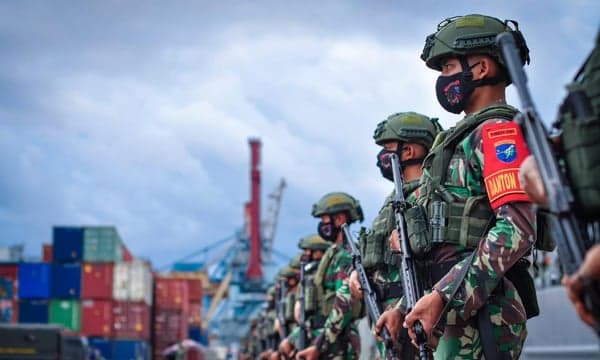
Introduction: A Delicate Balance of Security and Oversight
Indonesia has long grappled with the specter of terrorism, from the devastating Bali bombings of 2002 to a series of more recent attacks linked to domestic and transnational extremist networks. In response, the country has developed a multi-layered counterterrorism architecture that involves both civilian law enforcement agencies and the Indonesian National Armed Forces, known as the Tentara Nasional Indonesia or TNI. While the TNI's past involvement in counterterrorism has yielded notable results, a growing debate is emerging over whether further expanding its role could do more harm than good.
This article examines the historical context of TNI's counterterrorism contributions, the institutional landscape surrounding Indonesian security policy, and the potential risks associated with broadening military authority in a domain traditionally managed by civilian institutions.
A History of Military Involvement in Indonesian Counterterrorism
The TNI's engagement in counterterrorism is not a new phenomenon. Since the early 2000s, Indonesian security forces have collaborated across institutional lines to dismantle extremist networks operating within the archipelago. The military has provided critical logistical support, intelligence assets, and specialized capabilities — particularly in remote or conflict-affected regions such as Poso and parts of Papua — where the reach of civilian police forces is limited.
Indonesia's primary counterterrorism body, the National Counterterrorism Agency known as BNPT (Badan Nasional Penanggulangan Terorisme), operates alongside the elite police unit Densus 88, which has historically led tactical counterterrorism operations. In this framework, the TNI has largely played a supporting role, contributing to the broader security ecosystem without dominating it.
This arrangement has, for the most part, worked. Indonesia is widely cited as a regional success story in counterterrorism, having significantly weakened organizations like Jemaah Islamiyah (JI) and disrupted numerous attack plots before they came to fruition. The collaborative model — civilian-led with military support — has been central to that success.
The Push to Expand TNI's Counterterrorism Mandate
In recent years, voices within Indonesian policy circles and the military establishment itself have advocated for a more prominent role for the TNI in counterterrorism operations. Proponents argue that the evolving nature of terrorist threats — including the rise of ISIS-affiliated cells and returning foreign fighters — demands a more robust military response. They point to the TNI's superior resources, training infrastructure, and operational reach as reasons to integrate it more deeply into frontline counterterrorism efforts.
Legislative moves have reflected this sentiment. Revisions to Indonesia's military law and ongoing discussions around the counterterrorism legal framework have opened the door to a potentially expanded TNI mandate. Supporters of reform argue that clearer legal authorization for military action would eliminate ambiguity in the field and allow for faster, more coordinated responses to emerging threats.
Why Expansion Could Complicate Existing Efforts
Despite these arguments, expanding the TNI's counterterrorism role is not without serious risks. Critics — including civil society organizations, legal scholars, and international observers — warn that doing so could undermine the very framework that has made Indonesia's counterterrorism approach effective.
Erosion of Civilian Oversight
One of the most significant concerns is the potential erosion of civilian oversight over security operations. Indonesia's post-Suharto democratic transition was built, in part, on the principle of civilian supremacy over the military. Expanding TNI authority in counterterrorism without robust accountability mechanisms risks blurring the line between military and civilian domains, which could set a troubling precedent for democratic governance more broadly.
Risk of Human Rights Violations
Military forces operate under different legal frameworks and rules of engagement than civilian police. Where Densus 88 and BNPT are bound by criminal procedure law and subject to judicial oversight, military operations traditionally follow a different logic — one oriented toward neutralizing threats rather than building prosecutable cases. An expanded TNI role could therefore increase the risk of extrajudicial actions, excessive force, and human rights violations, particularly in marginalized communities already wary of state security apparatus.
Duplication and Coordination Failures
Indonesia's counterterrorism ecosystem is already complex, involving multiple agencies with overlapping jurisdictions. Introducing the TNI as a more active operational player — rather than a supporting one — could exacerbate coordination failures, create turf battles between institutions, and dilute accountability. Effective counterterrorism depends not just on capability, but on clearly defined roles, shared intelligence, and seamless inter-agency communication. Ambiguity in command structures could be exploited by adversaries or lead to costly operational errors.
Alienating Communities and Undermining Prevention
Perhaps most critically, a militarized approach to counterterrorism risks alienating the very communities whose cooperation is essential to long-term success. Prevention and deradicalization efforts — which have been a cornerstone of Indonesia's counterterrorism strategy — depend on trust between security forces and the public. A visible expansion of military presence and authority in civilian counterterrorism could undermine that trust, particularly in regions with historical grievances against the Indonesian state.
Striking the Right Balance Going Forward
The future of TNI's involvement in Indonesian counterterrorism should be shaped by evidence, legal clarity, and democratic accountability — not institutional ambition or short-term political pressures. Any expansion of the military's role must be accompanied by robust oversight mechanisms, clear delineation of authority, and strong protections for civil liberties.
Policymakers should invest in strengthening existing civilian counterterrorism institutions rather than defaulting to military expansion as a solution. BNPT and Densus 88 can be made more capable through better funding, training, and inter-agency coordination. Where the TNI's unique capabilities are genuinely needed, their deployment should be authorized through transparent legal frameworks with clear sunset clauses and parliamentary oversight.
Conclusion
Indonesia's track record in counterterrorism stands as a testament to what a well-coordinated, civilian-led security approach can achieve. The TNI has been a valuable partner in that effort, but partnership is not the same as primacy. As Indonesia charts the future of its security architecture, the lesson of its own success should guide the way: balance, accountability, and the protection of democratic norms are not obstacles to effective counterterrorism — they are its foundation.