
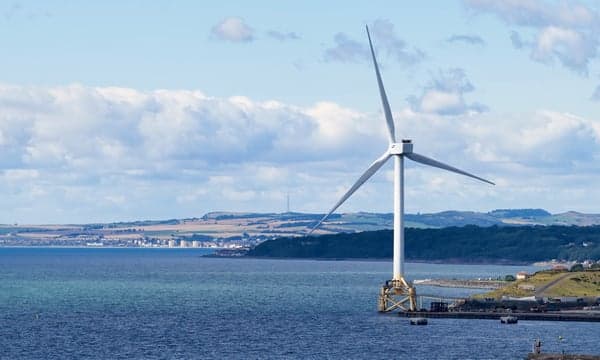
Japan Is Bankrolling Offshore Wind in the UK — But What About Japanese Waters?
Japan's major energy companies are quietly becoming significant players in the United Kingdom's offshore wind sector. Through a growing Japan-UK compact on clean energy investment, Japanese corporations have demonstrated that they have both the appetite and the capital to fund large-scale offshore wind development — at least when it's happening somewhere else. Back home, however, Japan's own offshore wind ambitions are moving far more slowly, raising an important question: why are Japanese firms more willing to invest in British waters than in their own?
The answer is complicated, touching on regulatory hurdles, grid infrastructure, community relations, and the particular geography of Japan's coastlines. Understanding this gap matters not just for Japan's energy policy, but for the global offshore wind industry as a whole.
The Japan-UK Energy Partnership: A Growing Commitment
In recent years, Japanese energy giants and trading houses have significantly deepened their ties with the UK's offshore wind market. Companies with roots in oil, gas, and traditional utilities have poured investment into North Sea wind projects, viewing the UK as a stable, well-regulated environment with a mature supply chain and clear government support mechanisms.
The UK, for its part, has welcomed this capital. Offshore wind is central to Britain's plan to decarbonize its electricity grid, and Japanese investment helps accelerate project timelines and spread financial risk across international partners. The relationship is mutually beneficial on paper — but it also highlights a stark contrast with conditions back in Japan.
Japan has set ambitious renewable energy targets, aiming for offshore wind to contribute a substantial share of the nation's electricity by 2030 and beyond. The government has passed enabling legislation, designated "promotion zones" along the coastline, and begun the slow process of licensing. And yet, the buildout remains sluggish compared to what Japanese companies are helping achieve in European waters.
Why Domestic Offshore Wind Development Is Lagging
Several structural factors explain why offshore wind in Japan has been slower to take off than many policymakers hoped.
Complex Seabed Rights and Regulatory Frameworks
Japan's regulatory landscape for offshore wind is still maturing. Securing seabed usage rights, navigating fisheries agreements, and satisfying environmental impact requirements all add layers of complexity that developers in the UK — with its decades-long offshore energy tradition — do not face to the same degree. The legal frameworks are newer in Japan, which means processes that should be predictable often are not.
Grid Infrastructure Challenges
Japan's electricity grid is fragmented. Unlike interconnected European grids that can absorb and distribute power over vast distances, Japan's grid is split into regional systems with limited interconnection between them. This makes it harder for offshore wind farms, which tend to be located away from major population centers, to deliver electricity where it is needed most. Grid upgrades are underway, but they are expensive, slow, and require coordination between multiple stakeholders.
Fierce Competition from Established Industries
Japan's coastal waters have long been the domain of fishing communities. Fisheries associations hold significant social and political weight in coastal regions, and their buy-in is effectively required before offshore wind projects can proceed. Developers who have underestimated the depth of this relationship have faced project delays or outright rejection. Negotiating with fishing communities is not simply a bureaucratic step — it is a foundational part of the social license that any project must earn.
Local Communities Must Not Be Left Behind
This brings us to perhaps the most important dimension of Japan's offshore wind challenge: equity and community inclusion. The Japan-UK compact may showcase Japanese corporate ambition, but ambition without community partnership will not be enough to unlock domestic potential.
In Japan's coastal regions, the communities that would live closest to offshore wind installations are often economically fragile. Fishing villages have seen declining catches and aging populations for decades. Rather than viewing these communities as obstacles to development, the offshore wind industry — and the government — must treat them as essential partners whose cooperation, and whose share in economic benefits, is non-negotiable.
Some international examples point to better models. In parts of Denmark and Scotland, local fishermen have become co-owners of wind projects, receiving revenue that supports their livelihoods while the turbines generate clean electricity. Community benefit funds, local employment guarantees, and transparent compensation schemes have all helped ease tensions between developers and coastal residents. Japan's developers and policymakers would do well to study these models carefully rather than defaulting to top-down approaches that have repeatedly stalled projects.
What Japanese Investment in the UK Reveals About Domestic Barriers
The willingness of Japanese companies to invest so confidently in British offshore wind is itself a revealing data point. It tells us that these companies understand the technology, trust the financial model, and believe in the sector's long-term viability. The hesitancy at home, therefore, is not about skepticism toward offshore wind as an industry — it is about the specific conditions in Japan that make domestic projects harder to execute.
Acknowledging this distinction is important because it reframes the problem. Japan does not need to be convinced that offshore wind works. What it needs is a domestic policy environment that reduces regulatory uncertainty, accelerates grid investment, and — critically — ensures that coastal communities are genuine partners in the energy transition rather than bystanders who absorb the disruption while the profits flow elsewhere.
The Path Forward: Turning Overseas Expertise Into Domestic Progress
The experience Japanese companies are gaining in the North Sea and other international markets is genuinely valuable. They are learning how to manage large, complex offshore projects in challenging marine environments. They are building relationships with turbine manufacturers, cable suppliers, and installation vessels. That expertise does not have to stay offshore — it can and should be channeled back into Japan's own emerging market.
To make that happen, Japan needs a few things to align. Regulatory timelines for offshore wind licensing need to become more predictable. Grid expansion must be treated as infrastructure as essential as roads and railways. And community engagement must be built into project design from the very beginning — not added as an afterthought when opposition has already hardened.
Japan has shown it can back offshore wind when conditions are right. The next challenge is creating those conditions at home, and making sure the communities that have shaped Japan's coastlines for generations are not left behind when the turbines finally start turning.