
Japan's Retail FX Traders Are Betting the Government Will Save the Yen
Japan's massive community of retail foreign exchange traders has made a striking pivot. After years of profiting from yen weakness — a strategy so popular it earned its own cultural nickname — these everyday investors have abruptly reversed course. Heeding warnings from Japanese government officials and sensing a policy shift in the air, retail traders have stopped betting against the yen and are now positioning for a rebound. The move puts them in direct opposition to professional institutional investors who still expect the currency to weaken further. The clash between these two camps reveals a deeper uncertainty gripping the global foreign exchange market: can Japan's government actually defend its currency, and who will be proven right?
Understanding Japan's Retail FX Trading Culture
Japan has one of the most active retail foreign exchange trading communities in the world. Known colloquially as "Mrs. Watanabe" — a nickname coined to represent the stereotypical Japanese homemaker who manages household finances and dabbles in currency speculation — these retail traders have historically been a significant force in global FX markets. Their collective trading volume is large enough that institutional players and central bank watchers pay close attention to their positioning.
For much of the past decade, the dominant trade for this group was straightforward: bet against the yen. With the Bank of Japan (BOJ) maintaining ultra-loose monetary policy while the U.S. Federal Reserve and other central banks raised interest rates aggressively, the interest rate differential made shorting the yen an almost reflexive choice. Borrowing cheaply in yen and investing in higher-yielding foreign assets — the so-called carry trade — generated steady returns and became deeply embedded in Japanese retail trading culture.
That long-running playbook, however, appears to be changing.
Government Warnings and a Shift in Sentiment
Japanese authorities have grown increasingly vocal about currency movements. Senior officials from the Ministry of Finance and the Bank of Japan have repeatedly issued verbal warnings, signaling discomfort with rapid yen depreciation and hinting at the possibility of direct intervention in currency markets. Japan has intervened in the foreign exchange market before — most notably in 2022 — spending tens of billions of dollars to slow the yen's slide. Those interventions demonstrated that the government was willing and able to act, and the memory has clearly registered with retail traders.
In response to the latest round of official warnings, Japan's retail FX community has scaled back or entirely reversed their short yen positions. Rather than continuing to bet on further depreciation, they are now positioning for the yen to strengthen — a direct acknowledgment that they believe government action is both credible and imminent. This represents a significant behavioral shift that underscores just how seriously retail traders take official guidance in Japan, where the relationship between citizens and state institutions carries considerable weight.
Professional Investors Tell a Different Story
Not everyone is convinced the yen is about to rebound. Professional investors and large institutional funds continue to hold bearish positions on the Japanese yen, pointing to structural fundamentals that are difficult to overcome through verbal warnings or even short-term intervention alone.
The key driver of their skepticism is the interest rate gap. While the Bank of Japan has taken tentative steps toward policy normalization — including a historic move away from negative interest rates — its benchmark rate remains far below those of the United States, Europe, and other major economies. As long as that differential persists, the carry trade incentive remains intact, and the fundamental pressure on the yen does not disappear simply because officials express concern.
Professional traders also note that past government interventions, while dramatic in the short term, ultimately did not reverse the yen's long-term trajectory. The currency continued to weaken over subsequent months even after billions were spent defending it. From their perspective, betting against the yen remains a structurally sound position regardless of the political noise surrounding it.
The Intervention Question: Can Tokyo Actually Prop Up the Yen?
Currency intervention is a blunt instrument, and its effectiveness is a matter of serious debate among economists and market strategists. When a government buys its own currency, it can create short-term spikes and squeeze speculative short sellers. However, without a corresponding change in underlying monetary policy, those moves tend to be temporary. Markets eventually reassert themselves.
Japan's foreign exchange reserves are substantial, giving the government real firepower if it chooses to act. But using those reserves is costly, and repeated interventions can draw criticism from trading partners who view the practice as currency manipulation. The United States, in particular, has historically been sensitive to actions by major trading partners that appear designed to weaken their exchange rates for competitive advantage — though defending a currency from decline is a different dynamic from pushing it lower.
The critical variable is whether the Bank of Japan will follow up any intervention with more decisive monetary policy tightening. If the BOJ raises interest rates meaningfully, narrowing the gap with U.S. rates, the structural argument for yen weakness begins to erode. If it does not, intervention may amount to little more than an expensive speed bump.
What This Standoff Means for FX Markets
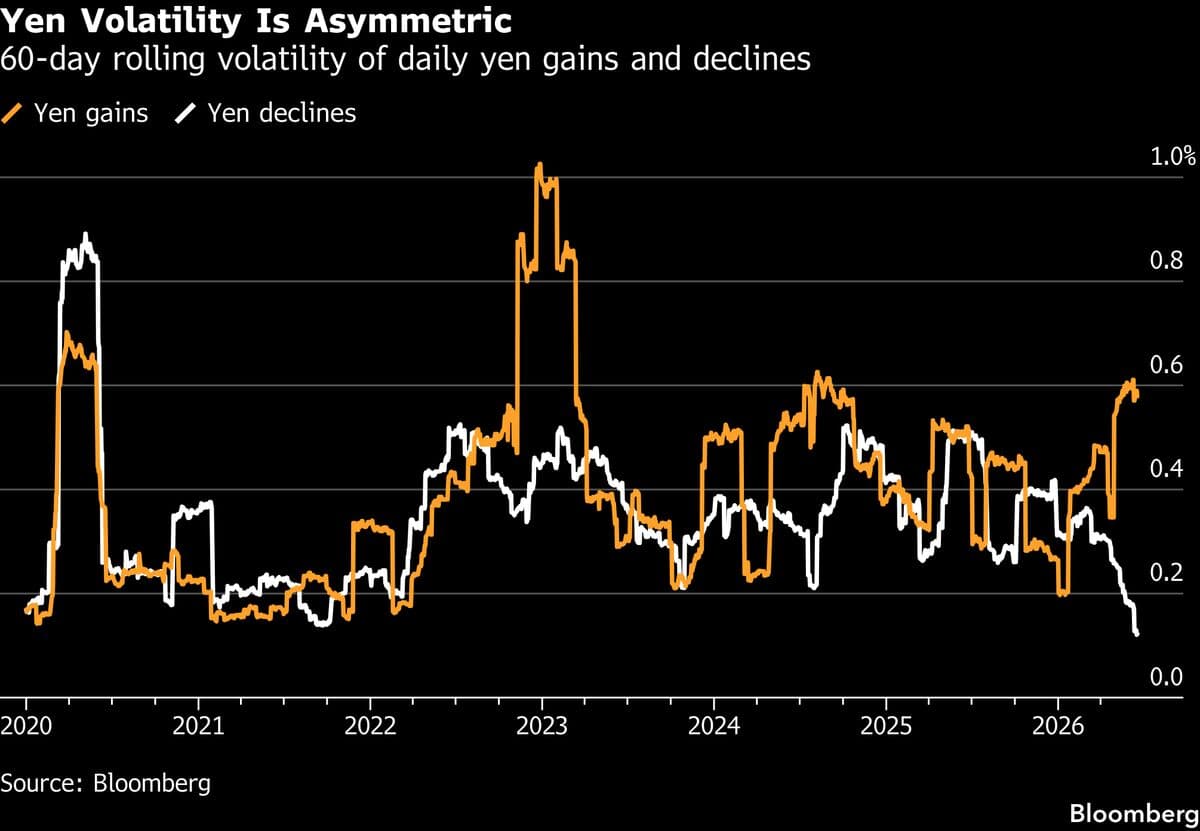
The divergence between retail and professional positioning creates an interesting dynamic in the market. Retail traders clustered on one side of a trade and professionals on the other is a setup that historically resolves with volatility. One group will ultimately be proven wrong, and when positions unwind, the moves can be sharp and fast.
- Retail traders are betting on government credibility and the possibility of near-term intervention, accepting lower carry income in exchange for potential capital gains if the yen rebounds.
- Institutional investors are leaning on interest rate differentials and historical precedent, maintaining short yen exposure while watching for signs that BOJ policy is genuinely shifting.
- Market volatility is likely to remain elevated as long as this standoff persists, with official statements and BOJ meeting outcomes serving as key catalysts.
For anyone watching global currency markets, Japan's yen remains one of the most closely monitored and consequential pairs in the world. The outcome of this battle between retail conviction and institutional skepticism will likely have ripple effects well beyond Tokyo's trading desks — influencing everything from emerging market capital flows to global risk appetite. Whether Japan's retail traders prove prescient or get caught leaning the wrong way, the stakes for this trade have rarely felt higher.