
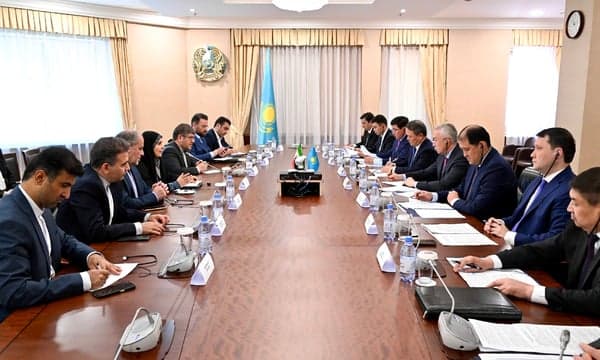
Kazakhstan and Iran: A Transport Partnership Under the Spotlight
Long before the escalation of hostilities between Iran and the United States drew global headlines, Kazakhstan and Iran were quietly building one of Central Asia's most strategically significant transport relationships. Years of bilateral negotiations, infrastructure investments, and corridor planning had already laid a foundation — but the Iran-U.S. conflict has suddenly brought that foundation into sharp relief, forcing both nations to confront a critical question: can they sustain, and even accelerate, the momentum they have built?
The answer matters not just for Astana and Tehran, but for the broader architecture of Eurasian trade and connectivity. Transport corridors are rarely built in a vacuum, and the geopolitical turbulence surrounding Iran introduces both new pressures and, paradoxically, new incentives to push development forward.
The Strategic Logic Behind the Kazakhstan-Iran Transport Axis
Kazakhstan occupies a unique position in the geography of Eurasian transit. Landlocked and vast, it sits at the crossroads of routes connecting China to Europe, Russia to the Persian Gulf, and Central Asia to South Asia. For decades, Kazakhstani policymakers have recognized that transforming the country into a genuine transit hub — rather than merely an energy exporter — requires reliable southern corridors. Iran is the most direct and logical gateway to those corridors.
From Iran's perspective, the calculus is equally compelling. Facing sustained economic pressure from Western sanctions, Tehran has placed enormous emphasis on developing its transit economy as a source of revenue and geopolitical leverage. The International North-South Transport Corridor (INSTC), which runs through Iranian territory connecting Russia and Central Asia to the Indian Ocean, is a centerpiece of that strategy. Kazakhstan is a critical northern link in that chain.
Together, the two countries have worked on connecting rail networks across the Caspian, developing border crossing infrastructure, and aligning customs and logistics procedures. The Bolashak-Serakhes border crossing and the Aktau port on the Caspian Sea have both featured prominently in efforts to build a coherent, end-to-end transit route capable of handling meaningful cargo volumes.
What the Iran-U.S. Conflict Changes — and What It Doesn't
The eruption of direct hostilities between Iran and the United States has introduced a layer of uncertainty that neither Kazakhstan nor Iran can entirely control. For Kazakhstan, the risk is reputational and financial. Astana has spent years carefully managing its relationships with both Washington and Moscow, threading a diplomatic needle that allows it to deepen ties with sanctioned neighbors without triggering secondary sanctions or damaging its access to Western capital and markets.
The conflict amplifies those risks. Any appearance of significantly deepening economic integration with Iran during a period of active U.S. military engagement could invite scrutiny from Washington, complicate Kazakhstan's relationships with international financial institutions, and deter foreign investors who might otherwise fund corridor infrastructure.
At the same time, the conflict does not erase the underlying geographic and economic logic that has driven the transport relationship. If anything, it reinforces Tehran's motivation to operationalize corridors that reduce its dependence on maritime chokepoints vulnerable to U.S. naval pressure. An active, high-volume overland transit route through Kazakhstan and beyond is strategically valuable for Iran in ways that go beyond simple economics.
Infrastructure Progress: How Far Have They Come?
Despite the headline-grabbing nature of current events, it is worth stepping back to assess how much genuine progress has already been made. Over the past several years, both governments have concluded a series of bilateral transport and transit agreements. Rail connectivity across the Caspian — through a combination of rail-ferry links and port upgrades — has improved, though significant bottlenecks remain. Kazakhstan has invested in modernizing the Aktau port complex, expanding its capacity to handle containerized cargo and rolling stock.
On the Iranian side, the long-delayed Rasht-Astara railway, a missing link in the INSTC, has received renewed attention and investment. Completion of this segment would significantly reduce transit times and increase the corridor's commercial attractiveness for shippers moving goods between Russia, Central Asia, and the Persian Gulf.
Progress has been real but uneven. Customs harmonization, while improving, remains a source of friction. Differences in rail gauge standards require transshipment at border points, adding cost and time. And the financing of large-scale infrastructure in Iran is complicated by the sanctions environment, which limits the participation of multilateral development banks and international contractors.
The Broader Regional Picture: Competing and Complementary Corridors
Kazakhstan and Iran do not develop their transport relationship in isolation. Both operate within a crowded and competitive landscape of regional corridor initiatives.
- The Middle Corridor — running from China through Kazakhstan, across the Caspian, through Azerbaijan and Georgia to Turkey and Europe — has gained significant traction, particularly following the disruption of northern routes through Russia after 2022.
- The China-Pakistan Economic Corridor (CPEC) offers an alternative southern outlet for Central Asian goods, though it presents its own political and infrastructural complexities.
- Gulf states, particularly the UAE and Saudi Arabia, are investing heavily in regional logistics infrastructure, creating both competition and potential complementarity with Iranian routes.
Within this landscape, the Kazakhstan-Iran corridor occupies a niche that competing routes cannot easily replicate: a relatively direct, overland connection between the Russian and Central Asian hinterland and the Persian Gulf, with potential onward links to South Asia. If the infrastructure and political conditions align, it represents genuine value for global shippers.
Can Momentum Be Sustained? A Measured Assessment
Sustaining momentum on corridor development will require both countries to manage a difficult balancing act. Kazakhstan must continue engaging Iran on transport while avoiding actions that could be characterized as sanctions evasion or that materially undermine its standing with Western partners. This likely means a cautious, incremental approach — advancing technical and operational cooperation while keeping the political profile of the relationship relatively low.
Iran, for its part, must demonstrate that it can be a reliable transit partner even under conditions of extreme external pressure. That means maintaining the security of corridor routes, honoring commercial agreements, and continuing to invest in the infrastructure improvements — particularly the Rasht-Astara link — that would make the corridor commercially viable at scale.
The Iran-U.S. conflict has not broken the Kazakhstan-Iran transport relationship. It has, however, raised the stakes considerably. The years of groundwork laid before the conflict began give both nations a foundation to build on. Whether they can build on it — with the discipline, resources, and diplomatic dexterity the moment demands — will determine whether this corridor becomes a genuine pillar of Eurasian connectivity or remains a promising idea perpetually deferred by circumstance.