
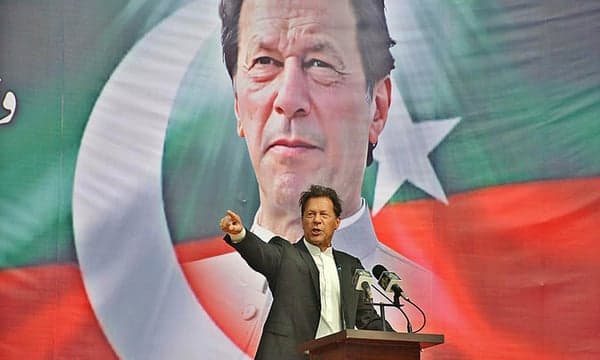
Pakistan at a Crossroads: Military Power and the Fate of Imran Khan
Pakistan has never been a stranger to political turbulence, but the current moment feels different in kind, not just degree. The rapid and deliberate consolidation of power by Field Marshal Asim Munir has set off alarm bells across the country's civilian political landscape — and nowhere are those alarms louder than inside the Pakistan Tehreek-e-Insaf (PTI), the movement built around former Prime Minister Imran Khan. As Khan continues to languish behind bars, his party is being forced to confront questions it has long deferred: Can PTI survive this new political reality? And is this, finally, the end of Imran Khan as a force in Pakistani politics?
The Rise of Field Marshal Asim Munir
The elevation of General Asim Munir to the rank of Field Marshal — a title historically reserved for wartime commanders of extraordinary distinction — sent an unmistakable signal about the direction of power in Pakistan. The promotion was not merely ceremonial. It cemented Munir's authority within the armed forces hierarchy and, more significantly, telegraphed to the entire political class that the military's role in shaping civilian affairs would be neither diminished nor challenged in the near term.
Munir's relationship with Imran Khan is well documented and deeply adversarial. Khan had Khan had previously pushed for Munir's removal as ISI chief before his own ouster in April 2022, a decision that many political analysts now view as a turning point in the military-PTI relationship. Since then, the two have existed in a state of open hostility, and the Field Marshal's consolidation of power only deepens the structural disadvantage PTI now faces.
Under Munir's watch, PTI has faced a sustained campaign of legal pressure, organizational disruption, and what party supporters describe as targeted persecution of its leadership cadre. Hundreds of party workers have been arrested, prominent figures have defected or issued public recantations under murky circumstances, and the party's ability to organize openly has been severely curtailed.
Imran Khan in Prison — and Still a Symbol
Despite being incarcerated since August 2023, Imran Khan has retained a remarkable hold on a significant segment of Pakistani public opinion. His supporters view his imprisonment not as proof of wrongdoing but as confirmation of a politically motivated crackdown. For many Pakistanis — particularly younger, urban voters — Khan remains the most credible symbol of resistance against a system they see as rigged in favor of entrenched elites, both military and civilian.
That symbolic power, however, is increasingly at odds with PTI's operational capacity. A party whose founder cannot speak, organize, or campaign freely is a party operating at a severe structural disadvantage. And yet the persistent popular support for Khan complicates any straightforward narrative of his political demise. His opponents have found, repeatedly, that removing him from the physical arena does not remove him from the political imagination.
PTI Reconsiders Its Options
Faced with this grinding reality, PTI's leadership is reportedly engaged in a genuine strategic reassessment. One of the most surprising elements of that reassessment is a renewed openness — at least in some quarters of the party — to engaging with the so-called "charter of democracy," a framework that PTI had long dismissed as a device for the traditional political establishment to entrench itself at the expense of new political forces.
The charter, originally signed in 2006 by the Pakistan Muslim League-Nawaz (PML-N) and the Pakistan Peoples Party (PPP) while both were in opposition, was designed to establish civilian supremacy and democratic norms in a country with a long history of military intervention. PTI under Khan had been deeply skeptical of this arrangement, viewing it as an agreement between two corrupt dynastic parties to divide power between themselves while shutting out genuine reform movements.
The fact that sections of PTI are now willing to revisit this document speaks volumes about how dramatically the landscape has shifted. When the military is ascendant and civilian parties — even those you've spent years denouncing — are the only available partners for political survival, old ideological positions become harder to hold.
What a "Charter of Democracy" Would Actually Mean
A revived or broadened charter of democracy involving PTI would represent one of the most significant political realignments in Pakistan's recent history. It would require Khan's movement to accept some form of cooperation with PML-N and PPP, parties that PTI has accused of large-scale corruption and collusion with the military establishment. For Khan's core base, that would be a bitter pill.
Conversely, for PML-N and PPP, bringing PTI under a shared democratic umbrella would risk legitimizing a movement they helped to suppress and would complicate their own delicate arrangements with the military. There is no easy path here for any of the parties involved.
The Deeper Question: Can Civilian Politics Survive?
The immediate drama surrounding Imran Khan should not obscure the more fundamental question it raises: whether meaningful civilian political autonomy can exist in Pakistan at all under current conditions. Field Marshal Munir's rise is not an aberration but an expression of structural dynamics that have persisted since Pakistan's founding — the military as the ultimate arbiter of who governs and on what terms.
- PTI's organizational capacity has been severely degraded by legal pressure and defections.
- Imran Khan's legal cases multiply while his ability to respond publicly remains limited.
- The traditional opposition parties face their own constraints in challenging military prerogatives.
- International attention to Pakistan's democratic backsliding has so far produced little concrete pressure for change.
Conclusion: An Uncertain Endgame
Whether this is truly "the end" for Imran Khan depends on which version of the question you're asking. If the question is whether Khan can return to the prime ministership in the short term, the answer appears to be no. The combination of legal jeopardy, organizational suppression, and a militarily dominant political environment makes that outcome nearly impossible to envision in the current moment. But if the question is whether Khan remains a powerful and disruptive force in Pakistani political life, the answer is considerably less clear. Pakistan's history is full of politicians who were written off prematurely, and Khan's grip on a substantial popular constituency has proven more durable than his enemies anticipated. The PTI's willingness to reconsider a charter of democracy may signal pragmatic adaptation rather than surrender — a movement recalibrating for a longer, harder fight rather than conceding the field. The endgame, in short, remains deeply uncertain. What is certain is that the military's ascendance under Asim Munir has fundamentally altered the terrain on which that endgame will be fought.