
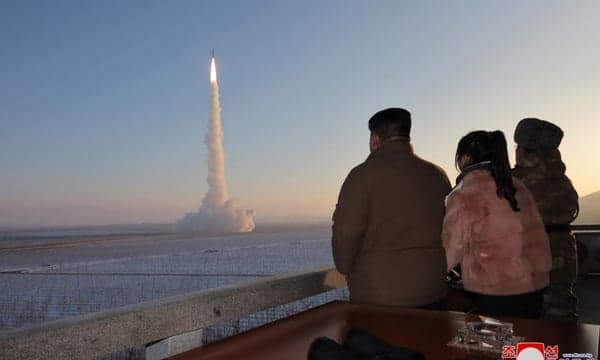
North Korea's Quiet Campaign to Be a 'Responsible' Nuclear Power
When most of the world thinks about North Korea's nuclear ambitions, the conversation centers on missile tests, UN Security Council resolutions, and the tense diplomacy between Pyongyang and Washington. But beneath that familiar surface, a far more subtle and strategically significant campaign is unfolding — one that is waged not in the halls of the United Nations, but in Korean-language state media, legal declarations, and official rhetoric carefully crafted for a domestic and regional audience.
North Korea is not merely trying to survive as a nuclear-armed state. It is actively working to redefine what that means — positioning itself as a responsible nuclear power, deserving of the same international recognition and grudging respect afforded to established members of the global nuclear club. As UN sanctions enforcement fractures under geopolitical pressure, this second contest — a battle over status rather than security — has never been more consequential.
Two Contests, One Strategy
Analysts who focus exclusively on Pyongyang's weapons capabilities risk missing the forest for the trees. North Korea is simultaneously fighting two separate but deeply intertwined battles. The first is the familiar military-security contest: developing nuclear warheads and delivery systems capable of deterring the United States and its allies. The second, far less discussed, is a legitimacy contest — an effort to shift international and domestic perception of the DPRK from a rogue proliferator to a responsible steward of nuclear weapons.
This distinction matters enormously. Legitimacy, in the language of international relations, carries real consequences. States recognized as responsible nuclear actors gain leverage in negotiations, face softer diplomatic pressure, and find it easier to attract trade partners willing to look the other way. For North Korea, achieving even partial legitimacy could erode the moral foundation of the sanctions regime that has defined its relationship with much of the world for decades.
What 'Responsible' Looks Like in Pyongyang's Framing
In Korean-language state media — largely invisible to English-speaking analysts — North Korea has steadily constructed a narrative around what it calls principled nuclear stewardship. This framing draws heavily on the language used by the United States, Russia, China, and other recognized nuclear states when they justify their own arsenals. Key themes include:
- Deterrence, not aggression: North Korean official texts consistently describe the country's nuclear forces as purely defensive, designed to deter a hostile United States rather than to threaten neighbors or pursue territorial expansion.
- No-first-use rhetoric: While not formally codified in a way the international community accepts, Pyongyang has increasingly employed no-first-use language in its domestic declarations — language that mirrors the postures of other nuclear states.
- Institutional framing: North Korea has enshrined its nuclear status in its constitution and passed laws governing the conditions under which nuclear weapons may be used, mimicking the legal architecture that established nuclear powers use to signal seriousness and control.
- Selective multilateralism: Pyongyang has begun engaging selectively in arms-control-adjacent discourse, not to disarm, but to present itself as a state capable of and interested in strategic dialogue — on its own terms.
The Sanctions Fragmentation Factor
North Korea's legitimacy campaign is gaining traction precisely because the enforcement architecture that once constrained it is visibly weakening. UN Security Council sanctions, once a source of meaningful economic pressure, have become increasingly difficult to enforce as China and Russia — both of whom have geopolitical incentives to keep Pyongyang functional and friendly — have stepped back from rigorous implementation.
Russia's deepening relationship with North Korea, cemented through arms transfers tied to the war in Ukraine, has fundamentally altered the calculus. Moscow, once a reluctant participant in sanctions coalitions, now has direct interests in North Korea's economic and military survival. China, navigating its own deteriorating relationship with the United States, has similarly softened its approach. The result is a patchwork enforcement environment where sanctions exist on paper but carry diminishing bite in practice.
This erosion does more than relieve economic pressure on Pyongyang. It signals to the broader international community — particularly developing nations and non-aligned states — that the Western-led consensus on North Korea's illegitimacy is neither universal nor durable. For a state campaigning for status, that fragmentation is an opportunity as much as a relief valve.
The Audience That Matters Most
While Western analysts debate whether to engage or contain North Korea, Pyongyang is busy cultivating a very different audience. Its legitimacy campaign targets several distinct groups: the North Korean domestic population, which must be convinced the nuclear program is a source of national pride and security rather than deprivation; neighboring states in Asia that might be persuaded to treat North Korea as a normal, if prickly, regional actor; and the loosely aligned bloc of nations that have historically chafed at Western-dominated international norms.
Each audience receives a subtly tailored version of the same core message: North Korea is a sovereign state that made a rational strategic choice to develop nuclear weapons, manages those weapons responsibly, and deserves to be treated accordingly.
Why This Campaign Deserves More Attention
The danger in overlooking North Korea's status campaign is that it can succeed incrementally and almost invisibly. Unlike a missile test, a shift in international perception generates no radar signature. Unlike a sanctions violation, a gradual normalization of North Korea's nuclear identity triggers no formal response mechanism. Yet the cumulative effect — a world that increasingly treats the DPRK as a nuclear power to be managed rather than a proliferator to be reversed — could prove more durable than any weapons system Pyongyang develops.
For policymakers in Washington, Seoul, and Tokyo, this means the diplomatic challenge is no longer solely about non-proliferation. It is equally about contesting a narrative — one that North Korea is writing carefully, in Korean, for an audience most Western analysts are not reading.
Conclusion
North Korea's nuclear ambitions have always been about more than bombs. They have been about survival, sovereignty, and status in a world order that has never fully accommodated the DPRK on its own terms. As UN sanctions fragment and geopolitical alignments shift, Pyongyang's quiet campaign to be recognized as a responsible nuclear power is entering a new and more consequential phase. Understanding that campaign — not just the warheads and missiles, but the words and the narratives — is essential to understanding what North Korea actually wants, and what the world may be slowly, quietly conceding.