
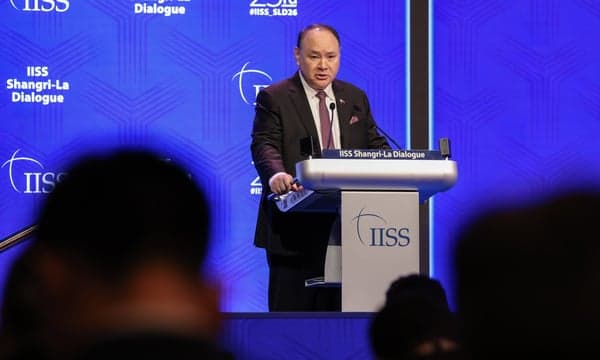
Philippine Defense Secretary Stands Firm as China Imposes Sanctions
In a bold and resolute statement that reverberated across Southeast Asia and beyond, Philippine Defense Secretary Gilberto Teodoro Jr. vowed to continue defending his nation's sovereignty and national interests following the announcement of sanctions imposed against him by China. The move, widely viewed as a retaliatory measure tied to escalating territorial disputes in the South China Sea, has drawn sharp criticism from Manila and further deepened the already strained relationship between the two nations.
The Philippines' Department of Foreign Affairs wasted no time in responding to Beijing's decision, officially characterizing the sanctions as "an unfriendly act" that "further complicates" bilateral relations. The strong language used by Manila signals that the Philippines is not prepared to yield to pressure, diplomatic or otherwise, as it continues to assert its sovereign rights within its own exclusive economic zone.
What the China Sanctions Against Teodoro Mean
Sanctions by one nation against the officials of another are rarely symbolic gestures. When China placed restrictions on Defense Secretary Gilberto Teodoro Jr., it sent a deliberate and calculated message — one that Manila has refused to receive without pushback. The sanctions are believed to be linked to Teodoro's vocal and active stance on defending the Philippines' territorial rights, particularly in contested waters such as the West Philippine Sea, which falls within the country's internationally recognized exclusive economic zone.
Teodoro has been one of the most outspoken voices in the Philippine government when it comes to confronting Chinese aggression in the region. Under his leadership, the Department of National Defense has pursued stronger defense partnerships, increased military readiness, and maintained a firm policy of not bowing to coercion. The imposition of sanctions, rather than silencing him, appears to have only strengthened his resolve.
In his public response, Teodoro made clear that neither personal sanctions nor diplomatic pressure from Beijing would alter his commitment to protecting Philippine citizens and upholding the country's constitutional mandate. His words resonated strongly with many Filipinos who have watched with growing concern as Chinese vessels have repeatedly challenged Philippine ships and personnel in disputed waters.
Philippines Calls China's Move an "Unfriendly Act"
The Philippine Department of Foreign Affairs issued a formal statement condemning China's decision to sanction Teodoro, describing the act as not only unfriendly but also counterproductive to any meaningful diplomatic engagement between the two countries. The use of the phrase "further complicates" is telling — it acknowledges that relations between Manila and Beijing were already under significant stress before this latest development.
The diplomatic fallout from such sanctions cannot be understated. When a country chooses to target a sitting cabinet official of a sovereign neighbor, it sets a provocative precedent that typically narrows the space for dialogue and mutual understanding. Rather than fostering cooperation, Beijing's move risks hardening the positions of Philippine policymakers and accelerating Manila's pivot toward stronger alliances with like-minded partners.
Observers have noted that the timing and nature of the sanctions underscore China's frustration with the Philippines' increasingly assertive posture in the South China Sea, a posture that has been supported by a growing chorus of international allies who back the rule of law and freedom of navigation in the region.
Rising Tensions in the South China Sea
The sanctions against Teodoro do not exist in isolation. They are the latest chapter in a long-running geopolitical drama unfolding in the South China Sea, one of the world's most strategically important and contested bodies of water. China claims nearly the entire sea based on its so-called nine-dash line, a boundary that has been rejected by an international arbitral tribunal and disputed by multiple neighboring nations, including the Philippines, Vietnam, Malaysia, and Brunei.
The Philippines has been particularly vocal in pushing back against Chinese maritime aggression. Under successive administrations, Manila has:
- Reinforced its legal claim to the West Philippine Sea based on the 2016 arbitral ruling under the United Nations Convention on the Law of the Sea (UNCLOS).
- Strengthened defense ties with the United States, Japan, and Australia through expanded military cooperation agreements.
- Increased the frequency of resupply missions to disputed outposts, despite repeated Chinese interference.
- Conducted joint naval and coast guard exercises with allied nations to project presence in contested waters.
- Publicly documented and reported incidents of Chinese vessels using water cannons and other aggressive tactics against Filipino ships.
Defense Secretary Teodoro has been a central figure in driving many of these initiatives, which likely contributed to his becoming a specific target of Beijing's sanctions regime.
International Community Watches Closely
The international response to China's sanctions on Teodoro is being watched closely by governments and analysts across the globe. Allied nations, particularly those with a stake in a free and open Indo-Pacific, are expected to signal their support for the Philippines in the face of what many are describing as diplomatic intimidation. The United States, which maintains a mutual defense treaty with the Philippines, has repeatedly affirmed that any armed attack on Philippine forces in the South China Sea would trigger its obligations under that treaty.
As geopolitical tensions continue to simmer, the resolve demonstrated by Defense Secretary Gilberto Teodoro Jr. stands as a clear signal that the Philippines will not be deterred. Manila's message to Beijing is unambiguous: sanctions will not silence a sovereign nation's determination to protect its people, its territory, and its dignity on the world stage.
Conclusion: A Nation Undeterred
China's sanctions against Philippine Defense Secretary Gilberto Teodoro Jr. represent a significant escalation in an already tense bilateral relationship. But rather than achieving its presumed goal of discouraging Philippine assertiveness, the move has drawn a sharp rebuke from Manila and appears to have only sharpened the country's determination to defend its national interests. As the Philippines stands its ground, the world is watching — and the message coming out of Manila is one of resilience, principle, and unwavering resolve.