
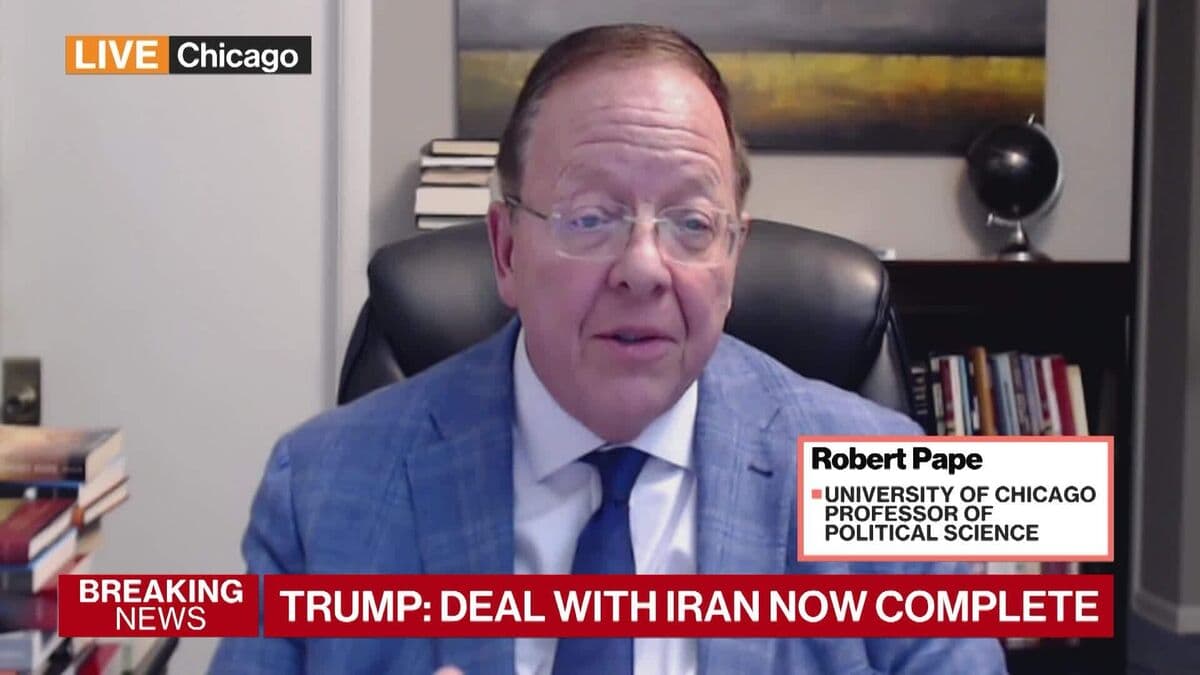
Robert Pape Warns Iran's Leverage Will Outlast the US-Iran Deal
As diplomatic circles cautiously celebrate what appears to be a new framework between Washington and Tehran, at least one leading voice in political science is urging the world not to pop the champagne just yet. Robert Pape, a professor of political science at the University of Chicago and one of the most respected scholars of international security, has issued a sobering assessment of the emerging US-Iran deal — and his concerns deserve serious attention from policymakers, analysts, and the global public alike.
Speaking on Bloomberg's The China Show with hosts David Ingles and Yvonne Man, Pape made two central arguments that cut to the heart of why this agreement may be far more fragile than it appears on the surface. First, Iran's geopolitical leverage is not going to simply "disappear" as a result of any deal. Second, the alarming lack of specific details released by both sides introduces a level of uncertainty that could undermine the agreement before it ever gains real traction.
Understanding Iran's Enduring Strategic Leverage
To understand why Pape's warning carries such weight, it is important to first grasp what he means by Iran's "leverage." This is not merely a reference to Tehran's nuclear capabilities — though those matter enormously — but rather a broader set of strategic tools that Iran has developed and deployed across the Middle East and beyond over many decades.
Iran's influence extends through a network of regional proxy forces, its control over key maritime chokepoints, its ability to destabilize neighbors, and its position as a central actor in the ongoing struggles that define the broader Middle East. These instruments of power do not dissolve with the signing of a diplomatic document. They are structural features of Iran's regional posture, built over years of deliberate investment and political maneuvering.
Pape's point, therefore, is a fundamental one in international relations theory: a deal that addresses one dimension of a rival's power — say, its nuclear enrichment program — does not neutralize the many other dimensions through which that rival exercises influence. Diplomats and political leaders sometimes conflate a deal with a comprehensive resolution. Pape is reminding us that those are two very different things.
This perspective aligns with a broader school of thought in political science that emphasizes the importance of understanding the full architecture of a state's power before declaring any agreement a lasting victory. Iran has consistently demonstrated an ability to adapt, persist, and expand its influence even during periods of intense international pressure, including years of crippling economic sanctions.
The Problem of Missing Details
Beyond the question of leverage, Pape flagged a second concern that is perhaps even more immediately troubling: the conspicuous absence of concrete details from both the American and Iranian sides regarding what the deal actually entails.
In diplomatic negotiations of this magnitude, ambiguity is rarely accidental. Both sides may have strategic reasons to keep certain provisions vague — appeasing domestic audiences, preserving room for future maneuvering, or simply reflecting genuine disagreements that have not yet been resolved. But whatever the reason, ambiguity at the foundational level of an agreement creates serious risks.
When the terms of a deal are not clearly defined, the risk of misinterpretation rises sharply. Each side may be operating under fundamentally different assumptions about what has been agreed upon. This is not a hypothetical concern. It is precisely what plagued earlier iterations of US-Iran nuclear diplomacy, where disputes over the interpretation of specific clauses led to accusations of bad faith on both sides and ultimately contributed to the collapse of prior frameworks.
The lack of transparency also has consequences beyond the negotiating table. Allies in the region — particularly Israel and the Gulf states — are watching these developments with intense scrutiny. Without clear details, they are left to speculate, and speculation in a region as volatile as the Middle East rarely leads to stability. Markets, too, respond poorly to uncertainty, and energy markets in particular remain sensitive to any signals about the future direction of US-Iran relations.
What History Tells Us About US-Iran Negotiations
Pape's analysis gains additional credibility when viewed against the historical backdrop of US-Iran relations. The 2015 Joint Comprehensive Plan of Action (JCPOA) was heralded as a landmark achievement when it was signed. It included detailed provisions, verification mechanisms, and international monitoring. Yet it ultimately unraveled following the US withdrawal in 2018 under the Trump administration, leading Iran to steadily expand its nuclear program in the years that followed.
If a highly detailed, multilaterally supported agreement proved this fragile, the prospects for an agreement that apparently lacks even basic public clarity are concerning indeed. Pape's skepticism is not pessimism for its own sake — it is the kind of rigorous, evidence-based caution that serious foreign policy analysis demands.
Why Pape's Voice Matters in This Debate
Robert Pape is not a peripheral commentator. His academic work on coercion, strategic bombing, and the dynamics of international conflict has shaped how scholars and practitioners alike think about the use and limits of state power. When he speaks about the structural persistence of Iran's leverage, he is drawing on decades of research into how states build, maintain, and deploy power across different domains.
His appearance on Bloomberg's The China Show brought this academic rigor to a global audience at a critical moment — one where the temptation to declare diplomatic success may be outrunning the evidence for it.
Looking Ahead: What Should Be Watched Closely
For observers seeking to assess whether the US-Iran deal represents genuine progress or a premature declaration of victory, Pape's framework offers a useful checklist. Watch for whether full details of the agreement are eventually made public. Watch for how Iran's regional behavior evolves in the weeks and months following any announcement. Watch for whether verification mechanisms are robust and independently administered. And watch, above all, for whether both sides demonstrate a genuine and sustained commitment to the spirit — not just the letter — of any agreement they have reached.
The stakes could not be higher. A durable, verifiable US-Iran deal would be a significant contribution to regional and global stability. But a superficial agreement that papers over unresolved tensions while leaving Iran's strategic leverage fully intact could ultimately prove more dangerous than no deal at all. Robert Pape, as he has so often done throughout his career, is asking the hard questions at exactly the right time.