
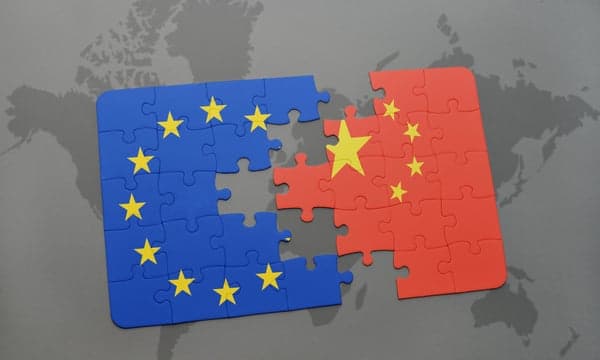
The EU's China Strategy: Built on Contradictions
The European Union has long struggled to define a coherent, consistent posture toward China. On one hand, Beijing remains one of the bloc's most significant trading partners — a source of vital goods, investment, and supply chain dependencies that EU member states have been reluctant to sever. On the other hand, China's expanding geopolitical ambitions, its industrial subsidies, and its deepening alignment with Russia since the invasion of Ukraine have forced Brussels to reckon with the strategic risks of economic interdependence. The result is a policy framework that is, by design and by structural necessity, deeply contradictory.
The European Council's latest China mandate crystallizes this tension. By pairing continued diplomatic dialogue with the development of prospective new trade defense tools, the EU has institutionalized an approach that attempts to do two incompatible things at once: maintain open channels of engagement while simultaneously arming itself with instruments designed to penalize Chinese economic behavior. Understanding why this contradiction exists — and why it is so difficult to resolve — requires looking at both the political architecture of the EU itself and the evolving nature of the China challenge.
What the European Council's Mandate Actually Says
The European Council's latest guidance on China reaffirms the bloc's tripartite framing of Beijing: as a partner in areas of shared interest, a competitor in economic and technological domains, and a systemic rival when it comes to governance values and geopolitical influence. This framework, first articulated in 2019, has become the conceptual spine of EU China policy — but it has also become its central weakness.
In practice, treating China simultaneously as a partner, competitor, and rival makes it extraordinarily difficult to pursue any single objective with clarity or force. The new mandate doubles down on this ambiguity. It endorses continued high-level dialogue — including on climate, global health, and financial stability — while also supporting the development of new trade defense mechanisms, including stronger anti-subsidy tools aimed directly at Chinese industrial policy. The implicit message to Beijing is: we want to talk, but we are also building the legal and institutional infrastructure to act against you.
For Brussels, this may seem like a pragmatic balancing act. For Beijing, it reads as a provocation dressed in diplomatic language.
The Trade Defense Dimension: A Necessary But Risky Tool
The push for new trade defense instruments is not without justification. Chinese state subsidies have enabled domestic firms to undercut European competitors in sectors ranging from electric vehicles and solar panels to steel and semiconductors. The EU's anti-subsidy investigation into Chinese electric vehicles — which led to provisional tariffs in 2024 — demonstrated both the appetite and the legal capacity within the bloc to push back against what it sees as unfair competition.
However, deploying these tools carries serious risks. China has responded to European trade measures with its own countermeasures, including investigations into European cognac, dairy, and pork imports — sectors with deep political significance in France, Ireland, and other key member states. This tit-for-tat dynamic illustrates how quickly trade defense tools can escalate into broader economic conflicts that damage both sides.
More fundamentally, the institutionalization of these instruments signals a structural shift in the EU-China relationship. Trade defense tools are not designed for partnerships — they are designed for adversarial contexts. By building them into the formal architecture of its China policy, the EU is essentially conceding that the relationship has moved beyond the bounds of normal commercial diplomacy.
Member State Divisions: The Fault Lines Within
Any honest analysis of the EU's China policy must grapple with the deep divisions among member states that constrain what Brussels can actually do. Countries like Germany, Hungary, and several Central and Eastern European nations maintain significant economic ties with China and have historically resisted strong EU-level measures that might jeopardize those relationships. Germany, in particular, faces an acute dilemma: its automotive sector has enormous exposure to the Chinese market at precisely the moment when EU tariffs on Chinese EVs are straining bilateral commercial relations.
France and the Netherlands, by contrast, have taken harder lines, advocating for more assertive use of trade defense instruments and tighter scrutiny of Chinese investment and technology transfers. This divergence means that the European Council's mandates often reflect the lowest common denominator rather than a genuinely strategic consensus — language that papers over disagreement rather than resolving it.
The Long-Term Cost of Strategic Ambiguity
The structural limits of the EU's China policy are not merely tactical problems to be managed through clever diplomacy. They reflect a deeper failure to make fundamental choices about what kind of relationship Europe wants with China over the next decade. As long as the EU continues to institutionalize ambiguity — pursuing dialogue and defense simultaneously, without a clear hierarchy between the two — it risks achieving neither.
Beijing is unlikely to engage substantively in diplomatic dialogue while the EU is simultaneously expanding its legal toolkit to restrict Chinese economic activity. And European firms, investors, and governments will struggle to plan effectively for a future in which the EU's China posture could shift dramatically depending on which political pressures dominate in any given cycle.
Toward a More Coherent EU China Strategy
What would a more coherent approach look like? Analysts and policymakers have proposed several paths forward. Some argue for a cleaner separation of domains — genuine partnership on climate and global governance, clear-eyed competition management in trade and technology, and firm boundaries on security-sensitive sectors. Others advocate for a more explicitly transactional framework, in which the EU conditions the depth of its engagement on measurable changes in Chinese behavior on issues like market access, intellectual property, and Russia support.
What nearly all observers agree on is that the current approach — institutionalizing contradiction rather than resolving it — is not sustainable. The European Council's latest mandate may represent the political art of the possible within a complex, multi-member institution. But art of the possible is not the same as effective strategy. As China's global role continues to expand and the geopolitical stakes around Taiwan, trade, and technology continue to rise, the EU will face increasing pressure to choose — and the cost of continued ambiguity will only grow.
- The EU's tripartite China framework (partner, competitor, rival) creates inherent policy contradictions that are difficult to manage in practice.
- New trade defense tools signal a structural shift toward an adversarial posture, even as dialogue remains officially prioritized.
- Member state divisions — particularly Germany's economic exposure to China — constrain the EU's ability to act with strategic clarity.
- Long-term EU-China relations will require clearer choices about hierarchy of interests, not more institutionalized ambiguity.
The EU's China policy is, at its core, a reflection of Europe's unresolved identity as a geopolitical actor. Until the bloc decides what it is willing to risk — and what it is willing to sacrifice — in its relationship with Beijing, its strategies will continue to be structurally limited by the very contradictions they are designed to manage.