
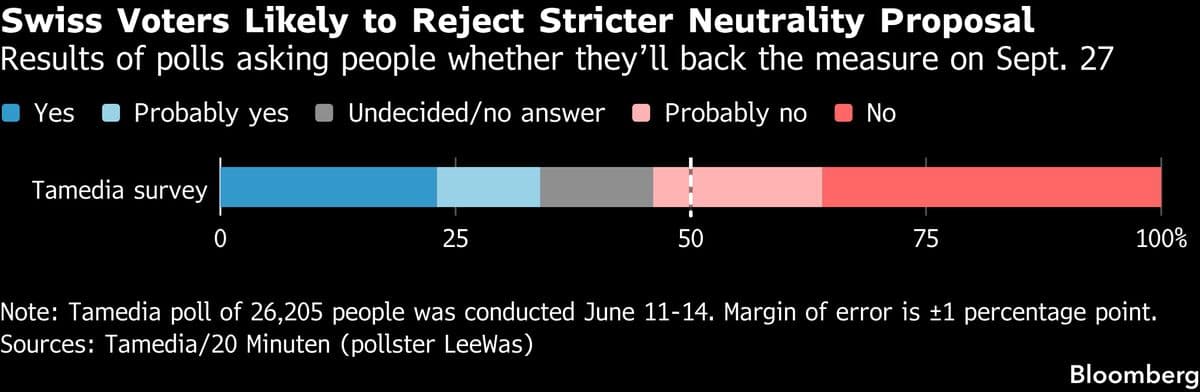
Swiss Voters Poised to Reject Stricter Neutrality Initiative, Early Poll Reveals
Switzerland has long been synonymous with political neutrality — a principle so deeply embedded in the nation's identity that it has guided its foreign policy for more than two centuries. Yet a landmark early poll now suggests that Swiss voters are set to reject a ballot initiative that would have formally strengthened and legally codified that very neutrality. The implications of this anticipated vote extend well beyond Switzerland's borders, carrying significant weight for the ongoing geopolitical standoff between Western nations and Russia over the invasion of Ukraine.
What Is the Swiss Neutrality Initiative?
The initiative in question was put forward by a coalition of Swiss politicians and civic groups who argued that Switzerland's traditional neutrality had been compromised by the country's decision to adopt European Union sanctions against Russia following the 2022 invasion of Ukraine. Proponents of stricter neutrality contended that aligning with EU-led economic measures against Moscow represented a departure from Switzerland's centuries-old diplomatic stance — one that has historically kept the country out of military alliances and international conflicts alike.
The proposed initiative sought to enshrine a more rigid interpretation of neutrality into Swiss law, effectively preventing the government from joining or endorsing any form of international sanctions regime without a specific constitutional mandate. Supporters framed it as a return to the country's foundational principles and a safeguard against what they described as an unwanted drift toward alignment with Western geopolitical blocs.
What the Early Poll Results Indicate
According to early polling data, a clear majority of Swiss voters appear prepared to vote against the initiative. While Swiss referendums are known for their unpredictability — and opinion can shift significantly in the final weeks of a campaign — the polling figures represent a notable signal about where public sentiment currently stands.
Political analysts have pointed to several reasons why the initiative appears to be failing to gain sufficient popular support. Many Swiss citizens, while proud of their country's neutral heritage, seem to recognize that the international landscape has changed dramatically since the doctrine was first established. Russia's full-scale invasion of Ukraine, widely condemned by international bodies and democratic governments alike, has prompted a reassessment in parts of Swiss society about what neutrality should mean in the modern era and whether passive non-alignment is a morally defensible position in the face of large-scale military aggression.
Why This Vote Matters for Russia Sanctions
The stakes of this referendum stretch far beyond Switzerland's domestic political debate. If voters reject the stricter neutrality initiative — as current polling suggests they will — the Swiss government will retain greater flexibility in its foreign policy choices, including its current posture on sanctions against Russia.
Switzerland adopted the EU's package of sanctions against Russia in 2022, a move that broke with its historical approach to international disputes and generated considerable domestic controversy. Critics at home argued the decision undermined Swiss neutrality, while supporters maintained that standing aside in the face of a clear violation of international law would itself represent a moral and reputational failure for the country.
A rejection of the neutrality initiative would effectively serve as a democratic endorsement — or at least not a repudiation — of Switzerland's current approach. It would give the federal government a clearer mandate to maintain its sanction alignment with Western nations, a result that will be closely watched in Brussels, Washington, Kyiv, and Moscow.
The Broader Debate Over Swiss Neutrality in the Modern World
This referendum has sparked a far deeper national conversation about what Swiss neutrality means in the 21st century. For many decades, Switzerland's neutral status served as a practical asset: it allowed the country to host international diplomatic negotiations, serve as a base for global organizations like the International Committee of the Red Cross, and position itself as a trusted broker in global disputes.
However, critics of rigid neutrality argue that the doctrine was designed for a different era — one in which conflicts were more contained and international norms were less developed. Today, they suggest, a blanket refusal to take sides can effectively benefit aggressors rather than promote peace.
Supporters of the initiative, on the other hand, warn that abandoning strict neutrality risks dragging Switzerland into geopolitical rivalries it has no interest in and could undermine the country's trusted status as a global mediator. They argue that Switzerland's value to the world lies precisely in its impartiality, and that compromising this for short-term political alignment comes at a long-term cost.
What Comes Next
While early polls paint a reasonably clear picture, Swiss political history is filled with examples of public opinion shifting dramatically between initial polling and referendum day. Campaign organizations on both sides of the debate are expected to intensify their public outreach efforts as the vote approaches, making the final outcome difficult to predict with certainty.
What is clear is that this referendum represents one of the most significant tests of Swiss political identity in recent memory. However voters ultimately decide, the debate itself has forced Switzerland — and the watching world — to grapple seriously with what it means to be neutral in an age of international conflict, economic interdependence, and increasingly polarized global politics.
As the vote draws nearer, all eyes will remain on Switzerland — a nation whose foreign policy choices, often understated, carry outsized consequences on the world stage.