
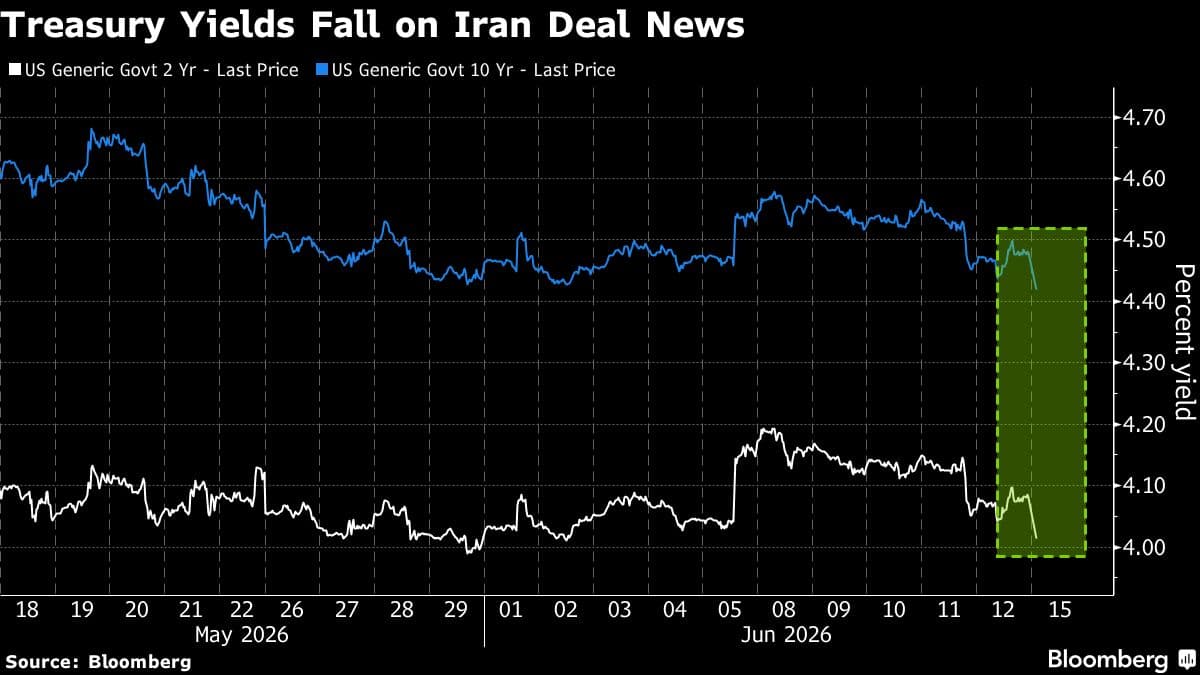
Treasuries Rally Sharply as Iran Deal Reshapes Federal Reserve Rate-Hike Expectations
US Treasury bonds surged across the entire yield curve on Wednesday after news broke of a landmark deal to halt the Iran war, prompting investors to rapidly reassess how aggressively the Federal Reserve will need to raise interest rates in the months ahead. The development sent bond prices higher and yields lower, reflecting a significant shift in market sentiment that underscores just how tightly geopolitical events and monetary policy expectations are intertwined in today's financial landscape.
For fixed-income investors who have spent the past year bracing for a relentless series of Fed rate increases, the Iran deal represents a potential turning point — one that could ease inflationary pressures, reduce energy price volatility, and ultimately give the central bank more room to pause or slow its tightening cycle.
What the Iran Deal Means for Financial Markets
The announcement of an agreement to halt the Iran conflict caught many traders off guard. Geopolitical risk premiums that had been quietly embedded in commodity and energy markets began to unwind almost immediately. Oil prices softened on the news, and that single development carried enormous implications for the broader inflation outlook.
Energy costs have been one of the most stubborn contributors to elevated consumer price index readings over the past several years. A stabilization or decline in oil prices — even a modest one — can meaningfully reduce headline inflation figures, which in turn reduces the urgency for the Federal Reserve to keep tightening monetary policy at an aggressive pace.
Bond markets, which are exquisitely sensitive to inflation expectations and Fed policy signals, responded swiftly. Treasuries advanced across the curve, meaning both short-dated bills and longer-duration bonds saw prices rise and yields fall. This broad-based rally is a strong signal that traders are repricing the entire path of future Fed rate decisions, not just the next meeting.
Understanding the Treasury Yield Curve and Why It Matters
To fully appreciate the significance of a broad Treasury rally, it helps to understand how the yield curve works. The yield curve is a graphical representation of interest rates on US government debt across different maturities, ranging from one-month bills to 30-year bonds. When investors grow more confident that the Fed will raise rates less aggressively — or begin cutting sooner — yields across all maturities tend to fall, and bond prices, which move inversely to yields, rise accordingly.
A rally "across the curve" as described in today's market action is particularly meaningful because it suggests consensus, not just a specific bet on short-term rates. It implies that investors broadly believe the macroeconomic backdrop has shifted in a way that makes aggressive tightening less likely or less necessary.
Short-Term Treasuries
Short-term Treasury bills, which are most sensitive to near-term Fed policy decisions, saw notable price gains. This reflects traders trimming bets on imminent rate hikes — essentially lowering the odds that the Fed will move as sharply or as frequently at its upcoming policy meetings.
Long-Term Treasuries
Longer-duration Treasuries, such as the 10-year and 30-year bonds, also rallied. These instruments are more sensitive to long-run inflation expectations. Their rally signals that the market believes the Iran deal could contribute to a structural easing of inflation over a longer horizon — not just a temporary blip.
Federal Reserve Rate Hike Bets: What Has Changed?
Prior to the Iran deal announcement, federal funds futures markets were pricing in a relatively hawkish path for Fed policy, with traders assigning meaningful probability to additional rate increases in the coming quarters. The Fed had made clear through its communications that it remained data-dependent and would not hesitate to raise rates further if inflation proved persistent.
The Iran deal has now introduced a new variable into that calculation. Markets are now trimming bets on further hikes for several key reasons:
- Lower energy price trajectory: A cessation of the Iran conflict reduces a key source of upward pressure on oil and natural gas prices, which flow directly into headline inflation readings.
- Improved supply chain dynamics: Geopolitical stability in a strategically critical region tends to ease broader supply chain concerns, reducing cost-push inflation pressures across a range of goods and services.
- Reduced risk premium: With one major geopolitical risk factor diminished, overall financial conditions may ease somewhat, reducing the need for the Fed to act as aggressively to cool demand.
- Softening growth outlook: Paradoxically, if markets price in less Fed tightening, there may also be expectations that growth remains more resilient, giving the central bank even less justification for sharp additional hikes.
Historical Precedents: Geopolitics and Bond Markets
This is not the first time a geopolitical resolution has triggered a meaningful bond market reaction. Historical precedent shows that periods of conflict and uncertainty tend to push inflation higher through energy and commodity channels, while resolutions or de-escalations often have the opposite effect. The end of major conflicts has, in several historical instances, been followed by a softening of commodity prices and a corresponding adjustment in monetary policy expectations.
Investors and analysts will be watching closely to see whether the Fed itself acknowledges the changing geopolitical backdrop in its upcoming communications. Fed Chair commentary and meeting minutes will be scrutinized for any signal that policymakers view the Iran deal as a material factor in their inflation and rate-path assessments.
What Investors Should Watch Going Forward
While the initial market reaction has been strongly positive for Treasuries, several key data points and events will determine whether this rally has lasting staying power or proves to be a short-lived knee-jerk reaction.
Upcoming inflation data, particularly the Consumer Price Index and the Personal Consumption Expenditures index, will be critical. If energy-driven disinflation begins to show up in the hard data, it will validate the bond market's current optimism and potentially accelerate the re-pricing of Fed rate bets even further.
Labor market data will also matter. The Fed has consistently emphasized that a tight labor market supports continued wage growth and, by extension, services inflation. Even with energy prices falling, the central bank will need to see convincing evidence of broad-based disinflation before it meaningfully pivots its stance.
Finally, the durability of the Iran deal itself will be tested. Markets are forward-looking, and any signs that the agreement is fragile or at risk of unraveling could quickly reverse today's bond rally as geopolitical risk premiums re-enter the equation.
Conclusion: A New Chapter for Treasuries and Fed Policy
The Treasury market's strong response to the Iran deal highlights just how sensitive bond investors are to any development that could alter the Federal Reserve's rate-hiking trajectory. By easing one of the more persistent sources of inflationary pressure — energy market volatility tied to geopolitical conflict — the deal has given traders a credible reason to dial back their most hawkish expectations.
Whether this marks a genuine turning point for Fed policy or merely a temporary reprieve will depend on the data in the weeks and months ahead. For now, however, the bond market has delivered a clear verdict: less geopolitical risk means less inflation pressure, and less inflation pressure means fewer rate hikes. Treasuries are pricing that view in — and investors would be wise to keep a close eye on how the story develops.