
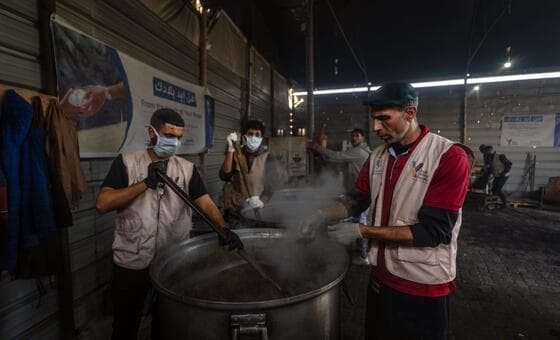
UN Security Council Puts Gaza Back in the Spotlight Amid Deepening Humanitarian Crisis
The United Nations Security Council convened a critical session to debate conditions on the ground in Gaza, a territory that continues to endure one of the most severe humanitarian crises in recent memory. The meeting was called at the request of the Council's 10 elected members, who expressed growing alarm that Gaza's catastrophic situation risks being overshadowed by broader and increasingly complex regional developments. As international attention stretches thin across multiple conflict zones, advocates and diplomats alike are pushing to ensure that the people of Gaza are not forgotten.
A Ceasefire in Name Only
A ceasefire technically has been in place since October 2025, offering a nominal pause to the open hostilities that have ravaged the Gaza Strip for over a year. However, the reality on the ground tells a far grimmer story. Since the truce was declared, nearly 1,000 Palestinians have lost their lives, raising serious questions about whether the ceasefire is functioning in any meaningful sense. For many observers and humanitarian organizations, a cessation of hostilities that still results in nearly a thousand deaths is not a ceasefire — it is a slow-burning catastrophe dressed in diplomatic language.
The ceasefire's fragility has been a central point of debate among Security Council members. While some nations have celebrated it as a diplomatic achievement, elected members of the Council have been more forthcoming about its limitations, calling for an urgent reassessment of how international mechanisms are protecting — or failing to protect — civilian lives in the region.
Tom Fletcher Warns of "Fragile Gains" Falling Short
Among the most powerful voices at the Security Council session was Tom Fletcher, the UN's chief of humanitarian affairs and emergency relief coordinator. Fletcher addressed ambassadors directly, delivering a sobering assessment of conditions in Gaza. He described whatever progress has been made since the ceasefire as "fragile gains" — improvements so minimal and so precarious that they barely register as forward movement for the people experiencing them daily.
Fletcher made clear that these gains represent "the bare minimum of what Palestinians need," a phrase that encapsulates the yawning gap between the international community's stated commitments and the lived realities of Gazans. His testimony underscored that humanitarian corridors, aid deliveries, and provisional arrangements remain deeply insufficient, and that without a robust and sustained international response, even these marginal improvements could evaporate.
Relief agencies have for months been sounding the alarm about shortages of food, clean water, medicine, and shelter. Fletcher's remarks at the Security Council gave those warnings new urgency and an authoritative platform, reminding world leaders that diplomacy without humanitarian follow-through is a hollow achievement.
Displacement Remains a Defining Crisis
Beyond the death toll, the displacement of Gaza's population stands as one of the most defining and heartbreaking dimensions of the ongoing crisis. The vast majority of Gazans remain displaced from their homes, forced into overcrowded shelters, makeshift camps, or the homes of relatives in areas that have themselves suffered significant damage from prolonged conflict.
Displacement of this scale carries consequences that extend well beyond the immediate need for shelter. It disrupts access to education for children, dismantles healthcare infrastructure, fractures community support networks, and compounds the psychological trauma already inflicted by months of violence. Humanitarian organizations working in the region have repeatedly emphasized that displacement is not simply a logistical problem — it is a profound human rights issue that demands a coordinated, long-term response.
- Most of Gaza's population remains internally displaced with no clear timeline for return.
- Access to basic services including clean water and sanitation remains critically limited across displacement sites.
- Children and vulnerable populations face acute risks from malnutrition, disease outbreaks, and psychological distress.
- Humanitarian agencies report severe underfunding relative to the scale of needs on the ground.
Why Gaza Is at Risk of Being Overshadowed
One of the more pointed concerns raised at the Security Council session was the risk that Gaza's crisis is being eclipsed by wider regional developments. In a world where media cycles move rapidly and diplomatic bandwidth is finite, there is a genuine danger that sustained attention to Gaza — so essential for maintaining pressure on both aid delivery and political accountability — could wane as other flashpoints compete for the international community's focus.
The 10 elected members of the Security Council who requested the meeting did so with this concern explicitly in mind. Their decision to bring Gaza back to the table was a deliberate act of advocacy, a reminder that the scale of suffering in the territory does not diminish simply because other crises emerge. For the families living among rubble and the aid workers navigating dangerous logistics every day, the fading of international attention can be as dangerous as any weapon.
What the International Community Must Do Next
The Security Council session made one thing abundantly clear: words and ceasefire declarations, while necessary, are not sufficient. The international community faces an urgent obligation to translate diplomatic frameworks into tangible improvements for the people of Gaza. This means ensuring humanitarian access is not merely permitted on paper but actively facilitated on the ground, and that funding for relief operations meets the enormous scale of need.
Long-term recovery efforts, including reconstruction, mental health support, and the rebuilding of civic infrastructure, must also enter the conversation. A durable peace cannot be built on a foundation of despair, and the fragile gains Tom Fletcher described at the UN can only become meaningful if they are nurtured, expanded, and protected by genuine political will.
As the Security Council continues to monitor developments, the world's attention — and conscience — must remain fixed on Gaza. The people there are not a footnote to regional geopolitics. They are the central story, and they deserve nothing less than the international community's full and sustained commitment to their safety, dignity, and future.