
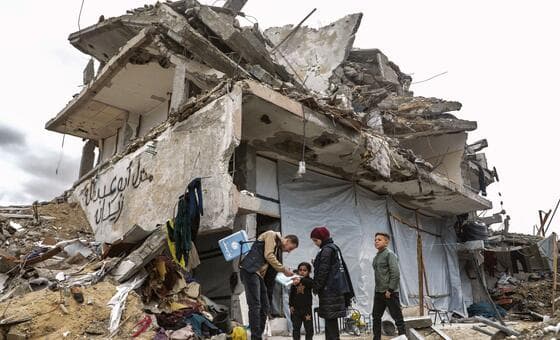
UNICEF Sounds Alarm Over Gaza Child Deaths: "Sneeze and You Might Get Shot"
In one of the most visceral and haunting warnings issued by any United Nations body in recent memory, UNICEF has told the world that children in Gaza are living under conditions so deadly, so unpredictable, and so indiscriminate that even the most involuntary human reflex could cost a child their life. The phrase, stark and deliberate, was deployed to cut through the numbness that years of conflict reporting can produce — to force the global community to truly reckon with the daily reality faced by Palestinian children in the Gaza Strip.
The alert comes in the wake of another deadly night of clashes in Lebanon, where the humanitarian situation continues to deteriorate alongside the crisis in Gaza. For aid agencies stretched across the region, the overlapping emergencies are compounding an already catastrophic picture.
265 Palestinian Children Killed Since the October 2025 Ceasefire
Perhaps the most alarming figure embedded in UNICEF's alert is this: 265 Palestinian children have been killed in Gaza since a ceasefire was announced in October 2025. For many observers, a ceasefire represents a moment of relief, a pause in violence, a chance for humanitarian corridors to open and for innocent lives — especially young ones — to be spared. In Gaza, that assumption has proven tragically wrong.
The death toll of 265 children in the period following a ceasefire declaration signals not just a failure of enforcement, but a catastrophic collapse in the protection of civilian life. Under international humanitarian law, children are afforded explicit protections during armed conflict. The fact that hundreds have died after a supposed halt to hostilities raises urgent questions about accountability, oversight, and the very meaning of a ceasefire in modern conflict zones.
Aid organizations have repeatedly pointed out that children in Gaza are not dying only from direct strikes. The cumulative impact of destroyed hospitals, contaminated water supplies, food shortages, and the collapse of basic medical infrastructure means that children are being killed both by bullets and by the absence of the systems meant to keep them alive.
Lebanon Clashes Add a Second Front to the Regional Humanitarian Crisis
The UNICEF alert was issued against a backdrop of renewed violence in Lebanon, where another deadly night of clashes has deepened fears of a widening regional conflict. Lebanon's civilian population, already burdened by years of economic collapse and political instability, now faces the additional trauma of active armed conflict.
For humanitarian agencies operating across the region, the simultaneous crises in Gaza and Lebanon are stretching resources, personnel, and logistical capacity to a breaking point. Aid convoys face access restrictions, staff members operate under threat, and funding pipelines remain inadequate relative to the scale of need. UNICEF, the World Food Programme, and a range of NGOs have all issued calls for immediate, unimpeded humanitarian access to affected populations in both territories.
The regional dimension of the crisis matters because it shapes diplomatic responses, funding allocations, and the bandwidth of international media attention. When multiple emergencies compete for visibility, individual crises — and the children caught within them — risk fading from the headlines even as the death toll climbs.
What UNICEF's Warning Actually Means for Children on the Ground
When UNICEF says that a child in Gaza could be shot for sneezing, the agency is not engaging in hyperbole for shock value alone. It is describing an environment in which movement, sound, and visibility have become life-threatening variables. Children in active conflict zones often describe learning to suppress their own instincts — not to cry, not to run, not to draw attention. The psychological toll of this learned suppression is enormous and long-lasting, even for those who survive physically unharmed.
UNICEF's alert draws attention to several interlinked realities facing children in Gaza right now. Access to clean water remains critically limited, with many families relying on contaminated or severely rationed supplies. Malnutrition rates, already elevated before the most recent escalation, have worsened. Schools have been destroyed or repurposed, meaning that an entire generation of children is losing not just safety but education, stability, and the structures that support healthy development.
Medical facilities capable of treating injured children are functioning at drastically reduced capacity, if at all. The combination of physical danger and collapsed infrastructure means that a child wounded in an incident — whether by direct fire or by the secondary effects of explosives — may have little realistic chance of receiving timely, adequate medical care.
International Response: Calls for Accountability and Immediate Action
Aid agencies and human rights organizations have responded to the continuing toll with renewed demands for international accountability. They are calling on member states, the United Nations Security Council, and regional powers to move beyond statements of concern toward concrete mechanisms of enforcement — whether through humanitarian ceasefires with genuine monitoring, the protection of medical and aid workers, or the establishment of clearly delineated safe zones for civilian populations.
UNICEF has specifically called for all parties to the conflict to uphold their obligations under the Convention on the Rights of the Child and under international humanitarian law more broadly. Children, the agency reiterates, are never legitimate targets. Their protection is not conditional on politics, strategic interest, or negotiating leverage.
A World That Must Not Look Away
The phrase "sneeze and you might get shot" is designed to land. It is designed to make the abstract concrete, to transform a statistic — 265 children — into something a reader can feel in their own body. UNICEF is asking the world not simply to register horror, but to demand change. As Lebanon burns and Gaza grieves, the children caught in the middle have no voice in the negotiations that shape their fate. That responsibility falls to the rest of us.