
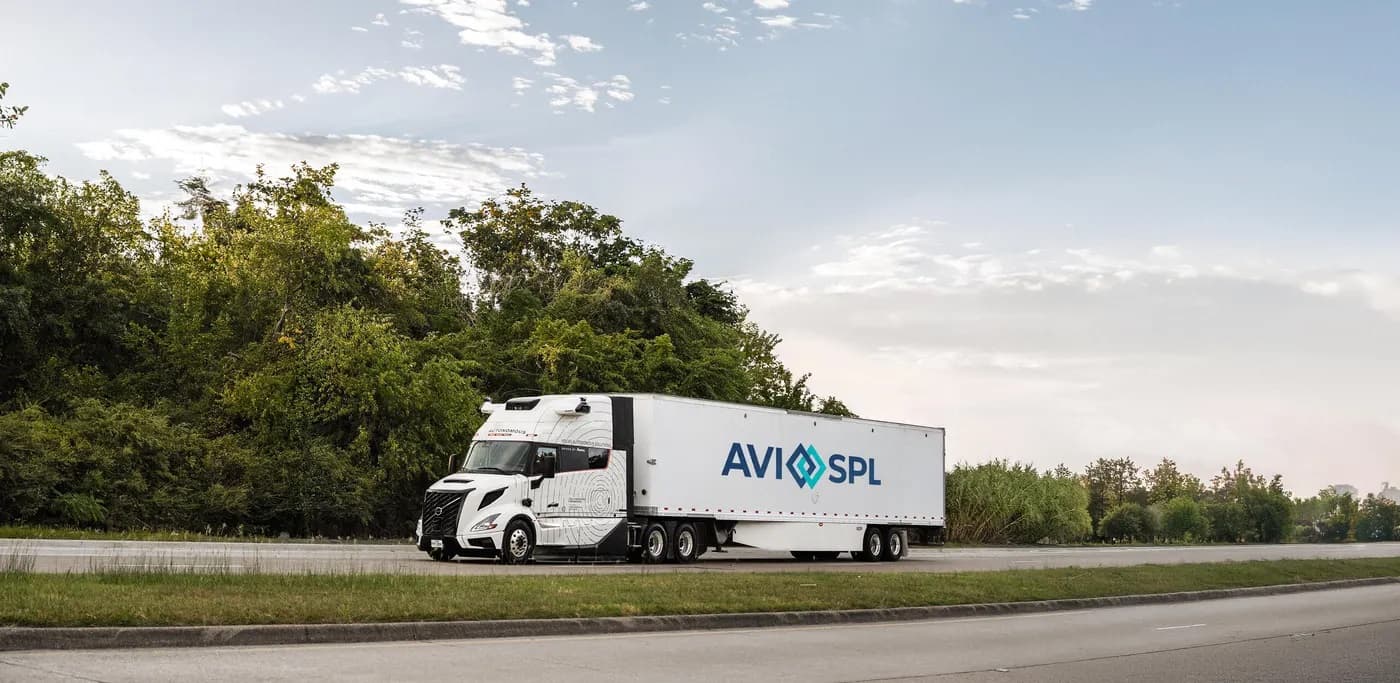
Volvo and AVI-SPL Launch Commercial Autonomous Freight Operations Between Dallas and Houston
The autonomous trucking industry has reached a significant milestone. AVI-SPL, a global technology solutions provider, has officially begun commercial autonomous freight operations along one of the most strategically important freight corridors in the United States — the Dallas-to-Houston route in Texas. Running Volvo VNL Autonomous trucks powered by the Aurora Driver, this collaboration marks a pivotal step toward reshaping how high-value, time-sensitive freight moves across America's roads.
For logistics professionals, supply chain managers, and anyone watching the future of freight unfold in real time, this launch is more than a headline. It signals that autonomous trucking is no longer a distant promise — it is a commercial reality operating on public roads today.
What Is Actually Happening on the Dallas-Houston Corridor?
AVI-SPL is using Aurora-powered Volvo VNL Autonomous trucks to transport audio-visual electronics along the Dallas-Houston corridor. The cargo includes a mix of new products as well as end-of-life equipment, the latter of which is fed into AVI-SPL's electronic recycling program for precious metal recovery. This dual-purpose operation — moving new goods while managing the responsible disposal of old ones — reflects a sophisticated, sustainability-minded approach to logistics that goes beyond simple point-A-to-point-B delivery.
The Dallas-to-Houston corridor was not chosen by accident. It is one of the highest-volume freight lanes in the country, stretching approximately 240 miles and connecting two of Texas's largest economic hubs. High freight volume, predictable highway conditions, and strong infrastructure make it an ideal proving ground for scaling autonomous operations.
The Technology Behind the Trucks: Aurora Driver and Volvo VNL Autonomous
At the heart of this operation is the Aurora Driver, Aurora Innovation's self-driving system designed specifically for commercial trucking. The Aurora Driver is integrated into Volvo's purpose-built VNL Autonomous trucks, creating a vehicle engineered from the ground up — not retrofitted — for driverless freight operations.
What sets this system apart is the end-to-end nature of what Volvo Autonomous Solutions delivers. The offering is not simply a truck with sensors bolted on. It encompasses the full stack of autonomous logistics infrastructure, including:
- The purpose-built Volvo VNL Autonomous vehicle
- The Aurora virtual driver system
- Required physical and digital infrastructure
- Operations and uptime support services
- A fleet management system that orchestrates transport operations and manages logistics flows
This comprehensive package is designed to lower the barrier of adoption for companies like AVI-SPL, removing the need to piece together technology from multiple vendors and instead offering a unified, managed solution.
Why This Launch Matters for the Freight Industry
The timing of this launch is not incidental. The freight industry is grappling with a persistent set of structural challenges that autonomous trucking is uniquely positioned to address. Qualified driver shortages continue to strain carrier capacity, with the American Trucking Associations estimating a deficit of tens of thousands of drivers that is expected to grow over the coming decade. Meanwhile, freight demand is on an upward trajectory, driven by e-commerce growth, nearshoring trends, and the ongoing reconfiguration of global supply chains.
Into this environment, autonomous freight operations offer a compelling value proposition. Driverless trucks can operate continuously without the federally mandated rest requirements that govern human drivers, enabling faster transit times and more predictable delivery windows. For high-value, time-sensitive shipments — exactly the kind AVI-SPL is moving — this reliability is not a convenience; it is a competitive differentiator.
Sasko Cuklev, head of on-road solutions at Volvo Autonomous Solutions, captured the core promise clearly: "This collaboration shows how autonomous transport can help reduce transit times, improve service, and meet the demands of time-sensitive, high-value freight."
AVI-SPL's Strategic Rationale: Resilience, Scalability, and Customer Experience
For AVI-SPL, the decision to partner with Volvo Autonomous Solutions is grounded in long-term strategic thinking rather than short-term experimentation. Tim Riek, chief strategy officer at AVI-SPL, framed the collaboration in terms of what it enables for the business going forward: "Autonomous transportation has the potential to significantly reshape the future of logistics. This collaboration allows AVI-SPL to explore innovative technologies that can help improve operational resilience, support long-term scalability, and strengthen the overall customer experience."
Those three pillars — operational resilience, long-term scalability, and customer experience — are exactly what enterprise shippers are seeking as they try to future-proof their supply chains against disruption. By beginning autonomous freight operations now, AVI-SPL gains first-mover insight into how the technology performs at commercial scale, data that will prove invaluable as the company looks to expand its logistics capabilities.
Supply Chain Benefits: Uptime, Asset Utilization, and Cargo Security
Beyond individual transit times, the broader supply chain implications of this collaboration are substantial. As operations scale, the partnership has the potential to deliver meaningful improvements across three dimensions that supply chain professionals consistently rank as top priorities:
- Greater uptime: Autonomous trucks are not subject to driver fatigue, illness, or scheduling conflicts. Operations can run around the clock, significantly improving asset utilization rates compared to human-driven fleets.
- Improved asset utilization: When trucks run more hours per day and more days per week, the cost per mile of operation drops, making the economics of freight more favorable for shippers and carriers alike.
- Enhanced cargo security: Autonomous systems generate continuous data streams about vehicle location, speed, and operational status, providing shippers with greater visibility into their freight and reducing the risk of loss or tampering.
Together, these benefits point toward a model of freight operations that is not only more efficient but more dependable — a critical attribute as businesses increasingly demand supply chain predictability.
The Bigger Picture: Autonomous Trucking's Commercial Momentum
The Volvo-AVI-SPL launch joins a growing list of commercial autonomous trucking deployments that are collectively demonstrating the technology's readiness for real-world logistics. What was once confined to pilot programs and closed-course demonstrations is now generating actual revenue on public highways.
The Texas corridor, with its favorable regulatory environment and high freight volumes, has become something of a proving ground for the autonomous trucking industry. Multiple players are active in the state, and each successful commercial deployment adds weight to the argument that driverless freight is not a futuristic concept but an emerging operational standard.
For carriers, shippers, and logistics technology providers watching from the sidelines, the window for early adoption is open — but it will not remain so indefinitely. As autonomous systems accumulate more commercial miles and the cost of the technology continues to decline with scale, the competitive advantages available to early movers will become harder to replicate.
What Comes Next
Both AVI-SPL and Volvo Autonomous Solutions have signaled that this launch is a starting point, not an endpoint. As the collaboration matures and operational data accumulates, the expectation is that the scope of autonomous freight operations will expand — potentially to additional corridors, larger fleet sizes, and a broader range of cargo types.
The Dallas-Houston corridor represents a model that, if successful at scale, could be replicated across other high-volume freight lanes throughout the United States. For Volvo Autonomous Solutions, each new commercial deployment strengthens the case for its end-to-end autonomous logistics platform. For AVI-SPL, it positions the company as a logistics innovator at a moment when operational differentiation is increasingly difficult to achieve through conventional means.
The driverless freight era is not approaching. On a stretch of Texas highway between Dallas and Houston, it has already arrived.